Susan Blumenthal receives Marie Curie Legacy Medal for global leadership in the fight against cancer
Inspired by her mother and Marie Curie, Susan Blumenthal dedicated her life to women’s health and the fight against cancer.


Susan Blumenthal vividly remembers the day she was inspired to become a doctor.
She was 10 years old, visiting her mother in the hospital after she had been diagnosed with thyroid cancer. Blumenthal remembers seeing a big skull and crossbones with the menacing word “radioactive” on the door of her mother’s ward.
“She’d been given radioactive iodine to treat her cancer and had been [feeling] too hot to handle a child’s kiss,” Blumenthal said.
Blumenthal asked a doctor what “radioactive” meant. The doctor told her about Marie Curie, who coined the term radioactivity, received two Nobel Prizes, and yet was never admitted into the French Academy of Sciences because she was a woman.
Her mother’s illness, combined with Curie’s perseverance and persistence, motivated Blumenthal to become a doctor and, eventually, an internationally recognized medical expert known for helping expose inequities in women’s health.
Blumenthal, a retired rear admiral and provost’s distinguished professor at Northeastern University, was recently awarded the Marie Curie Legacy Medal by Institut Curie in recognition of her “extraordinary advocacy and scientific leadership in the fight against cancer.” Founded in 1909 by Curie, Institut Curie is France’s leading cancer center, combining a world-renowned research institution with a hospital group that treats all types of cancer.
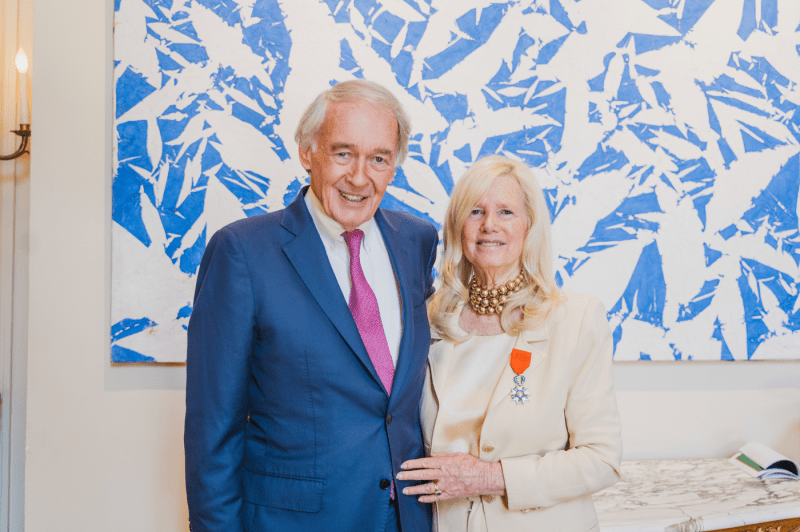
“Being able to be involved in fighting cancer and in trying to modernize the methods that are used today and [will be used] tomorrow is very important to me,” Blumenthal said. “It was very moving to be honored by them.”
For more than two decades, Blumenthal served as a leading U.S. health expert across four presidential administrations. As the nation’s first deputy assistant secretary for women’s health and as U.S. assistant surgeon general, she pioneered groundbreaking programs, including “Missiles to Mammograms,” which adapted imaging technologies from NASA, the CIA and the Department of Defense to breast cancer detection. It was one of the earliest applications of artificial intelligence to improve disease diagnosis, helping to save countless lives through early detection.
Blumenthal also chaired a presidential initiative on breast cancer, established the National Centers of Excellence in Women’s Health and created the first government health website.
Today, Blumenthal serves as the U.S. ambassador for Institut Curie, helping sustain Marie Curie’s legacy in the 21st century while fostering collaboration between American and French cancer researchers.
Curie visited the U.S. twice — first in 1921, when American women raised $100,000 (more than $1.2 million today) to fund the first gram of radium for her radiochemical research, and again in 1929, when Americans donated funds for a second gram of radium for a new Polish Radium Institute in Warsaw.
“Americans played a very important role in her work early on,” Blumenthal said.
Editor’s Picks


Institut Curie is now building the Chemical Biology of Cancer Research Center in Paris. The center will be the first of its kind in the world studying metastasis and developing novel therapies to stop cancer from spreading.
“Madame Curie once said ‘I never see what has been done; I only see what remains to be done,’” Blumenthal said. “Institut Curie’s new chemical biology center will do what remains to be done to understand and stop metastases linked to 90% of cancer deaths. This innovative work will make a lifesaving difference in the prevention and treatment of cancer.”
At Northeastern, Blumenthal is working on another emerging frontier: public health technology.
“During the COVID-19 pandemic, I felt there was a need for a new field that created techno-fluent public health professionals who were bilingual in both public health and technology,” she said.
During COVID, many technologists wanted to help fight the pandemic, Blumenthal said, but they were not familiar with public health. Public health professionals, at the same time, had limited exposure to technology or social media, allowing misinformation to spread rapidly.
To address this gap, Blumenthal has been working with faculty across Northeastern to foster cross-disciplinary collaboration, advance research and create new educational opportunities for students.