New London tech hub at Northeastern wants to make AI technology faster, more reliable
After the Boston hub’s success, the new London arm of the Institute for Intelligent Networked Systems opens the door to Europe and boosts AI research with new partnerships, according to director Tommaso Melodia of Northeastern University.


LONDON — The Institute for Intelligent Networked Systems will open the door to more European partnerships and groundbreaking research in the fields of artificial intelligence and wireless communications with its new London hub.
Having secured 68 patents for new inventions, built more than 30 industry partnerships and conducted advanced wireless research since its inception in 2019 at Northeastern University’s Boston campus, the institute, formerly known as the Institute for the Wireless Internet of Things, has opened its first research office outside of the U.S. The new hub at Northeastern’s London campus means a transatlantic expansion of industry partnerships in the AI and wireless communications space.
“We’re going to be working at creating an interface between the world of connectivity and the world of intelligence,” institute director Tommaso Melodia told a launch event on Friday. “We will have an expanded focus … with new research topics, new areas and new expertise that is brought by the London hub.”
“We think that the creation of the hub in London will create an opportunity to partner even more in Europe and to create additional opportunities,” Melodia added.
The institute is dedicated to making wireless communications faster, more energy efficient and more secure, with a focus on AI, machine learning and telecommunications. London becomes its third location, adding to its headquarters in Boston and a satellite office in Burlington, Massachusetts.
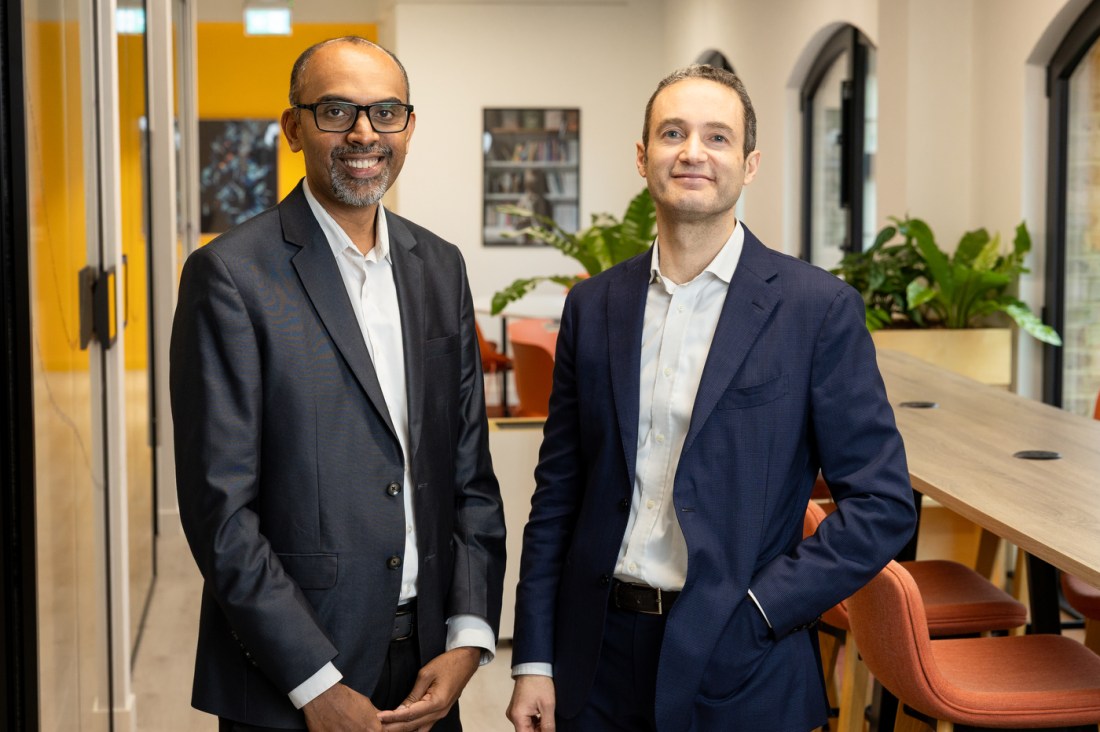
The U.K. office is being led by Bipin Rajendran, professor of intelligent computing systems, and Osvaldo Simeone, professor of information engineering.
The researchers’ projects include working with U.S. tech giant IBM to develop the next generation of AI hardware and investigating misbehavior by the AI technology that is behind everyday use apps such as OpenAI’s ChatGPT and Google’s Gemini.
Melodia told Northeastern Global News that the new researchers would help diversify its expertise with their focus on machine learning, neuromorphic computing — computing that is inspired by how the human brain can process large quantities of information at speed — and quantum computing.
Editor’s Picks




Simeone said the U.K. hub’s two missions would be “developing reliable AI” and focusing on “emerging computing for our times.” Rajendran and Simeone are only two weeks into the job but already front a team of about 20 researchers based at Portsoken One, the technology and engineering-focused building on Northeastern’s London campus.
The two professors have been buddied up for the past decade, first working together in New Jersey before moving as a duo first to King’s College London and now to Northeastern.
Rajendran described himself and Simeone as “complementary” in terms of their research expertise. “I totally agree,” Simeone responded. “Bipin is an expert on systems, hardware, software and co-design. And I’m more of a theoretician — an information theorist. So the way this works for me is that, typically, when I come up with some kind of idea or system that can work on paper, Bipin makes it work in practice.”
Their joint arrival will significantly bolster the research portfolio on the London campus. Simeone has acquired funding from the European Research Council to investigate the reliability of AI in telecommunications. He is currently hiring researchers for the project, which is expected to start in February.
He also has funding from the American not-for-profit organization Coefficient Giving — formerly called Open Philanthropy — to detect when large language models misbehave. Known as LLMs, they are the basis of the chatbot technology found in apps such as ChatGPT and Microsoft’s Copilot.
“Maybe they’re trying to cheat or jailbreak and behave in ways that you would not like them to,” Simeone explained. “We put probes inside the model to figure out when the model is reasoning or going in directions it isn’t supposed to.”
The U.K.’s Advanced Research and Invention Agency, an arms-length scientific government funding body, has commissioned Rajendran, with Simeone also part of the three-year project, to look at building accelerators for large language models. “The aim is to reduce the cost of LLM training or model development by a factor of one hundred or so compared to the [current] graphics processing units,” Rajendran said.
Rajendran is also working with U.S. technology giant IBM — a company he formerly worked for as a lead investigator into brain-inspired computing — on a project funded by Horizon Europe, the European Union’s research body, aiming to produce the next generation of AI hardware in a bid to move beyond the silicon-based semiconductors currently used.
Simeone said he and his colleague were “excited” to “spearhead” the institute’s move into Europe. Praising Melodia’s leadership, Simeone said the institute had become “the most recognized name in telecommunication research.” The institute has attracted $130 million in funding in seven years, has 225 members and works with more than 30 industry partners.
“I have wanted to work with him [Melodia] for a while,” continued Simeone, “so when we found out that they were opening a branch in London, I thought it would be a great opportunity.”
Having worked closely with Rajendran for so long, Simeone was keen to keep their partnership intact. “Of course, I reached out to Bipin almost immediately when I had the idea,” he said. Rajendran said he, too, felt the move marked a “fantastic opportunity.” He added: “And the opportunity to continue to collaborate with Osvaldo was also a huge pull for me.”
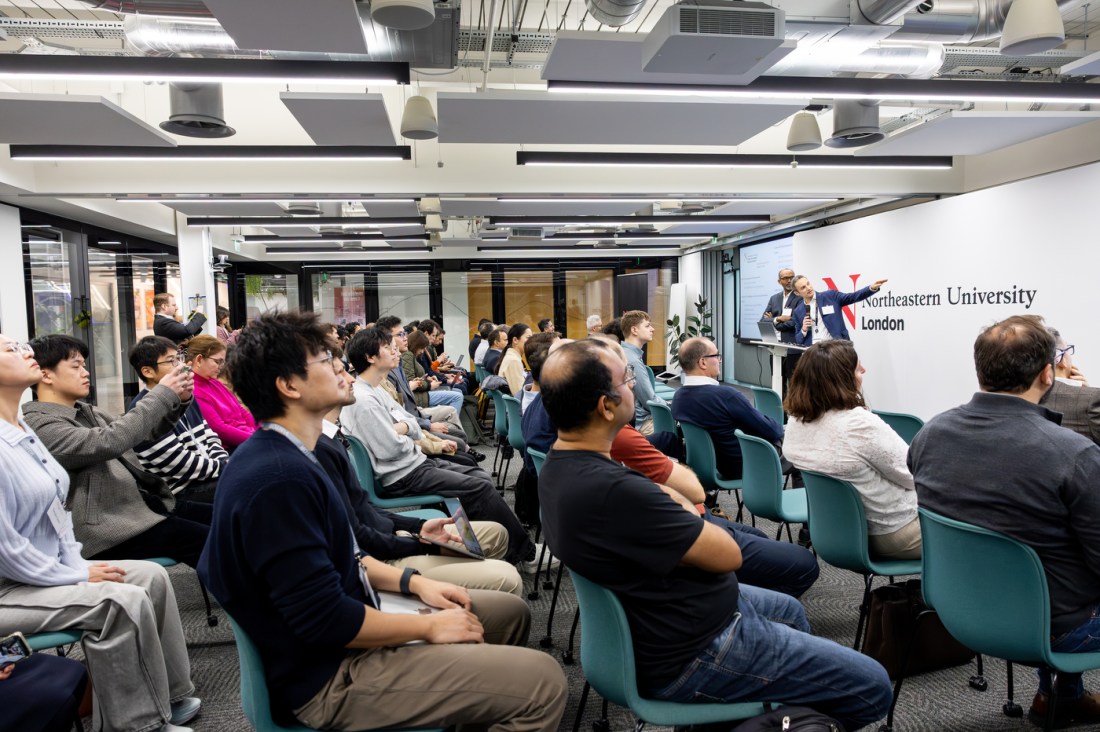
The London hub’s launch was marked with a conference on Friday in Devon House. It brought together an international lineup of speakers from academia and industry, including representatives from major American technology companies such as IBM and Nvidia.
The inaugural event was designed to let Europe-based experts know that “we’re here and we are open to collaboration,” said Simeone. “It is to put us on the map and to celebrate this new initiative.”


