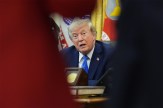
European leaders weigh ‘trade bazooka’ against the US. Here’s what that might mean for the economy
Amid tension between President Donald Trump and European leaders over the acquisition of Greenland, the EU is threatening to deploy its “anti-coercion” instrument. What is it?


In December 2021, when China moved to freeze trade relations with Lithuania after a diplomatic spat involving the opening of a “Taiwanese” representative office in the Lithuanian capital of Vilnius, European leaders sought leverage against Beijing’s use of what they described as economic coercion.
The result was the adoption of a legal tool in 2023 designed to fight fire with fire: an “anti-coercion” instrument, or ACI, that gives the European Commission the authority to impose countermeasures to deter threats, such as those made China against Lithuania.
Now, amid fresh tension between the Trump administration and European leaders over Greenland, the EU is threatening to deploy its ACI, the so-called “trade bazooka,” to stop the United States from exerting economic pressure to achieve a political objective.
“It is a pretty new policy instrument for the EU,” said Mai’a Cross, dean’s professor of political science, international affairs and diplomacy at Northeastern University, and an expert on international relations, space diplomacy and European security. She said it would be the first time Europe would look to activate the policy since its adoption in 2023.
“Although the instrument was intended with countries like Russia and China in mind, Trump’s ultimatum to the EU to either give up sovereign control of Greenland or face new tariffs is absolutely in line with the purpose of the instrument, which is to prevent coercion,” Cross said.
So, how exactly does the trade bazooka work?
European leaders would closely examine the case and institute a series of measures to restrict U.S. access to EU markets, Cross said. Those measures range from potentially punitive duties, or tariffs, and other barriers to market access, to the exclusion of foreign firms from EU funding, finance and investment — even rewriting certain rules governing intellectual property protections.
Editor’s Picks


Cross said Europe could also single out specific U.S. companies in an effort to apply targeted pressure while limiting broader economic fallout, which she noted could be substantial, should leaders take that step.
“Using the instrument would harm both economies, but at least the EU would have something available to efficiently retaliate against new U.S. tariffs that are explicitly intended to force Europe into supporting Trump’s seizure of Greenland,” Cross said.
On Wednesday, Trump spoke at the World Economic Forum in Davos, Switzerland, after days of escalating rhetoric over his administration’s interest in the icebound nation, which has been part of the Kingdom of Denmark for more than 300 years. He appeared to defuse the tension during a speech in which he said that the U.S. wouldn’t take Greenland by force.
“I won’t do that,” Trump told world leaders. “That’s probably the biggest statement I made, because people thought I would use force. I don’t have to use force. I don’t want to use force. I won’t use force.”
Some experts question whether the ACI would be an effective weapon against such a fast-moving target. Ravi Ramamurti, founder and director of Northeastern University’s Center for Emerging Markets and university distinguished professor for international business and strategy, said the instrument “cannot be deployed at the speed necessary to deal with Trump’s mercurial trade policies.”
Northeastern Global News, in your inbox.
Sign up for NGN’s daily newsletter for news, discovery and analysis from around the world.
“Trump has relied on [International Emergency Economic Powers Act] to make unilateral, snap decisions, raising and lowering tariffs on a whim,” Ramamurti said. “Nothing in the EU arsenal, including ICA, can counter that.”
Indeed, should the trade bazooka be unleashed in full force, Ramamurti said it could trigger an “ugly trade war” between the U.S. and its European allies that will slow growth in both blocs, crash stock markets and stoke more inflation fears.
“The only winners from such an escalation will be countries like Russia and China,” he said. “If the EU doesn’t want to escalate the trade war with the U.S., it might use a more measured response, something more like firing a pistol than a bazooka.”