Can ICE agents search homes with only an administrative warrant? What are the rights of protesters?
The Jan. 7 killing of Renee Good has generated much discussion over whether the use of force was justified, the limits of federal law enforcement authority and cooperation between state and federal officials.
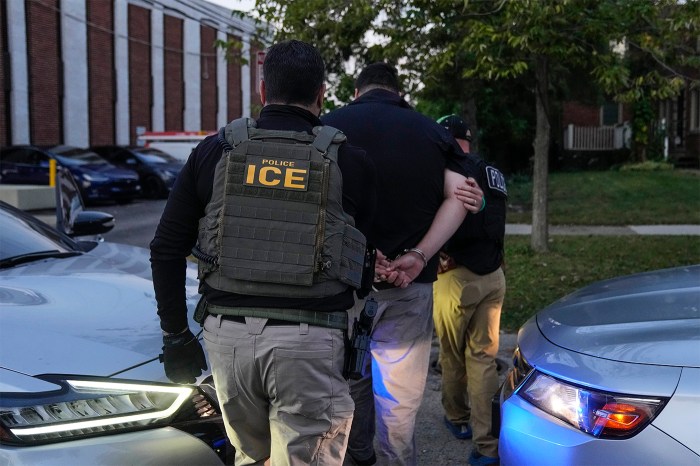

The fatal shooting of a Minnesota resident by an Immigration and Customs Enforcement officer earlier this month sparked protests across the country, led to investigations of a slew of local officials and now has federal agents reportedly executing “administrative warrants” to search the homes of individuals suspected of being in the country illegally across the state.
Extensively shared footage of the incident from multiple angles appeared to show the ICE officer, identified as Jonathan Ross, shooting at the driver of a Honda Pilot SUV, Renee Good, 37, as the vehicle was moving forward.
Homeland Security said the officer shot in self-defense after Good attempted to run over officers. Ross was struck and injured by Good’s vehicle. Some state and local officials have said they support witness accounts that suggest Good was trying to flee the scene.
The Jan. 7 killing has generated much discussion over whether the use of force was justified, the limits of federal law enforcement authority in state jurisdictions, the rights of protesters and the prospect for cooperation between state and federal officers in a case like this.
What is the scope of Immigration and Customs Enforcement’s authority?
Like every federal law enforcement agency, ICE has the power to do “what is necessary and proper” to enforce the nation’s immigration laws, said Deborah Ramirez, professor of law emerita, who formerly chaired Northeastern University’s criminal justice task force.
In practice, that means ICE can take actions related to enforcing federal immigration law, so long as its officers don’t run afoul of the Constitution or federal law, she said.
As a federal law enforcement agency, ICE’s powers are spelled out in more than 400 federal statutes, according to the Department of Homeland Security. Its most basic functions include the power to arrest, detain and remove noncitizens, including individuals suspected of being unlawfully present in the United States. Those enforcement functions derive from a federal law governing naturalization and immigration more broadly, or the Immigration and Nationality Act, signed into law in 1952.
Immigration and Customs Enforcement’s ambit also includes combating human trafficking and smuggling, terrorism and the illegal movement of goods. Created in 2002, the agency’s authority is rooted in the federal government’s immigration enforcement powers that expanded in the decades following the Immigration and Nationality Act, particularly with the Immigration Reform and Control Act of 1986 and the Illegal Immigration Reform and Immigrant Responsibility Act of 1996.
How does ICE’s authority overlap with state law enforcement powers?
State and federal law enforcement authorities frequently intersect and collaborate while upholding the law. In general, ICE enforces laws dealing with transnational crime, or crimes that cross state lines or concern the nation’s borders, while state law enforcement deals exclusively with state crimes, Ramirez said.
In cases involving overlapping jurisdiction, federal and state prosecutors typically cooperate by sharing evidence and investigative resources. What’s currently playing out in Minnesota, Ramirez said, is a jurisdictional dispute as federal authorities have taken control of the investigation into Good’s death, and are preventing state investigators from accessing evidence.
Northeastern Global News, in your inbox.
Sign up for NGN’s daily newsletter for news, discovery and analysis from around the world.

Can ICE use administrative warrants to search individuals’ homes?
An internal ICE memo circulated by a watchdog group on Wednesday — and first reported by the Associated Press — reveals that agency officials had given officers the green light to search the homes of individuals suspected of being in the country illegally without consent on the basis of an administrative warrant.
Ordinarily, Ramirez said, the Fourth Amendment protects anyone living on U.S. soil from warrantless searches and seizures. In order for a federal officer to enter a person’s home, they must obtain a judicial warrant — not an administrative warrant, she said.
Ramirez points to a Supreme Court precedent in Payton v. New York. The 1980 decision notes that to enter the home to effect an arrest, or to conduct a search or seizure, an officer must have a warrant issued by a “neutral and detached judicial officer,” Ramirez said.
“That is the law,” she said, describing such searches as unconstitutional. “It has been settled law.”
What are the rights of protesters?
Those participating in protests or demonstrations enjoy First Amendment protections. That means people have the right to show up, march, chant, carry signs and film government officials — including law enforcement, Ramirez said. Citizens generally have the right to watch and record law enforcement in public spaces, so long as they don’t interfere with official operations.
But they can’t disobey traffic laws, Ramirez said, and blocking streets or interfering with vehicle or pedestrian traffic without permits can lead to citations or arrests.
At issue in the shooting death of Good, according to Ramirez, isn’t whether she was lawfully protesting or disobeying traffic laws, but whether the officer was acting lawfully when he used deadly force against Good. “The use of deadly force within a traffic stop is ordinarily not necessary and proper,” she said.
The federal government has defended Ross’ actions, saying he was acting in self-defense and believed his life was in danger. Officials suggested that Good “weaponized her vehicle” and that the officer’s use of deadly force was justified to protect himself and others.
Editor’s Picks


Can Minnesota prosecute the officer involved?
The fact that an ICE officer was involved in the shooting death of a Minnesota resident does not exempt that officer from state prosecution, Ramirez said. State law enforcement agencies are allowed to prosecute any state crime that occurs within their state, she said. Homicides, in particular, are rarely prosecuted in federal courts.
Still, a state investigation that results in charges to the officer faces numerous obstacles. Under the so-called Supremacy Clause of the Constitution, federal officers are shielded from prosecution for actions deemed to be within the scope of their “lawful federal duties,” so long as they’re not considered unlawful.
“The question would be whether the state decides to prosecute Ross for a state violation, such as reckless manslaughter, for the death of Good, alleging that Ross’s reckless conduct caused her death because his conduct was a gross deviation from what a reasonable law enforcement officer would do,” Ramirez said. “That would be their theory of prosecution.”
Ross would likely contend that he was acting in his official role as an ICE officer enforcing federal immigration law when the incident occurred, and that his actions should, therefore, be judged under standards that protect federal officers carrying out their duties, Ramirez said. If charges were brought, his attorneys would ask a federal court to recognize that his conduct is immune from state prosecution unless it falls outside what is “necessary and proper” to carry out those responsibilities, she said.
A judge considering this would assess whether Ross’s use of force was part of his responsibilities tied to enforcement of immigration laws, and whether it was lawful under those standards. The judge would also weigh whether the conduct exceeded lawful authority or was excessive, which ultimately would determine whether immunity would apply.
It’s a high legal bar for state prosecutors, not only because federal officers generally have immunity when acting within the scope of their official duties, but also because the federal government is withholding evidence from the state.
“So if the court found that he used deadly force at a time when he was not in imminent danger of death or serious bodily injury, then immunity would not be granted, and he would have to face state prosecution,” Ramirez said.