How one club is making a difference in Uganda and Panama
Established in 2004, Northeastern’s Engineers Without Borders chapter works to help communities in developing countries gain access to basic necessities.


Casey Laguna has had a lot on her plate lately.
In addition to the rigorous coursework accompanying her final year at Northeastern University, the fourth-year bioengineering student and her peers oversee projects to build water distribution systems in Panama and Uganda.
It’s part of her mandate as the head of the Engineers Without Borders, Northeastern University’s Student Chapter. Established in 2004, the student-led organization’s goal is to help communities in developing countries get access to basic human needs.
Laguna says it’s been a lot of hard work and responsibility — technical, community-focused and deeply gratifying.
“Most of my work is coming in now,” Laguna says. “I probably spend another five to 10 hours a week on the club, but it’s much more on the administrative side of things and making sure that everybody is functioning to the best of their abilities.”
In addition to the task of building these complex systems, the students get to develop deep and sometimes lasting bonds with those communities, says Elizabeth-Anne Burgett, who was a co-lead, alongside Laguna, of the Uganda project.
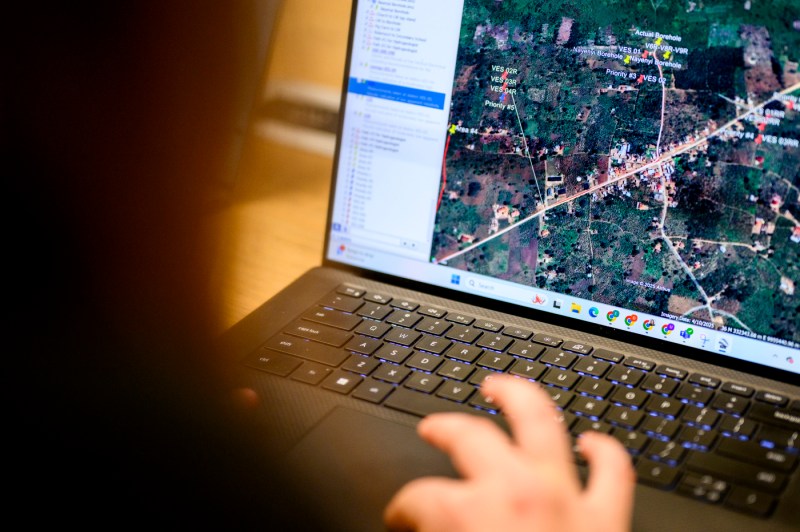

“This club to me is community at its fullest,” says Burgett, the club’s vice president of development. “The people I’ve met in Boston are some of my closest friends.”
Burgett traveled to Uganda in 2023, and now manage the projects remotely on the Boston campus. The club also has a project in Guatemala, where a separate team is designing and constructing a school building and latrines for 50 schoolchildren.
In helping to deliver these projects, the club follows certain design standards and principles laid out by the national Engineers Without Borders USA chapter. The team is currently working on submitting a suitable design for a system capable of servicing 4,000 community members in Nakyenyi, Uganda, and 250 people in La Pedregosa, Panama.
The time commitment ebbs and flows depending on the project stage, but it often involves managing responsibilities, contracts and communication just as much as design work, the pair say.
While they’re on site, the club conducts water quality testing and assesses current water sources. A key part of their work involves “PMEL” — planning, monitoring, evaluation and learning — which means engaging with community members to understand their daily needs.
“This is just a fancy way of saying we talk to community members about their needs,” Burgett says. “We ask questions like: Where do your kids go to school? How far do you have to walk to get water? What’s your current water source?”
That information helps inform design decisions the club members make when they return from the trip.
“Even though Panama and Uganda are both building water distribution systems, the process of that design looks completely different between locations,” Laguna says.
That’s because each community has its own set of problems complicating the construction of those systems. In Panama, Laguna says one challenge has been that some of the key roads that crews use to transport materials to the construction site have become too unstable to handle frequent travel.
“We can’t get the drilling rig to that location to build the system there because the roads keep crumbling,” she says. “That’s a unique problem that Panama is facing that Uganda doesn’t have, for example.”
Editor’s Picks


To repair those roads, officials there have to wait until the wet season is over, Burgett notes.
Laguna and her team are responsible for a significant chunk of project planning and implementation, overseeing everything from financials, technical knowledge and design and, to a lesser extent, resources. They work hand in hand with nongovernmental organizations, which put the students in touch with local engineers to coordinate plans when they aren’t able to be on site.
But the students aren’t completely on their own in the work: they have professional engineering mentors who help ensure that their designs are sound.
The club funds roughly 95% of the cost of the projects, with the community stakeholders responsible for the remaining amount. Those local funders are the very community members who will directly benefit from and use the water systems.
Part of the task of working with their colleagues abroad, Burgett says, is centered around effective communication. Everyone has to be on the same page with respect to these water systems, which can involve a lot of complicated engineering.
“Making sure the community knows how to maintain what we’ve implemented is very, very important, because one day we won’t be there to maintain it,” she says.
Although catered to civil and environmental engineers, the club welcomes anyone interested in participating in the far-flung projects. Even Laguna (a bioengineer) felt her own expertise and learning didn’t immediately comport with the know-how required to manage the logistical, technical and operational sides of the projects.
“The kind of engineering, decision-making and problem-solving here is completely unlike anything I’ve ever seen in another organization,” Laguna says. “Getting a position like this isn’t about the experience you bring to excel in it — it’s the grit and the hardworking attitude that you have to learn the material.”
She says the experience has been incredibly meaningful.
“EWB is such an important organization to me,” Laguna says. “I’m getting on a Zoom and I’m speaking to people living in Uganda who are waiting for us to deliver on this water distribution system — and that is a level of responsibility I have never experienced.”


