This AI teen named Jordan helps train nurses to ask the tough questions
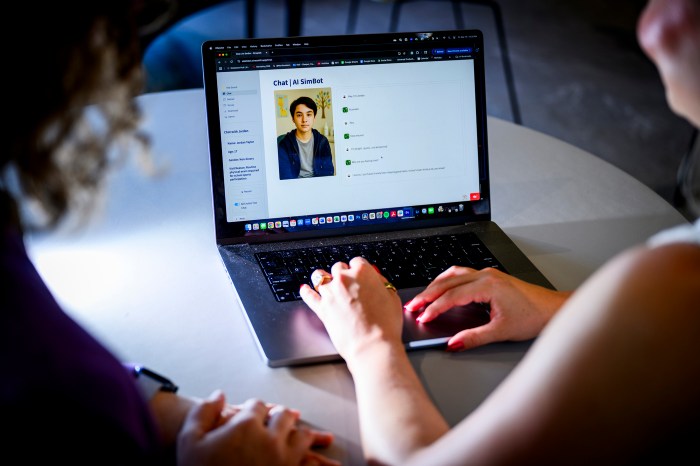
Northeastern students enrolled in the public health community nursing course have been using the “AI SimBot” — an audio-based simulation program that allows students to conduct mock interviews with a virtual AI patient

In addition to administering medications, taking vitals and preparing patients for surgery, nurses also speak one-on-one with patients to go over their medical history, offer guidance and provide general support.
Tiffany Kim, associate clinical professor in the Bouvé College of Health Sciences at Northeastern University, says “the gold standard” method to prepare nursing students for patient interactions is by having them conduct standardized patient simulations — mock interviews with paid actors hired to be patients.
But those come with certain logistical limitations, Kim notes. First, you have to hire the actors. Second, you need to find the space to do it. And third, professors have to individually debrief each nursing student after each interaction, which can be time-consuming.
To address this, Kim turned to artificial intelligence. Since fall 2024, students in her public health community nursing course have been using the “AI SimBot” — an audio-based simulation program that allows students to conduct mock interviews with virtual patients.
Kim developed the AI tool using large language models from OpenAI and with the help of Northeastern graduate Yash Gopalji Pankhania., who did a co-op with Kim to get the first version of chatbot up and running. It’s been updated regularly since.
It was created to help students in the class conduct substance use screenings following the CRAFFT (Car, Relax, Alone, Forget, Friends, Trouble,) model, a questioning method used to identify whether a teen is in a substance abuse situation.
Students interact with AI SimBot in two parts. First, they have a conversation with an AI teen named Jordan, asking him questions about his alcohol and drug use patterns. Once completed, students debrief with an AI assistant named Dr. Casey to discuss how the conversation went.


All of the students’ conversations with AI SimBot are recorded and transcribed, allowing students to upload their conversations to Canvas, a learning management system, for review and grading.
“Students administer the CRAFFT tool while simultaneously practicing therapeutic communication skills (particularly active listening, empathy, and nonjudgmental engagement),” Kim says.
Isabelle Iannotti, a recent Northeastern graduate of the nursing program, used the tool this summer while enrolled in Kim’s class.
She says she appreciated the chatbot because it allowed her to “practice rapport building and communication without impacting real patients.”
Editor’s Picks




“The chatbot was pretty apprehensive at first to answer questions, which was very realistic,” she says. “Obviously, a teenager who thinks they are at the doctor’s office for suspicion of drug use is going to be a little wary of answering questions truthfully.”
While talking to a chatbot can’t compare to chatting with a real person — you can’t read body language or have eye-to-eye contact — Iannotti says the conversation was a “good test of how we would navigate a situation like this.”
Her conversation with the AI debriefer was also instructive, she says.
“When I interviewed the patient, I jumped around with the CRAFFT tool [questions] and would ask one question, talk about something, and then ask another question,” she says. “The debriefer said something to the effect of, ‘You have to ask the questions consecutively all at the same time.’ … I didn’t know that and it was actually really useful feedback.”
Kim says professors teaching the course at Northeastern’s Boston, Burlington, Fall River and Charlotte campuses have all integrated the chatbot into their courses.
The chatbot has gone through several iterations since Kim released the first beta, and it has been open-sourced, meaning anyone can download and use it from GitHub.
Kim says the SimBot allows students to take part in more “experiential practice when high-fidelity simulation is limited by faculty, space, and scheduling constraints.”
“And because students can repeat the exercise as often as needed, it reinforces competency-based learning, where mastery comes through practice, feedback, and reflection over time,” she adds.