How stronger wireless networks can save lives
Northeastern research on wireless signals could transform public safety communication for emergency responders.

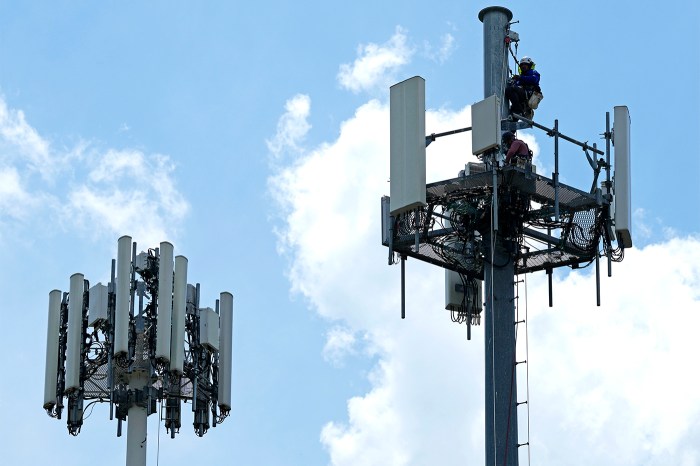
Picture this: A fire breaks out in your neighborhood and first responders are called to the scene.
In situations like these, communication is critical, and public safety workers rely heavily on cellular services to act fast while on the move.
In fact, all the major mobile carriers in the U.S. have specific priority programs designed for public safety, yet they are not without reliability issues. Service can be spotty and, while rare, outages can also occur.
But what if there was a way for those public safety officials to have temporary access to even greater amounts of available network support as the situation unfolded?
Researchers at Northeastern University’s Institute for the Wireless Internet of Things are rethinking how spectrum — radio frequencies integral for wireless communication — is shared, managed and pooled. This research builds on their work in Open Radio Access Networks (OpenRAN), a new standards-based approach to make mobile networks interoperable and less expensive to manage.
Their work — which they are calling the Open Spectrum project — could be transformative in not only developing better public safety communication systems, but in other domains where spectrum is critical, including global positioning systems (GPS), climate forecasting and radar sensing, says Michael Polese, an electrical and computer engineering professor at Northeastern University and the principal investigator of the project.
It’s hard to overstate the importance of spectrum in wireless communications. It’s what allows you to access the internet on your laptop, connect your wireless earbuds to your phone and listen to your favorite radio station in your car.
Understanding how spectrum is shared and distributed can be tricky to follow.
Editor’s Picks


Some spectrum is licensed, like the cellular data provided by telecom providers, which is regulated through the Federal Communications Commission. Other spectrum is unlicensed, like Wi-Fi and Bluetooth radio bands.
“There is also a middle ground where different services can share the same portion of the spectrum,” says Polese. “But how to do this in a way that is efficient is very much an open research question that is something that our group has been working on addressing.”
For this project, Polese will be working alongside Tommaso Melodia, the William Lincoln Smith Chair Professor and the director of the Institute for the Wireless of Internet of Things, and Paolo Testolina, a research scientist in the institute, to answer that question.
“For many years, spectrum was allocated in a very static way,” says Melodia. In the U.S, the FCC authorizes a telecom provider to have access to a certain amount of spectrum and, in exchange, they provide a public good for consumers.
Now by taking advantage of advancements in AI-assisted software-defined radios and spectrum sharing, the researchers aim to create more dynamic systems.
Imagine, if you will, an emergency occurs and public safety officials need to rush to the scene, Polese says.
Presently, public safety officials only have access to a small bucket of spectrum. In the solution Northeastern researchers are proposing, the bucket can be greatly expanded during emergency situations, Polese explains.
Over the next three years, the researchers will work to develop the algorithms, frameworks and testbeds to make this scenario a reality, Polese says.


