How do you clean a giant ship? This Northeastern student is building robots that do it
Barnacles, algae and other marine hitchhikers cost the shipping industry billions. Northeastern student Timothy Wong spent his co-op helping develop a high-tech solution.


Timothy Wong didn’t suspect it at the time, but his dives off the coast of Rockport and the hours he spent immersed in studying the wheels and gears of the world of robotics were leading to one mission: Figuring out a way to get unwanted sea matter off some giant ships in need of some serious cleaning.
Wong, a third year mechanical engineering and marine science student at Northeastern University, worked as a mechanical and validation engineer at Fleet Robotics, a Boston company, while trying to come up with a modern solution. Starting in January 2026, his co-op lasted for 6 months and ended in June of the same year. His sidekick in the task turned out to be a Roomba-like robot that scrubs and scrapes green sludge from the hull.
“It starts with algae, and then it becomes barnacles, mollusks, seaweed,” Wong said. “All of that increases the drag along the ship, which causes the ship to burn much more fuel in order to achieve the same speed.”
The extra weight results in up to an extra $36 billion in fuel and antifouling paint costs across the U.S. shipping industry each year to overcome the drag, according to Sofar, an ocean sensor network.
Known as biofouling, the gunk often contains invasive species — stowaways that tag along and displace local organisms while throwing off the delicate balance of food networks. According to the International Maritime Organization, Asian paddle crab brought the White Spot Syndrome virus to New Zealand’s crustaceans, while the North Pacific seastar, a “voracious carnivorous feeder,” wreaked havoc in the Northeast Pacific. White Spot Syndrome virus causes mass die-offs among shrimp and other crustaceans, while the seastar threatens local fisheries by preying on commercially valuable shellfish, including mussels, scallops and clams.
With vessels currently stationed around Iran because of the conflict, the problem is gaining traction, said mechanical and validation engineer at Fleet Robotics, Northeastern alum Joshua Batra. Marine organisms accumulate on the ship’s hulls while they remain stranded. Once vessels resume sailing, they risk spreading invasive species to other parts of the world.
The International Maritime Organization is gearing up to release additional regulations, giving ship owners another incentive to clear the decks — or the hulls below them, as the case may be. For now, keeping invasive species from hitching a ride is largely a matter of voluntary guidelines, but the upcoming rules are expected to make it mandatory.

Cleaning the ships is no small task. The thick and sticky goop can mean a couple of tons of buildup or much more.
And all that scrubbing has to happen in moving water.
“We get a lot of turbulence, and so the forces against the robot from flowing water and even just waves are very high.”
That’s where the robots come in.
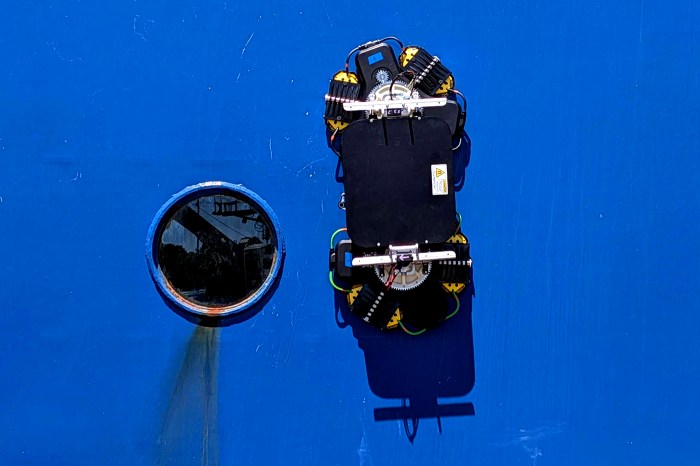
Wong described the robot as two large Roombas equipped with scrubbing brushes. Joined by a bridge, each has feet that stick to the side of the ship with switchable magnets that allow for precise navigation and path planning. Unlike traditional wheeled systems that skim the side of the vessel like a trolley on tracks, the newer system lets the robot climb over the surface in actual steps.
“It walks from one end of the ship to the other by picking up one foot, spinning, picking up the other, spinning, along the length of the ship,” Wong said.
At about a meter long and 60 centimeters wide, it might be big for a Roomba.
“But compared to the size of a container ship, it’s still tiny,” Wong said.
Editor’s Picks


While other systems deep-clean vessels in port, Fleet’s approach focuses on daily preventative maintenance at sea.
“It’s like brushing your teeth every day versus going to the dentist,” Batra said.
Just like overbrushing strips away the tooth’s enamel, overcleaning can be counterproductive.
Clean too frequently, and you risk damaging the vessel’s paint, which could lead to corrosion and leak toxic chemicals into the water, Batra explained.
The idea is to install one on the vessel on a permanent basis, where it would keep the hull clean and scrub away unwanted passengers.
Like its floor-cleaning counterpart, the robot will return to a docking station between autonomous cleaning runs, Batra said.
Wong started the co-op experience by testing how the robot performed on various paints and ship coatings before experimenting with brushes and cleaning techniques.
After learning the ropes, he designed a compliance system for the robots to coordinate their motions. Later, he led testing on an actual vessel at Woods Hole Oceanographic Institute.
“It was a huge loss when his co-op was over, to be honest,” Batra said. After spending 6 months at Fleet Robotics, Wong returned to his studies at Northeastern and his part-time gig as a climbing instructor at Central Rock Gym, where he works with competitive young athletes.
“He was just great to have as a part of the team,” Batra added.
Wong’s marine science background was also a plus since it gave him a deeper understanding of how biofouling forms in the first place.
“We were always very impressed by his sort of self-starting and coming up with cool new ideas for cleaning systems,” Batra said.
When working on test fixtures, Wong would find ways to improve them by implementing new designs.
“He was effectively acting as another full-time person,” Batra said. “Which is kind of wild for someone, (as) it was his first co-op.”
A lot of it was easier said than done. The cold water and waves threatening to send the robot surfing made for some tough days.
“The ocean is a very unforgiving environment,” Batra said. Engineers have to seal electronics to keep them from corroding, deal with pressure cycling at 40 meters in depth, map out a path for the robot and keep the cleaning going.
With no Wi-Fi or tether to guide it, the robot has to navigate underwater obstacles on its own.
“It’s completely sort of operating blind,” Batra said.
Wong feels the experience has given him a leg up in his engineering classes and set him up for future success. He’s currently applying for his next co-op and hopes to land another position in marine robotics.
“I care deeply about the oceans,” he said, adding that he wants to build durable tools that help scientists protect coral reefs and track migrating whales while reducing the environmental footprint of their work.


