Northeastern student sent her co-op work on microchips up on a rocket
Microchip manufacturing’s future could be in outer space


Rhea Dharia’s summer co-op assignment was to help send a capsule on the tail of a SpaceX Falcon 9 rocket and hope it didn’t break.
Dharia, 21, a Northeastern University senior from Jericho, New York, put aside her hobby of triathlon training and toiled for months earlier this year on a cargo-package for her co-op session as a payload specialist for the D.C.-based Besxar Space Industries. It’s a startup company that is testing technology to produce semiconductors in space.
Dharia’s work involved helping design a canister that would eventually be able to carry a device into space that can cook up a stew of silica sand, primarily made of quartz, and electrically conductive elements. The canister needs to be out of the Earth’s atmosphere so the vacuum of space can suck out any impurities left in the air inside. Then the stew can be heated into the material needed to make microchips.

The equipment in the capsule had to survive the shocks and vibrations of rocket-travel without breaking. Dharia also helped write test plans and together with a team of five engineers assisted with getting the company’s fabships ready to launch.
The re-usable canisters were called “fabships” which would hold the actual equipment to make the semiconductor material.
Industrial-grade vacuums are expensive to achieve on Earth, but needed to keep impurities from the air getting in the raw materials, said Sabrina Atkin, a mechanical engineer at Besxar, who served as Dharia’s boss.
“We were working at a pretty fast pace and we were a small team [and] she was super eager to learn,” Atkin said of Dharia, who is working toward a bachelor’s of science degree with dual majors in mechanical engineering and bioengineering at Northeastern.
Besxar’s exact process to make the semiconductor material is a company secret. But in general, semiconductors are made from a molten stew of quartz sand and trace elements including boron and arsenic which are superheated in forges, according to the American Chemical Society, a non-profit scientific organization.
The materials are cooked into ultra-pure polysilicon which is ultimately sliced into mirror smooth wafers that form the base for etching microscopic circuits. Semiconductor material is also used in other electronics such as diodes, a one-way valve for electricity to travel, along with transistors and even solar cells that convert sunlight into electricity.
Dharia said her work experience at Besxar lifted her confidence and reinforced her desire to pursue a career in aerospace.
“They want to take chip manufacturing to space and I was a part of that,” Dharia said. “They want to make chips better and cheaper.”
Her work survived a July 5, SpaceX launch and the 1,200 Fahrenheit re-entry heat. The canister was still attached to the booster which had had a controlled landing on a floating platform in the Atlantic Ocean about 8.5 minutes after liftoff at Cape Canaveral, Florida.
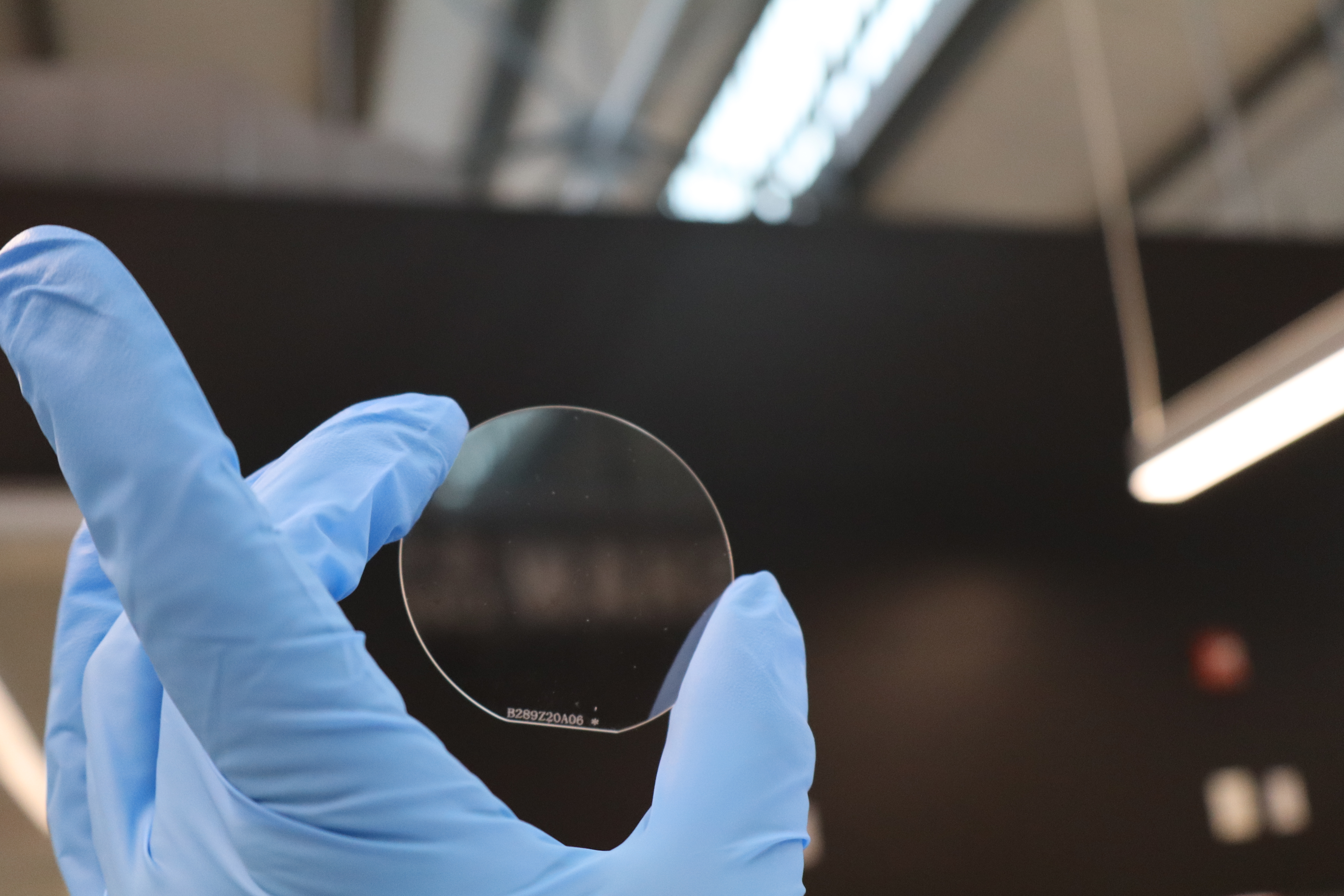

Dharia said that manufacturing in space is the future of chip making.
Besxar did not disclose its financial plans to Northeastern Global News, but the company’s chief revenue officer Diem Salmon explained that as more commercial space ships are launched, the payload costs will go down. That means that electronics will become cheaper to make, even using high-end computer chips.
The U.S. led the world in commercial space launches in 2025, sending up 217 rockets out of the 329 commercial space launches globally, according to information published in September by U.S. Transportation Secretary Sean Duffy.
Duffy predicted that the number of commercial FAA-licensed launches and reentries is expected to rise dramatically each year.

The online space industry website Space Index, estimated in an August posting that there are currently around three dozen companies exploring ways to make microchips in low Earth orbit.
Dharia said that coming to Northeastern helped build her confidence and the skill sets needed to excel in engineering, although she initially was a little apprehensive, according to her university advisor, Heather Carpenter-Oliveira.
“She was doubting herself more than she should have,” said Carpenter-Oliveira, who serves as a senior associate director and senior co-op coordinator for Northeastern. “But she was willing to take the risks to fulfill her goals,” she added, praising Dharia’s positive attitude and commitment to her goals.
Dharia said her course work made her ready for anything Besxar “could throw at me.”
“I fell in love with Northeastern and being able to create your own journey” through the co-op program, she said. “It transformed me almost into a different person, more confident.”