Magnets could help quantum computers talk to each other, according to this Northeastern researcher
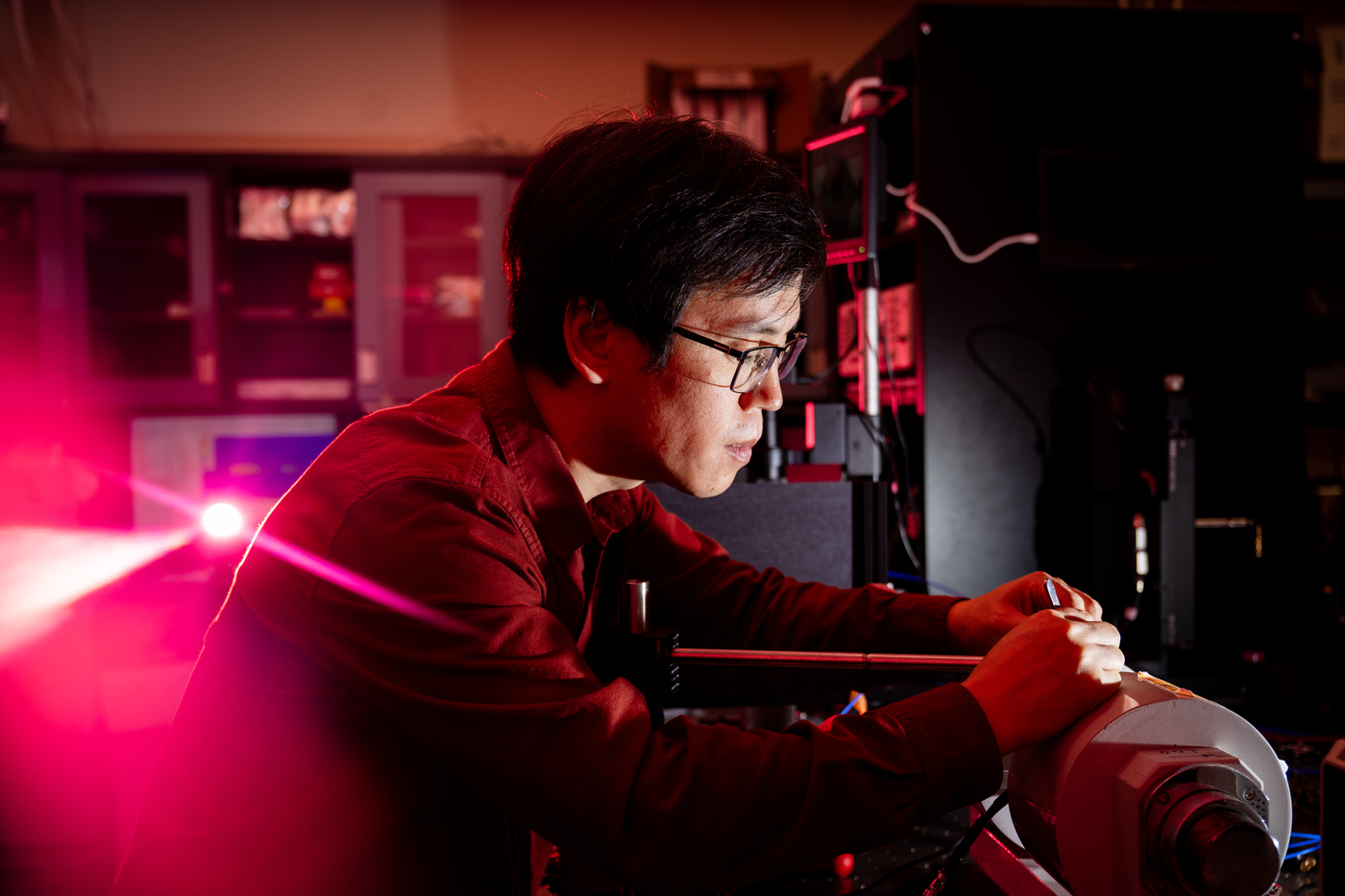

Xufeng Zhang is using magnets to make computers more power efficient at the quantum level.
The Northeastern professor of electrical and computer engineering recently published two papers over the past year highlighting small-scale magnetic systems he and his team developed that could help make computers much more power efficient in the future.
From placing over 300 microwave sources on a single computer chip to creating a new approach to making his systems easier to deploy globally, Zhang is working on the cutting edge.
Central to Zhang’s research are magnons, tiny waves that travel through magnetic materials – including nickel and iron — when they are disturbed.
Northeastern Global News caught up with Zhang to learn more about magnons, his research, and its potential for the future of computing.
What is a magnon?
A magnon is a term used in quantum mechanics to describe a specific type of quasi-particle, which is particle-like systems that perform a specific shared behavior, Zhang explained.
Magnons perform a phenomenon known as spin wave, which is when electrons in magnetic material are disturbed. Notably, this action does not emit an electrical charge.
Devices made using spin waves won’t face any “ohmic loss,” Zhang explained, referring to electrical power that turns into unwanted heat.
“That’s the biggest enemy when it comes to modern electronics. That’s why your computer processing unit gets hot,” Zhang said. That’s why [it] is converting so much power into heat due to ohmic loss.”
Researchers like Zhang are studying magnons for their potential to transmit information between digital systems while emitting very little power use when compared to traditional digital systems, according to Zhang.
During the spin wave process, no electrons move, but they still emit energy through magnetic interaction, he said.
Editor’s Picks


What are hybrid magnonic devices?
Hybrid magnonic devices are systems that take advantage of spin wave and other information channels such as microwaves and acoustic waves, Zhang said. He and his team are creating these hybrid systems to take advantage of the pros and cons of each type of wave system.
Acoustic waves, for example, are great for cellphones since they can be used to filter out unwanted frequency interference during calls. They aren’t, however, very easy to tune and adapt in practice. Magnonic devices by contrast are very tunable.
“By combining magnons and acoustics you can have narrow filters and make them tunable,” Zhang said.
The researchers combine magnon technology with other sensing systems since magnons have limited use cases on their own, primarily in research domains, he said.
“We basically design new devices so that you can boost interactions with magnets, lights, and acoustic waves,” he said. “We’re also designing new approaches so we can control those interactions on demand.”
Ok, but why is this research important for the general public?
These technologies have a range of real world applications, Zhang explained, from improving the cellular reception of your smartphone and making MRI machines more accurate to dark matter research, which explores “mysterious matter that holds galaxies together,” according to NASA.
One major potential application is in the development of quantum computers, he said. While still in the early stage of development, quantum computers — which are advanced machines that process quantum bits — are poised to transform everything from drug discovery to artificial intelligence.
But “right now, there’s not a lot of good ways for quantum computers to talk to each other,” Zhang said. “We are hoping to use magnets to connect different kinds of quantum computers.”