355 goats return to Northeastern’s Oakland campus to perform an important ecological job
A herd of hungry goats has returned to the Oakland campus to mitigate wildfire risk by munching on the dry brush that can fuel nascent blazes.


OAKLAND – Hike the 2.5-mile Pinetop nature trail that winds around the perimeter of Northeastern University’s lush Oakland campus, and you’re sure to stumble across a number of memorable sights.
You’ll pass by the campus farm, where golden sunflowers stand guard over rows of fresh tomatoes, cucumbers and kale, cared for by a rotating cast of sustainability-minded students. You’ll weave through miniature forests of redwoods, eucalyptus and coastal live oaks, tread up gently sloping hills on the north side of campus and down into dusty basins scented by nearby sage bushes on the southern end.
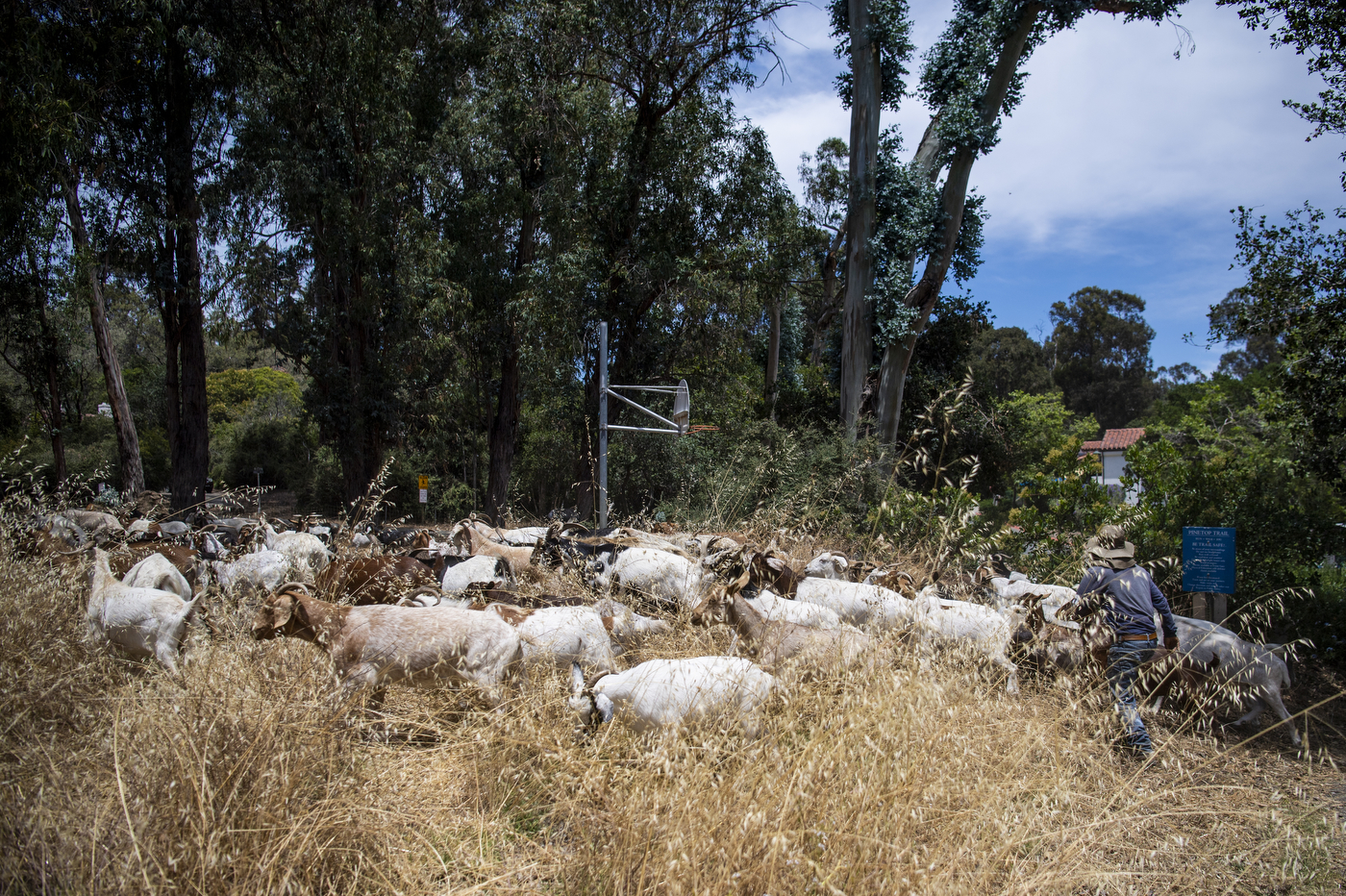
But this week, hikers who find themselves on the trail will encounter something truly un-bleat-able. Listen closely, and you’ll hear tree trunks creaking under the weight of furry climbers, a chorus of baa-ing and hooves crunching through the undergrowth, and thousands of teeth gnawing on delicious leafy foliage.
Indeed, the herd of 355 hungry goats has returned to Northeastern’s Oakland campus for its annual duty: mitigating wildfires in the dry Northern California region by munching on the brush and low-hanging growth that can serve as dangerous fuel for nascent blazes.
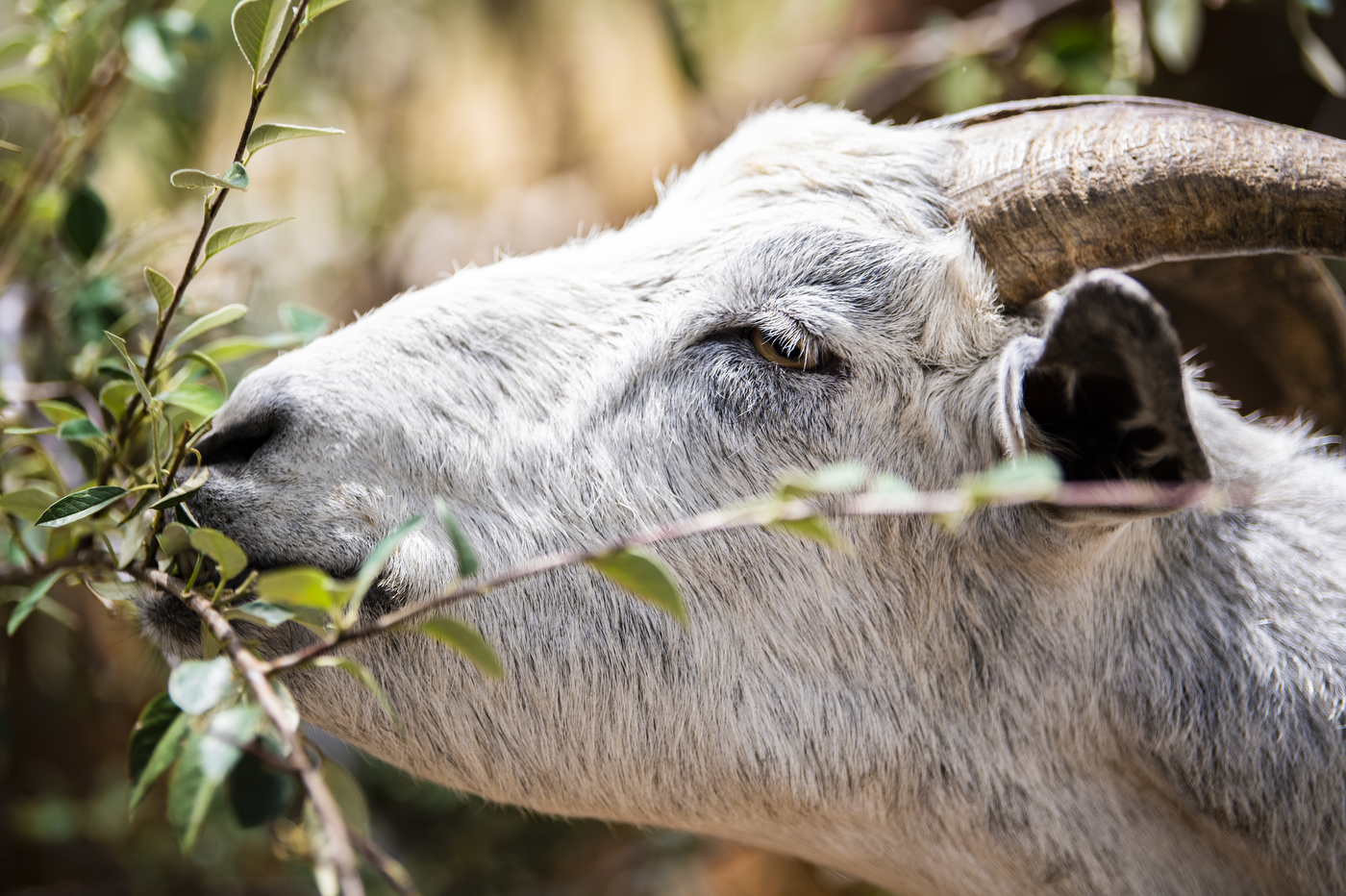
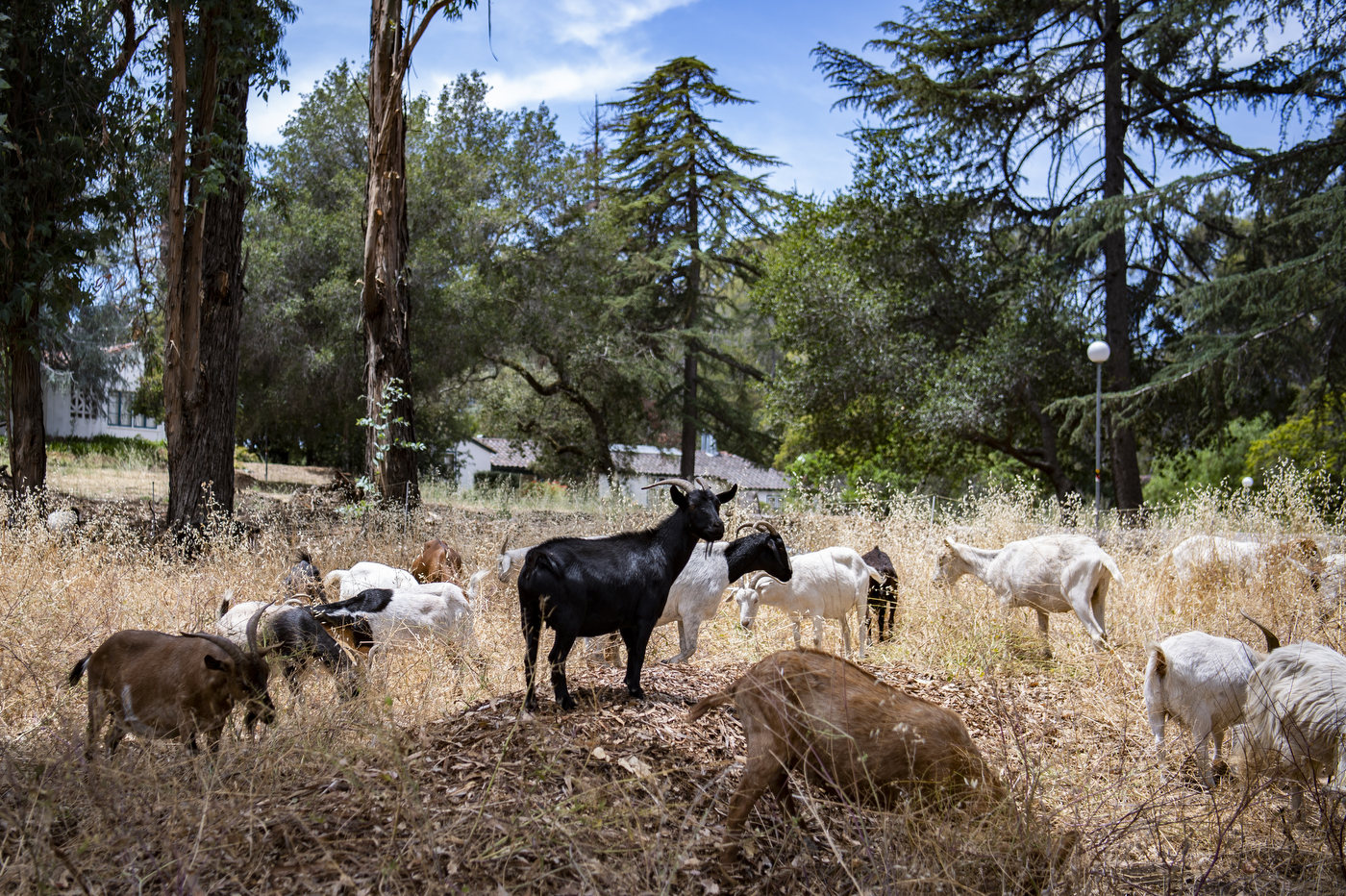
There are black goats and brown goats. Goats with horns and long tongues. Baby goats and elders. Pygmies and La Mancha goats. Goats that prefer lounging in the shade and lazily chewing the grass beside them, and others that trot up to the fences bordering their grazing spots and poke their noses through to greet onlookers.
This motley crew of rescued goats from vegetation management company Goats R Us is being guided around the 135-acre campus by a contracted shepherd, chomping designated areas down to the soil before moving on to the next one. They have been spending their summers on campus for nearly 30 years, feasting on buffets of dried grasses, non-native plants and other untidy brush that accumulate on campus throughout the year.
“As things get drier and hotter and windier, you get larger fires that move faster and burn more intensely, and that is a big, big part of the reality of living in California,” said Sarah Swope, evolutionary ecologist and associate professor of biology at Northeastern. “Mitigating fire risk by having goats eat down all of the light fuels and ladder fuels is a good thing.”
Ladder fuel refers to the bits of foliage that grow on the sides of trees and which, if ignited, can quickly spread fire up the branches. Light fuels are small wildland materials that ignite easily and burn rapidly. These growths must be trimmed regularly to reduce the risk of spread if a wildfire were to break out, Swope said.
The goats’ work on campus is important because of its location within the expansive urban area that makes up Oakland, Swope said. The campus is in what’s called a wildland-urban interface, a transition zone where human infrastructure intermingles with undeveloped wildland vegetation, she said.
“The risk of fire here is very real because we do have a lot of [plant] fuel, and it’s deeply interwoven with houses and businesses,” she said. “So, were a fire, even a very small fire, to break out in a place like this, it could have devastating effects.”
Editor’s Picks




Lucky for the Oakland campus, goats are not picky about their food.
“They are voracious eaters, they will eat almost anything,” Swope said. “They are highly domesticated, so they’re easy to work with. And they are small enough that you can move them around in large groups.”
Using goats as a means of wildfire mitigation comes with unique benefits, according to Terri Oyarzun, who owns Goats R Us with her partner Egon. Goat droppings fertilize the soil around where they eat, and their small hooves aerate the ground much more effectively than cattle, which leave larger and heavier footprints, she said.
“Goats were created exactly for this task,” said Oyarzun, whose 35-year-old business is based in nearby Orinda, California. “Goats are a great solution, a green alternative.”
Goats R Us employs thousands of goats that work year-round in Northern California and are typically accompanied by a shepherd and border collie. Oyarzun said the goats are given to her by an assortment of ranchers, pet owners and even animal control organizations who can no longer care for them.
When they’re off the clock, the goats receive regular medical treatment and even retirement care at the Goats R Us ranch in Orinda, Oyarzun said.
“We have a hospital here on our ranch. We have a herd vet that visits weekly,” she said. “The retirement herd is also here. When they’re too old to enjoy travel, they get retired and they don’t have to move around as much.”
The 355 goats will soon be led back onto a truck and whisked away to their next assignment, leaving Northeastern’s Oakland campus neatly trimmed and in safe condition just in time for the largest-ever class of incoming undergraduates to arrive and begin their academic journeys.
“I think that they very much enjoy this,” Oyarzun said of the goats’ busy schedules. “They jump off the truck, eager to see what new wonders are waiting for them in their new environment.”


