Northeastern professor weighs in on why marching still matters
Political marches have the same political punch as the 1960s
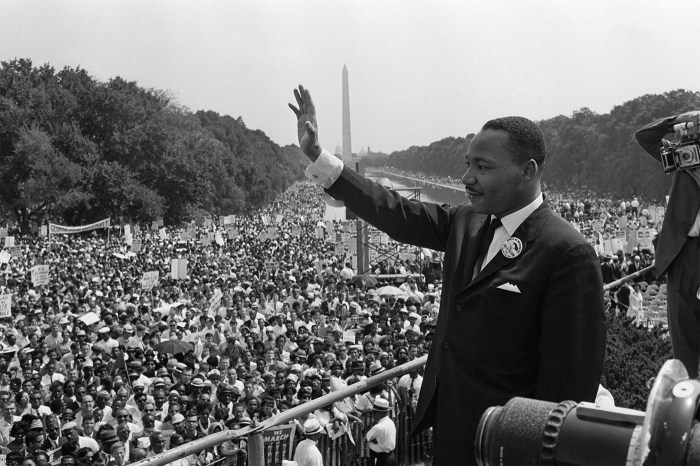

Sixty-three years ago, Northeastern University professor Ted Landsmark stood among the throngs of 250,000 people at Washington’s Lincoln Memorial and listened as the Civil Rights movement’s most distinguished preacher, the Rev. Dr. Martin Luther King Jr., delivered a call for social justice in his famed “I have a dream” speech.
It was 1963. Landsmark was 17, and witnessing the historic March on Washington – at the time, the largest rally ever to be held in the nation’s capital, and an action that would succeed in helping to pressure a hesitant President John F. Kennedy to propose federal civil rights legislation.
“It was apparent to me as a 17-year-old that I couldn’t stand on the sidelines and watch other people put their lives on the line to support equal rights,” said Landsmark, now 80, and a longtime distinguished professor of public policy and urban affairs.
On Friday, Aug. 28 – the 63rd anniversary of King’s speech – Landsmark is heading to D.C. to rally again at the new “March on Washington 2026: Defend the Vote,” because he feels society is again in deep trouble.
“In many respects the times feel more dire now than then, because the efforts to roll back the progress that had been made are far more wide ranging,” he said in an interview with Northeastern Global News.
In April, the U.S. Supreme Court struck down as unlawful a gerrymandered majority Black congressional district in Louisiana and opened the door for more redistricting across the country that could reduce minority representation.
Justice Samuel Alito, among the six conservative justices who carried the decision, wrote that the change was needed because, “allowing race to play any part in government decision-making represents a departure from the constitutional rule that applies in almost every other context.”
President Trump has argued that restrictive voting measures are needed to protect elections from fraud.


Critics view the ruling as hollowing out the landmark 1965 Civil Right Act that had fostered an increase in minority representation in Congress and elsewhere. Friday’s march, hosted by activists such as the Rev. Al Sharpton and King’s oldest son Martin Luther King III, intends to hammer home what they describe as an assault on civil rights.
But do these types of civic actions still carry weight? Are they enough to force the prolific changes that followed the mass rally of 1963?
Editor’s Picks


Civil rights proponents say yes.
“It’s really about putting the public pressure on,” said Richard O’Bryant, director of the John D. O’Bryant African American Institute at Northeastern University, adding that when people are angry and upset “that leads to public action.”
Landsmark said that since the 1960s, marches have served as a way to garner the public’s interest and help drive people to action, including to the voting booths to demand change.
They “raise the visibility of an issue to a national level, each time there are large numbers of people who demonstrate in Washington, or New York, or elsewhere,” Landsmark said.
The Million Man March of 1995 led by Nation of Islam leader Louis Farrakhan for a spiritual day of atonement and community involvement, is touted by the group to have helped register more than 1.1 million Black men as first time voters.
A protest Women’s March on Washington in 2017, the day after President Trump’s first inauguration, drew about 500,000 people, many wearing pink hats. And there have been several “No Kings” anti-administration demonstrations across the country with one drawing an estimated 5 million people across 2,100 cities and towns in June 2025.
Landsmark has been involved in political struggles for most of his life, inspired by his mother and the preachers at St. Mary’s Episcopal Church in his native New York, who he said taught about fairness and social justice.
He was in Selma, Alabama on “Bloody Sunday” at the Edmund Pettus Bridge in 1965 where demonstrators for voting rights were beaten by police for attempting to cross the bridge. News footage of the incident shocked the nation.
In 1976, while working as a lawyer, he was beaten on the steps of Boston City Hall by a white man brandishing a pole with an American flag. The moment was captured in a Pulitzer Prize-winning news photo.
Landsmark said that although marches serve to cast a floodlight on issues that people feel passionate about, it’s not clear whether a leader exists today who can inspire crowds the way King did.
“Dr. King was a profoundly charismatic speaker,” he said. “There are few in American history who could mobilize crowds around ethical issues as effectively as he could.”


