Political texts can boost voter turnout, but only slightly, study finds
Political operatives have taken to texting voters to get the word out about key races, dates and other bits of information in the days leading up to the midterms. But just how effective is texting as a strategy for galvanizing voters?
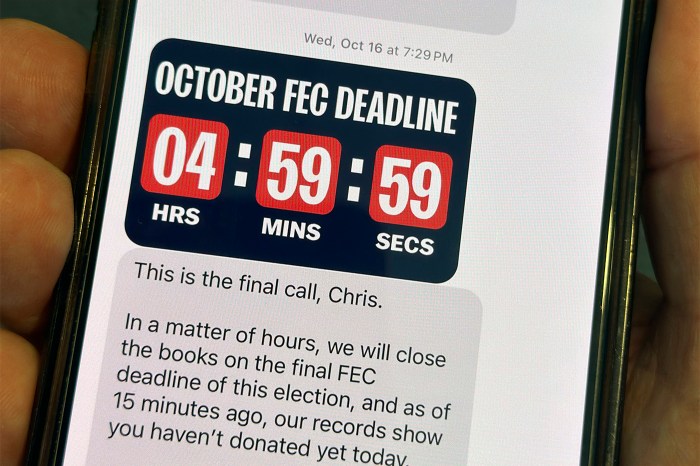

With fewer than 100 days until the midterms, there’s a lot of buzz about election season — including the literal buzzing of cellphones.
Political operatives have taken to texting voters to get the word out about key races, dates and other bits of information in the days leading up to the midterms.
But just how effective is texting as a strategy for galvanizing voters?
New research suggests that it can move the needle in getting voters to turn out — but only slightly.
Published recently in Political Behavior, researchers found that Short Message Service, or SMS, messages increased turnout by 0.25 percentage points during the 2018 U.S. midterms — or an additional 2.5 voters per 1,000 people — when compared to a control group that received no messages.
“Text messages are effective, but we’re finding that the effects are relatively small,” said Katherine Haenschen, associate professor in Northeastern University’s departments of communication studies and political science, an author on the study.
Research on voter mobilization has for years generally favored personal contact, particularly face-to-face canvassing, when campaigns get out into communities and knock on doors, as the more effective ways to encourage people to vote. Less personal methods, such as mail, direct phone calls and robocalls, tend not to move the needle as much as door-knocking, experts say.
But the landscape is changing as campaigns increasingly turn to digital channels that can reach voters more cheaply and at much greater scale, experts say.
The findings of the new study are based on a national field experiment conducted during the 2018 U.S. midterm elections to measure the effect of text messages on voter turnout — not just to observe whether receiving a text message made a difference, but also whether its content and timing mattered too, Haenschen told Northeastern Global News.
The study, which enrolled roughly 7.1 million people across more than two dozen states, was the largest published SMS-based voter-mobilization experiment, with more participants than all other published SMS experiments combined, Haenschen said.
Editor’s Picks


The study was conducted in collaboration with Vote.org, a nonprofit organization devoted to registering and mobilizing voters. The researchers used software platforms Relay and Hustle to disseminate the messages, randomly assigning participants into two groups of those who were sent a text and those who were not. They varied both the timing and the message type. Separately, a data vendor supplied the mobile number matches.
“One thing that is neat about text messages is they’re deployed to millions of people almost simultaneously,” Haenschen said. “We can very precisely vary the message content to know who exactly got what message.”
And that’s what they did. The researchers crafted different types of messages, varied when they were sent and compared these messages with Vote.org’s standard messaging practices. The messages received by the first group were designed to encourage people to vote, including reminders to add the election to their calendars, to tell their friends, and to note to the participants that voting records are public and to consider the candidates on the ballot.
Instead of asking participants if they’d voted, the researchers matched participants with updated voter files to compare turnout among people who received a variety of texted reminders against turnout among those who received no texts. In the 13 states with widespread early in-person voting, researchers also randomly assigned participants to receive messages encouraging early voting, Election Day voting or both.
What the team found: “Just telling people to vote early didn’t actually increase turnout — it just prompted the same number of voters to vote earlier,” Haenschen said. The key, she added, is that the messages have to allude to the social aspects of voting, including putting social pressure on voters, and to specifically mention Election Day in the message itself.
Despite the modest effects of the study, “Even small effects can be decisive in very close elections,” said Costas Panagopoulos, distinguished professor of political science. “And we’re seeing in many places, including at the presidential level, where elections are becoming very tight, that some of these tactics can help make or break the outcome in key races.”
Panagopoulos noted that while mobilization methods such as canvassing remain tactically superior, not all modes are equally cost-effective.
“Because [texting] is less costly, it can still be beneficial to use those techniques when you can send millions of text messages at a time,” he said.