What to know about the solar eclipse and where the path of totality will cross
Solar eclipses are ‘rare’ but scientists can predict them hundreds of years in the future. Here’s what you should know ahead of Wednesday’s solar eclipse event.
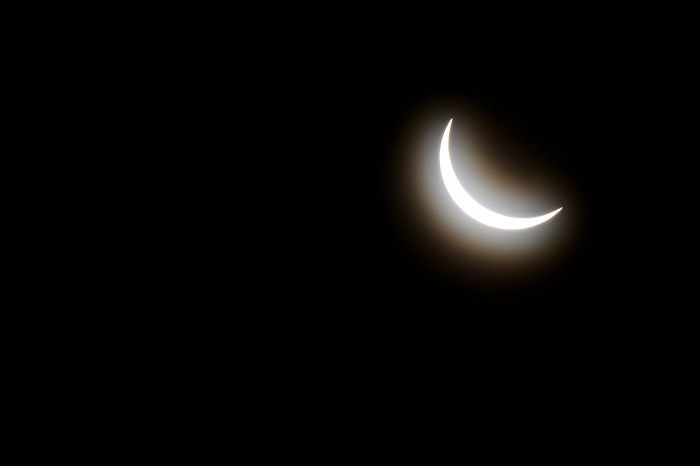

Darkness will fall for the briefest of moments before the sun sets this week in parts of Asia, North America and Europe. That’s because the moon will pass between the sun and Earth and create a total solar eclipse on Wednesday, Aug. 12.
During a solar eclipse, the moon partially or fully blocks light from the sun. When the light is fully blocked, a shadow is cast on parts of Earth on what’s called the path of totality. A partial eclipse, where the moon blocks part of the sun, can be viewed at varying degrees on either side of this path.
“Eclipses provide us with a fascinating opportunity to visualize where we are in the solar system,” said Jonathan Blazek, an associate professor in the physics department at Northeastern University. “The distances and sizes involved can be difficult to imagine, even for professional astrophysicists. Seeing one object pass directly in front of another gives us a unique, and beautiful, perspective.”
Most of the solar eclipse event is a partial eclipse. In areas that will see the total solar eclipse, darkness will last between one to two minutes, Blazek said.
The path of totality on Wednesday will twist around the North Pole, reaching remote northern Russia, Greenland, Iceland, Spain and a small sliver of Portugal.
Here’s what else you should know about the upcoming solar eclipse.
All times are local.

Where and when will the Aug. 12 total solar eclipse occur?
This total solar eclipse will start over the Khatanga Gulf near Bolshoy Begichev Island in northern Russia around midday, according to the National Aeronautics and Space Administration, NASA, and the National Solar Observatory, the federal research and development center for solar physics.
The path will slice through eastern Greenland and western Iceland around late afternoon or early evening. Then, over northeastern Spain and the tiniest portion of Parque Natural de Montesinho in Portugal will see totality in the late evening before sunset. The route will end near the Spanish islands of Mallorca and Menorca.
In Reykjavík, Iceland, totality begins at 5:48 p.m. and lasts for one minute, according to NASA. There, the partial eclipse will start at 4:47 p.m. and last until 6:47 p.m. In Valencia, Spain, totality begins at 8:32 p.m. and lasts one minute. The partial eclipse will be visible there from 7:38 p.m. to 9:01 p.m.
Editor’s Picks


Why are solar eclipses “rare”?
“Eclipses are rare because things need to line up perfectly,” Blazek said. “The moon is just barely large enough to cover the full sun, and only if you are in the right spot.”
There are different kinds of eclipses, including lunar, when Earth blocks the sun, or annular, when the moon is too far to fully block the sun. The latter can happen because the moon’s orbit isn’t a perfect circle, Blazek said.
During the 2024 solar eclipse, the path of totality cut across North America, but just missed Boston.
“We had over 90% of the sun blocked, but those last few percent make a big difference,” Blazek said. He told Northeastern Global News that, weather permitting, he would see his first total solar eclipse while at a cosmology conference in Spain.
How are scientists able to tell when and where solar eclipses will occur?
Scientists have a “very accurate understanding of how orbits work,” lending experts to predict in detail when the Earth, moon and sun will align, Blazek said. These forecasts can be made hundreds of years in advance. The length and width of the eclipse also change every time, he added.
“You can look up a table of past and future eclipses, going at least a thousand years into the future,” he said. “The uncertainty of these predictions increases slowly as you go further into the future, mainly because the Earth’s rotation is slowly changing due to interactions with the moon.”
The moon doesn’t always pass in front of the sun as it orbits Earth because the orbit is tilted at a slight angle to Earth’s orbit around the sun, according to the European Space Agency. This orbit crosses the Earth’s orbit with the sun twice a year, called a lunar node. An eclipse can happen within a 35-day period around this lunar node, according to the ESA. Solar eclipses can happen during new moons and lunar eclipses can happen during full moons.
The next solar eclipse will take place on Aug. 2, 2027, over Spain, North Africa, Saudi Arabia and Yemen, according to NASA. The next annular eclipse will happen on Feb. 6, 2027, and a partial lunar eclipse will happen on Aug. 27 and 28.
Where and when to see the solar eclipse on some Northeastern campuses, in local time?
According to NASA, the partial eclipse visible from Boston will begin at 1:01 p.m. and last until 2:46 p.m. The maximum eclipse at 16% will occur at 1:55 p.m.
In London, the partial eclipse will begin at 6:17 p.m. and last until 8:06 p.m. The maximum eclipse at 91% will occur at 7:13 p.m.
In Toronto, the partial eclipse will begin at 12:55 p.m. and last until 2:23 p.m. The maximum eclipse at 8% will occur at 1:40 p.m.
In Portland, Maine, the partial eclipse will begin at 12:57 p.m. and last until 1:53 p.m. The maximum eclipse at 19% will occur at 2:27 p.m.
Where else in the world can you see the partial solar eclipse?
- Anchorage, Alaska: maximum eclipse at 28% at 8:21 a.m.
- Washington, D.C.: maximum eclipse at 4% at 1:53 p.m.
- Algiers, Algeria: maximum eclipse at 96% at 7:33 p.m.
- Kraków, Poland: maximum eclipse at 64% at 7:56 p.m.
- Lisbon, Portugal: maximum eclipse at 95% at 7:36 p.m.
- Madrid, Spain: maximum eclipse at 99% at 8:32 p.m.
- Milan, Italy: maximum eclipse at 92% at 8:20 p.m.
- Paris, France: maximum eclipse at 92% at 8:17 p.m.
- St. Petersburg, Russia: maximum eclipse at 79% at 8:51 p.m.
More times and locations can be viewed here.
What do you need to see the solar eclipse?
A solar eclipse should only be viewed with proper eye protection, like eclipse glasses. Unlike regular sunglasses, eclipse glasses filter ultraviolet, visible and infrared light. With these glasses, you shouldn’t be able to see anything except for very bright lights that will appear faint, according to the American Astronomical Society.
Do not look at the sun through a camera lens, telescope, binoculars or other viewing device while wearing eclipse glasses, NASA warns. Special solar filters need to be attached to these devices.
A pinhole projector is a popular way to safely view the solar eclipse. That is where material like cardboard or paper with a punched hole can project the image of the moon passing in front of the sun through a shadow. Even holes in leaves can cast the image of the solar eclipse. Do not look at the sun through the hole of this material, experts say.


