This robot can snuff out wildfires with a cryogenic spray
Northeastern University professor Yiannis Levendis built a firefighting machine that “suffocates” flames.

About 20 years ago, Yiannis Levendis, a professor of mechanical and industrial engineering at Northeastern University, was working on an experiment to find an alternative to coal – grinding up old car and truck tires and burning the crumbs.
When he was igniting rubber tire bits in his lab back in 2008, on impulse, he fetched a spoonful of liquid nitrogen and threw it on the flames.
“Liquid nitrogen, when thrown on fire, quickly evaporates and expands into gas almost 1,000 percent,” he said. “That suffocates the fire and creates a cooling effect on the fuel.”
And that’s exactly what happened. “It was almost instant extinguishment,” Levendis said.

He knew that liquid nitrogen had been used to help stop fires deep in coal mines, but he thought they could also be developed to fight wildfires.
According to the National Interagency Fire Center, more than 5.13 million acres were scorched by wildfires in the U.S. in 2025. That’s more than 8,000 miles, or the equivalent size of Massachusetts.
He was especially hopeful about the approach because, unlike other retardants used to fight in wildfires, liquid nitrogen leaves no chemical residue that could damage the soil or harm the environment, Levendis said.
Many fire retardants used on wildfires today contain phosphorus, a chemical used in fertilizers, and according to the U.S. Geological Survey, in heavy concentrations, it can run off into streams and ponds. That can cause algae blooms that can kill fish and other aquatic lifeforms. Some retardants also contain sodium ferrocyanide, a chemical that can hurt the soil, the agency said in a 2002 report.
Even with the cryogenic as an alternative, Levendis needed a delivery system.
Spray it from firetrucks with special tanks and cold-resistant hoses? Drop it from helicopters with newfangled scoops to contain the cryogenic material until needed?
“Neither are far-fetched,” said Levendis, who has frequently developed new ideas at Northeastern University, such as using corn stalks or old plastics as a coal replacement.
But his ultimate answer for this project: robots.
Editor’s Picks



The robotic devices, either autonomous or guided by remote control, could get to wildfire hotspots that firefighters can’t, dousing small fires with the spray before the combustible material, such as layered pine needles, dried sticks and scrub grow into massive conflagrations.
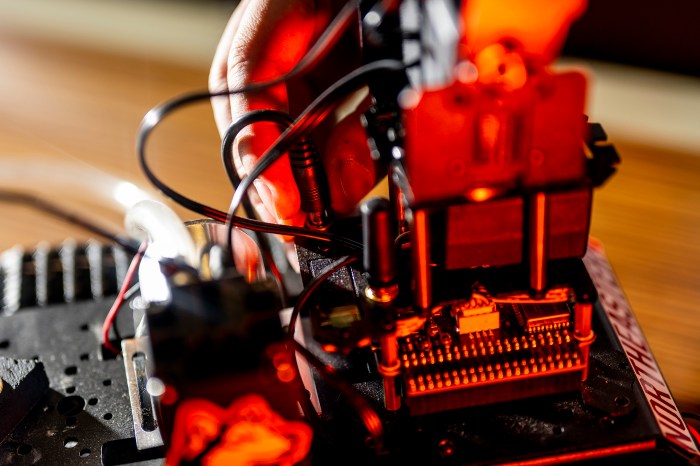
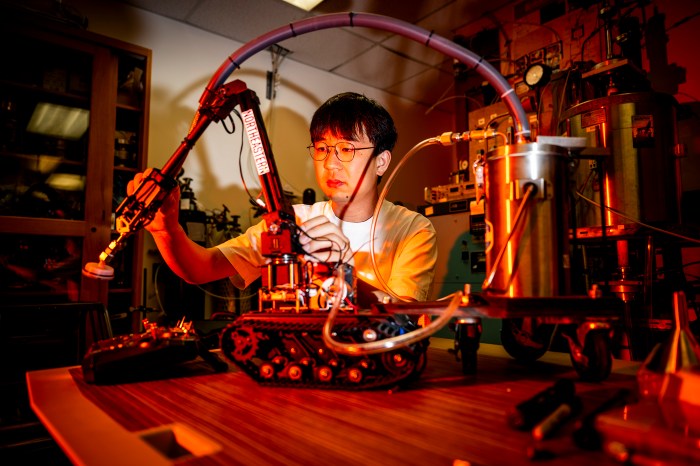
Now his prototype, built with help from Northeastern students Hayden Hishmeh and Aobo Liu, looks like a small trash can with a hose and all-terrain caterpillar treads. Levendis had noodled with the idea off and on for years until three years ago, when he received a grant from the Gordon and Betty Moore Foundation, a nonprofit that supports projects to advance scientific discovery and environmental conservation. The money allowed him to pay for equipment and outfit his lab, among other things.
Levendis has been testing the prototype on small, controlled fires using fuel found in the forests in the western U.S. where wildfires are prevalent.
Tom Ryden, the executive director of MassRobotics in Boston, said that Levendis’s invention just might catch the eye of firefighting agencies or an industrial partner.
“A perfect use for robots is to send them into dangerous spots,” said Ryden, whose Boston-based company serves as an incubator firm fostering more than 100 startup companies in the Boston area involving robots.
Police use robots now to retrieve and defuse bombs, and also to go in close on hostage situations to assess the danger.
“Even if we lose a robot, it’s just the cost of the machine that’s lost, not a person,” Ryden said.
The prototype is being tested but Levendis said he envisions other applications.
“I believe it can be converted to vehicles as large as firetrucks,” Levendis said. “We are fairly close.”