Northeastern program an ‘equalizer’ aimed to diversify the field of applied psychology
Undergraduate students with an interest in psychology are receiving weeks of guidance and experience through the ROADMAP Scholars Program housed at Northeastern University.


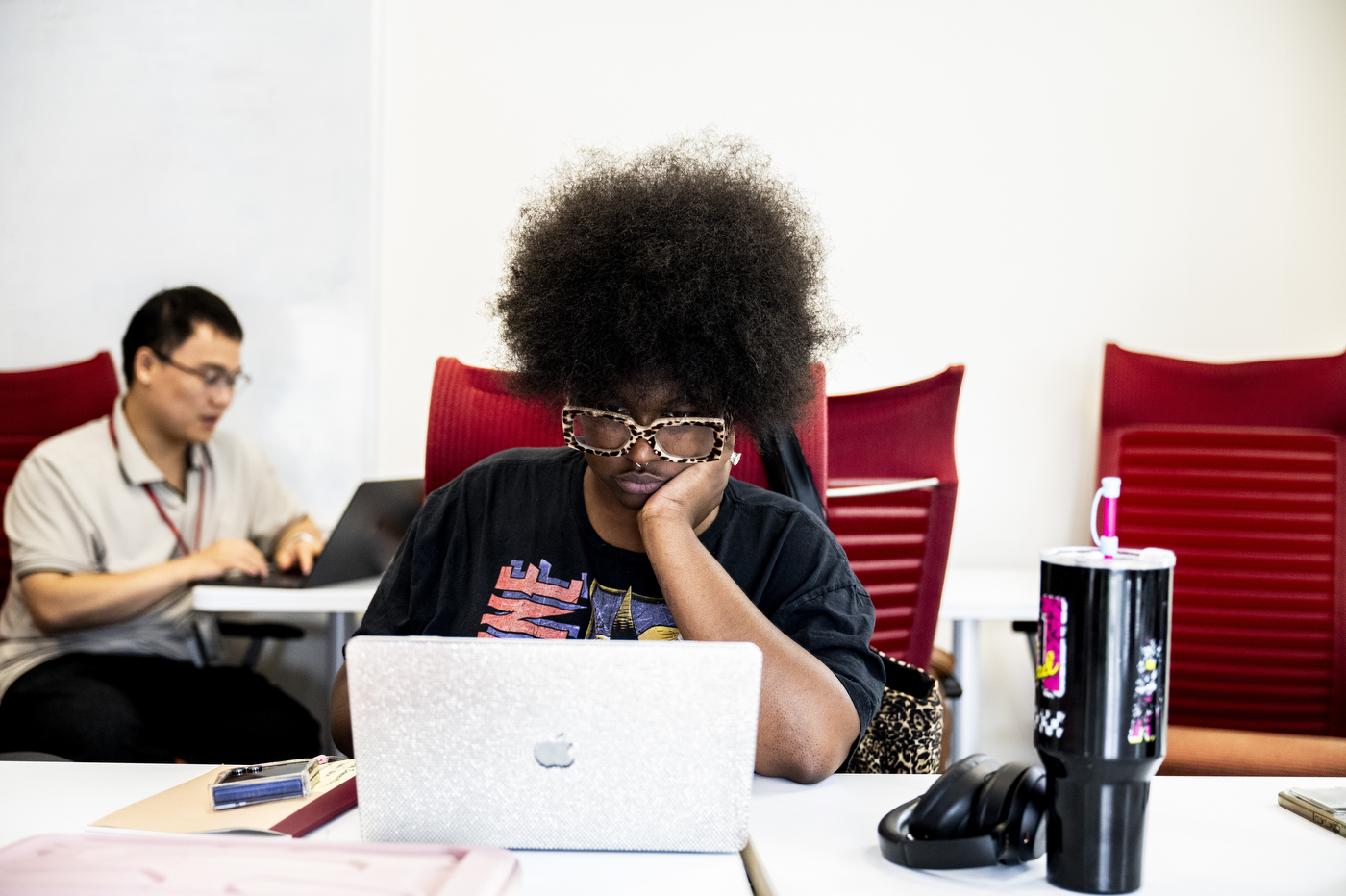
On a recent afternoon, 10 psychology undergraduate students were gathered around a conference table. Rather than a study session, the gathered crew was playing a low-stakes trivia round of “famous psychologists.”
The photograph of Sigmund Freud was easily identifiable, and, at least to these students, so was Marsha Linehan, an American psychologist who created a therapy technique that also incorporates mindfulness. But one image included to add levity stumped most of the students.
The unidentifiable picture in question? It was a photo of Adrianna Crossing, assistant professor of applied psychology at Northeastern University and director of the ROADMAP Scholars Program, the very one in which the students were participating.
Crossing, who was in the room, joked that the students may not have recognized her because the photograph was four years old. But the students’ failure to identify someone who was in the same room caused a fit of giggles – a welcome relief to unwind, learn and build community following an intense morning on learning to navigate imposter syndrome, perfectionism and procrastination and an afternoon of crafting personal statements and honing research questions.

All those activities were part of ROADMAP – which stands for Research Opportunities and Development through Mentorship in Applied Psychology. As part of the six-week intensive program, students get matched with faculty and peer mentors, gain research experience, understand how to navigate the graduate school process and learn strategies to balance deadlines and deliverables.
“This program really is like an equalizer, in a sense,” said Emi Santos, a fifth-year data and psychology student at Northeastern University. “Now we have the information and we have many more connections and now see what you can go and do.”
The program was born out of a $250,000 grant from the Accelerate the Future Foundation dedicated for research and scholarship in diversifying the pipeline for mental health professionals in Massachusetts. A 2025 study from Blue Cross Blue Shield of Massachusetts Foundation highlighted that a challenge in meeting the state’s mental health needs is due in part to a shortage of mental health professionals from marginalized communities, who face several barriers to licensure. Launched in 2024, the program returned in 2026 and organizers hope that with more funding, it can come back in 2028.
“The higher level of education that you go in this field, the less diverse it is ethnically, racially and linguistically. This is happening at the same time that our public in the nation, especially our children, are becoming increasingly diverse racially, ethnically and linguistically,” Crossing said.
Crossing also co-authored a review with then-applied psychology department chair Robert Volpe, in which they looked at different programs designed to help students of color prepare to study psychology in graduate school and “examine the diversity problem that we have in applied psychology,” she said.
“What we are really hoping to do is pull the curtain back on higher education and show these young people exactly how to go to graduate school, and how do you apply, how do you pick a research lab, how do you even choose the field in psychology that you want to study,” Crossing said.
The program has doubled in size since its first year. This year, 10 undergraduate students from Northeastern, Wheaton College and Wellesley College are participating in the program. The students received a $2,000 scholarship to ensure there’s no financial burden and that students who wanted to participate didn’t have to choose between a part-time job and getting access to this program, Crossing said.

“We’re hoping that through all of that, they walk out of this program going, ‘I can do this,’” Crossing said.
Students get research experience with Northeastern faculty, like testing prototype AI chatbots to help public health for underserved communities or studying the “what ifs” of counterfactual thinking in prolonged grief and PTSD. Some plan to continue on in these labs after the program finishes.
Editor’s Picks



Each week brought a new topic of discussion. The first week covered research fundamentals and understanding the difference between qualitative and quantitative research, while another focused on science communication to help them prepare to present their research work at the end of the program. There was also a lecture on AI ethics in clinical care and research, Crossing said.
For Northeastern students Santos and Danny Tran, a fourth-year behavioral neuroscience student, perhaps the most valuable information they received was about the graduate school process.
The program has “demystified a lot of the graduate school experience,” said Tran, adding that getting to work with peer mentor John Leman, a fourth-year counseling psychology Ph.D. candidate, has made him realize that graduate students “were once undergrads not too long ago.”
“Perhaps in the past, I may have never seen myself ever in the shoes of a grad student, like there’s too much of a gap between an undergrad and a grad student. But nowadays, I think that gap is becoming smaller,” Tran, who is interested in pursuing graduate school for clinical psychology, said.
The students were taught about the GRE standardized test and what it looks like to study for it, learned how to write a personal statement and update their resume to reflect their achievements. They were able to take what they learned in group settings to bring back to their mentor one-on-ones.
“In my family, nobody has gone down this route. It’s very confusing,” Santos said. “A lot about what has been surprising is the sheer amount of requirements, what these steps actually look like, and what programs you should actually be looking for.”
Leman said Tran has asked really insightful questions about graduate school – like how to approach special interests or whether where you go to school matters – in a way that he feels Tran is going to be “quite prepared.”
“The ROADMAP program might be this summer … but it’s the things that are more downstream that I think, if anything, might be even all the more worthwhile,” Leman said. “It’s the connections that we’ll continue to maintain, and the connections they’ll have to reach out to if they’re applying to grad school.”
Crossing was clear that the aim of the program is not to increase diversity for diversity’s sake, she said. But studies have shown certain mental health interventions that work for white people aren’t as effective for people of color, or that people of color can relate more to a counselor who they feel can better relate to them.
“None of that is on the fault of the clinician … but rather the social circumstances that we’re all born into,” she said. “Since we’re quite a ways away from solving this at the societal level, the least we can do is diversify the workforce, but also provide all clinicians with better tools to support diverse Americans.”


