Would the US defend Europe from a Russian attack? Leaders meet at NATO Summit
Northeastern scholars break down why the NATO Summit in Ankara is testing US commitment to defending Europe from Russia.
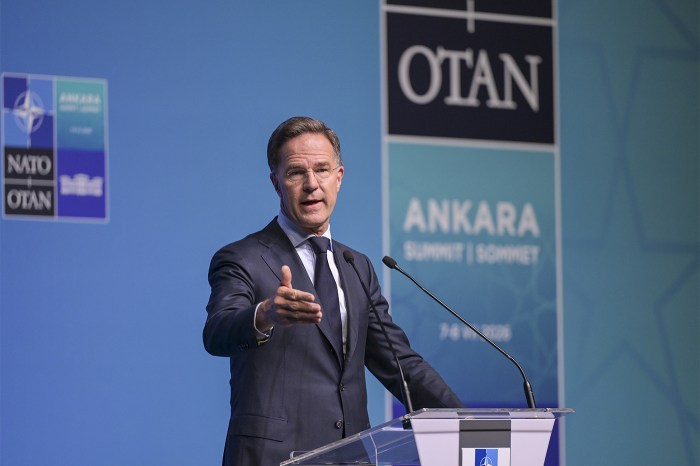

LONDON – For the first time since NATO was formed in 1949, European powers have been left wondering if the United States would rush to their defense in the event of a Russian attack.
Pablo Calderón Martínez, associate professor in politics and international relations at Northeastern University London, said that such fears are warranted, despite the unlikelihood that Russia would provoke the military might of Britain, France or Germany.
“Is Europe prepared for Russian invasion?” “No, they’re not,” he told NGN Northeastern Global News. But he added, as many experts believe, that Russia also lacks military readiness for another war, having struggled against the far smaller forces of Ukraine.
The uncertainty comes as leaders of the intergovernmental military alliance prepare to meet on Tuesday and Wednesday in the Turkish capital, Ankara, for a gathering that is expected to focus on defense spending and Ukraine’s security. Europe’s anxiety has intensified since Moscow invaded Ukraine in February 2022, launching the biggest land war on the continent since World War II, and raising the prospects that the Kremlin might expand the conflict beyond the borders of its smaller neighbor.
As members of the alliance assemble for the 2026 NATO Summit, Europe’s leaders will arrive hoping to strengthen security guarantees from the U.S., according to Northeastern’s international relations scholars. Threats by President Trump to withdraw from the treaty have created a lingering mood of uncertainty, but the summit presents a window of opportunity for “very, very cautious optimism,” said Mai’a Cross, dean’s professor of political science, international affairs and diplomacy at Northeastern.
At the G7 Summit in France last month, President Trump joined European leaders in offering “unwavering support” to Ukraine, creating hope for stronger commitments in defense of Europe.
“Everyone’s waiting with bated breath on what might happen,” said Cross of the upcoming gathering, with “the big caveat that Trump is famous for flipping back and forth on policy in dramatic and often damaging ways.”
The Future of NATO
The agenda for NATO is expected to comprise three main priorities: boosting defense investment, increasing industrial production and continuing support for Ukraine.
Yet plenty of unknowns remain as the summit begins, said Julie Garey, Northeastern associate teaching professor of political science. “What does this mean for the future of European security? What does it mean for the future of NATO? And what is the end goal (for the U.S.)?” she queried. Critically, it remains unclear if the U.S. intends to withdraw or take a softer line, she said.
Editor’s Picks


Since the 2025 summit, when President Trump demanded that European nations increase spending, there has been “sea change in Europe,” said Cross. All NATO members have since committed to spending 5% of GDP on defense, with the exception of Spain. Some European Union (EU) nations have rapidly altered fiscal rules to commit to greater defense investment, including Germany, which changed its constitution in March, she said. “Germany has committed to rearming and having an army bigger than France and the U.K., combined, within a very short period of time,” Cross added.
If the U.S. withdrew from cooperation with NATO tomorrow, Europe would “not yet be ready to deal with Russia on its own,” said Cross, who is also director of Northeastern’s Center for International Affairs and World Cultures. European nations still lack U.S. intelligence capabilities and heavy weaponry but are moving to become self-reliant, she said.
“That is a dramatic change because they were reorienting their militaries toward humanitarian action and now they’re thinking again about more traditional boots on the ground,” she said.
How Europe is preparing
In Europe, the President’s demands have resulted in some surprises. Nations have committed to allocate 3.5% of GDP to core military spending and a further 1.5% on other security-related investments, including roads, infrastructure, and energy grids. Many European nations are being clever with this extra expenditure, said Martínez, the politics and international relations professor, essentially moving existing investment, for example on research and development, into the defense column.
One unlikely winner is renewable energy, said Garey. European powers have long been proactive investors in climate change adaptation and then the war in Ukraine “escalated that urgency,” she said. Nations saw the risks of energy grids failing or being dependent on fossil fuel imports, she explained: “Now they’re looking at it and saying, this is actually a major national security issue.”
For now, in most European nations, little has changed on the ground, as nations like the U.K. balance a hypothetical threat from Russia against the everyday challenges such as health and housing, Martínez said. But nations closest to Russia are more likely to prioritize defense, he added.
The summit’s renewed focus on the defense of Ukraine is critical, said Garey. “If the U.S. were to withdraw from NATO and from Europe altogether, I think Ukraine would definitely fall into Russian control in some way or another,” she said.