Reflections on algae in the Lincoln Memorial Pool (and elsewhere)
Two Northeastern University experts explain what algal blooms are all about and what is — and isn’t — cause for concern.
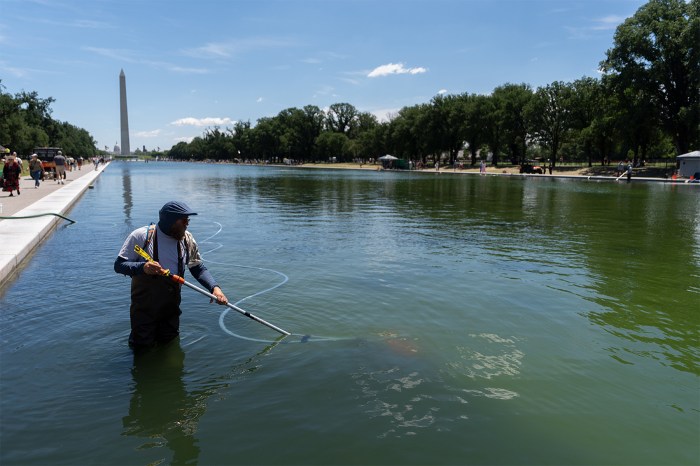

Since early June, images of algae that appears to have colonized the Lincoln Memorial Reflecting Pool in the nation’s capital have flooded newsfeeds. But the infestation of the toxic aquatic organism reaches beyond the National Mall. The National Oceanic and Atmospheric Association, NOAA, Thursday issued a forecast, warning that “moderate harmful” algae are expected in western Lake Erie this summer. And, Australia’s largest and longest harmful algal bloom is still wreaking havoc off the Southern Australian coast. It seems that algae are everywhere.
In fact, algal blooms—overgrowths of algae triggered by excess nutrients in the water—are indeed on the rise, according to the United States Environmental Protection Agency. Algae gone rogue scarf up over four billion dollars in damages every year in the U.S. and make dozens of people—as well as ocean and lake species—sick through toxins released into the water, research shows. In 2013, the organism led to the demise of 277 manatees. A tracker maintained by Hydralife, a phytoplankton aquaculture company that keeps tabs on U.S. Harmful Algae Blooms in real time, has already tallied up a total of 119 with a peak of 48 events hitting in June.
And while President Trump is blaming the influx of these organisms on saboteurs, the science behind these plant-like life forms tells a different story.
- 1. What are algae?
- Algae might look like plants, but they’re actually plant-like organisms equipped with the green pigment known as chlorophyll that lets them, like plants, make their own food through photosynthesis. According to AlgaeBase, there are over 50,000 species on our planet today, marked by a range of unique shapes, explains R. Edward Beighley, Northeastern College of Engineering Distinguished Professor. At one extreme, there’s single-celled Micromonas pusilla found in coastal zones around the world. At the other, giant tree-like kelp forests that colonize rocky seafloors on temperate coasts.
2. Are all algae harmful?
Algae might be getting bad press at the moment, and while some do contain toxins, others are “an important food supplement,” says Lianyong Wang, assistant professor of biology at Northeastern. In addition to serving as an alternative protein source that’s also chock-full of lipids, fiber, and micronutrients, it makes for a tasty dish in its own right. After all, what would a maki roll be without a sheet of nori, the “sushi seaweed”?
Calcified algae that naturally contains limestone in its cell walls can also be used to make “biocement”—a sustainable alternative to the traditional kind.
Besides, Wang points out that some microscopic single-celled microalgae can actually scarf up the nitrogen and phosphorus molecules in contaminated water, purifying it in the process.
Algal blooms, however, are a different kind of beast.
Editor’s Picks


3. What are algal blooms and why can they be harmful?
According to Beighley, it takes a “perfect storm” of three components to get an algal bloom, which is simply the proliferation of these organisms. Two of them are algae diet staples—nitrogen and phosphorus. When they’re in the water, these elements kick off an all-you-can eat food fest.
“It’s like the perfect breeding ground for algae … They’ll eat all the phosphorus, all the nitrogen, they grow until all that’s gone … Then they die,” Beighley says.
The third is elevated temperature, which is why so many algal blooms show up in the summer months.
As the algae die and decompose, they suck oxygen out of the water, which is bad news for any species that call it home.
As Mystic River Watershed Association expert Isaiah Johnson adds, under the right conditions “these organisms … can turn the water pea green, bluish-green, brown, or even red.”
Freshwater algal blooms, such as the ones in the Reflecting Pool—as well as in lakes, ponds, rivers, and reservoirs around the world—are often caused not by true algae, which are eukaryotes, but by microbes known as cyanobacteria, prokaryotes without nuclei or membrane-bound organelles. A different group of algae known as dinoflagellates or diatoms are the most common culprit in marine environments, where algal blooms are also known as “red tides.”
“People and animals can get sick by touching, breathing in, or swallowing water with harmful algae,” the U.S. Centers for Disease Control and Prevention warns. Most dangers come from direct contact, causing vomiting, diarrhea, or stomach pain.
Beighley’s work has focused on building cyanobacterial sensors in the Charles River. A handy online counter shows exactly what the current risk levels are.
4. How do you stay clear of and get rid of toxic algae?
Experts say that it’s a good idea to keep an eye on your water quality, whether it’s local tap water, since simply boiling it will not remove algae, or the water in your pool. Prevention is always easier, Beighley says. So make sure your pool’s chlorine levels are in that CDC-recommended sweet spot between 1.0 and 3.0 parts per million.
Beighley’s work has focused on building cyanobacterial sensors in the Charles River. A handy online counter shows exactly what the current risk levels are. An app called bloomWatch lets any aspiring citizen scientist keep tabs on the problem.
What happened in DC is most likely an accident. An outdoor pool “is not a bathtub,” Beighley explains. It’s “part of an ecosystem” with a delicate balance that’s easy to throw off.
Beighley says one clue could be where the water for the refill came from, ”the Potomac River or … from one of the water treatment plants?” The former could have already had some nutrients in it. Warm weather, in turn, “could have jumpstarted something.”
However, experts worry that the color of the American Flag blue paint used in the recent renovations of the rectangular basin of water is a recipe for future problems, as it absorbs more light and raises temperatures inside—the environment in which algae thrive.
Wang also says that what happened at the Lincoln Memorial is “inevitable.” His own fish tank at home fell prey to a miniature version of an algal bloom, he says.
Wang’s solution? For a while, he considered getting snails to gobble up the green stuff, but worried that the massive meal might “be hard for them to digest.”
When it comes to bigger blooms, like the one in the Reflecting Pool, experts have a few options. The National Park Service and the Department of the Interior set to work blasting it with hydrogen peroxide and using nanobubbles filled with ozone to target algae directly while boosting the oxygen levels of the water to keep nutrient release at bay. After a round of manual vacuuming to finish things off, the pool is once again reflecting the Lincoln Memorial.


