Regulations don’t go far enough to protect privacy when it comes to smart glasses, experts say
Reports this month on privacy concerns connected to smart glasses renew the argument that privacy regulations surrounding this technology are lagging, experts said.
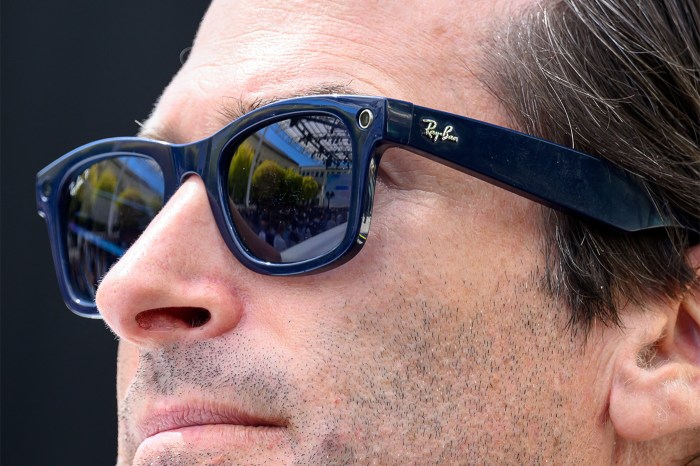

At first glance, they appear like regular glasses. However, a barely noticeable soft white glow on the corner of the rim of Meta’s smart glasses indicates that the wearer is not only watching, but also recording.
The issue is not just whether people know they’re being recorded and privacy concerns brought about by smart glasses aren’t new.
But a recent revelation about a new face-recognition feature for Meta’s smart glasses that was not yet available to users renews the argument that privacy regulations surrounding this technology are lagging, experts said.
Earlier this year, the New York Times reported that Meta had been developing face recognition software to be released this year. And WIRED reported this month that Meta had quietly added that technology to its Meta AI app that, when activated by the company, would create a unique biometric signature for each face captured by the glasses’ camera. That “faceprint” would be stored on the user’s phone. The software would also alert the wearer when it recognizes a person through that faceprint. The app, which is needed to operate these smart glasses, has been downloaded over 50 million times, the report said.
Meta removed traces of the software after WIRED’s report, telling the outlet that “no final decision has been made” about face-recognition software, adding that the feature did not exist.
Removal of this software from the app is “good,” said Aanjhan Ranganathan, an associate professor and the interim director of the BS in Cybersecurity program in the Khoury College of Computer Sciences at Northeastern University. But the fact that the code was sent to so many users in the first place “tells you the default direction the product is heading absent external pressure.”

Facial recognition in smart glasses raises concerns in several areas. With no choice to “opt-in,” some fear it would erode the expectation of privacy in public by changing “what a stranger in public can learn about you from essentially nothing to a full dossier,” Ranganathan said. That ability is partially why the government has been exploring similar technology for immigration enforcement, for example, to much controversy. Before the Department of Homeland Security had asked for $7.5 million to develop its own smart glasses for this purpose, lawmakers had introduced the ICE Out of Our Faces Act to ban Immigration and Customs Enforcement and Customs and Border Protection from using face recognition technology. That bill has not moved since its referral to a Senate committee in February.
But there’s a concern of bad actors abusing it. “In terms of the ethics, biometric surveillance is a real menace,” said Adam Schwartz, privacy litigation director for Electronic Frontier Foundation (EFF), a nonprofit that advocates for free speech and digital privacy. “There are not enough limitations on what the companies are doing with that data,” he said.
Some states do have privacy laws on the books that have implications for Meta’s collection and use of biometric data. Illinois law requires consent before biometric data can be collected, and in 2020, Meta agreed to a $650 million settlement over its “Tag Suggestion” feature that identifies faces in photos and videos uploaded to Facebook. Texas, which passed a similar law in 2009, won a $1.4 billion settlement against Meta for the same feature in 2024.
EFF has lobbied to get more states to have similar privacy protections for opt-in consent in an effort to broaden these regulations, according to Schwartz.
Editor’s Picks


While laws thus far have targeted biometric data collection more broadly, one state is exploring legislation specific to smart glasses. A Pennsylvania state lawmaker this month proposed privacy protections that require smart glasses consumers to be informed about the state’s recording laws — that all parties consent before recording. The proposal also requires that such glasses sold in the state have visual indicators when actively recording and that wearers be prohibited from disabling these indicators.
Northeastern Global News sought comment from Meta on this proposed legislation.
Meta glasses do have a light indicator that turns on when recording is active, but “people might not see it or know what it means,” Schwartz said. Plus, there is a growing market for disabling these light indicators, according to reports.
Ranganathan said this bill is “sensible,” but the better target is in regulating this facial recognition software as a whole because it could then address the function rather than the form, Schwartz said.
That approach might be especially prudent as Meta, which has partnered with the accessory companies Ray-Ban and Oakley, isn’t the only one that has smart glasses. Google announced it will similarly launch its own pair of smart glasses with Warby Parker and Gentle Monster later this year.
“Putting cameras into glasses is an inherent privacy threat, and putting face recognition on the camera and the glasses is an intolerable escalation of that privacy threat,” Schwartz said.
“This is a reminder that we need stronger laws to protect our privacy from the actions of corporations that are interested in making a buck, as opposed to thinking about our privacy,” he said.


