Whales display behavior typically seen in humans, new research shows
Humans are used to birth involving non-family, like doctors, nurses and midwives. In the animal kingdom, it’s a rarity. But scientists recently discovered that sperm whales do so to survive.


Humans are used to birth not always being a family affair, with doctors, nurses, doulas and midwives often on hand to help with welcoming a new life. But in the animal kingdom, it’s incredibly rare.
Now, for the first time, scientists have discovered that sperm whales exhibit the same behavior and might be more intelligent, and “human,” than previously thought.
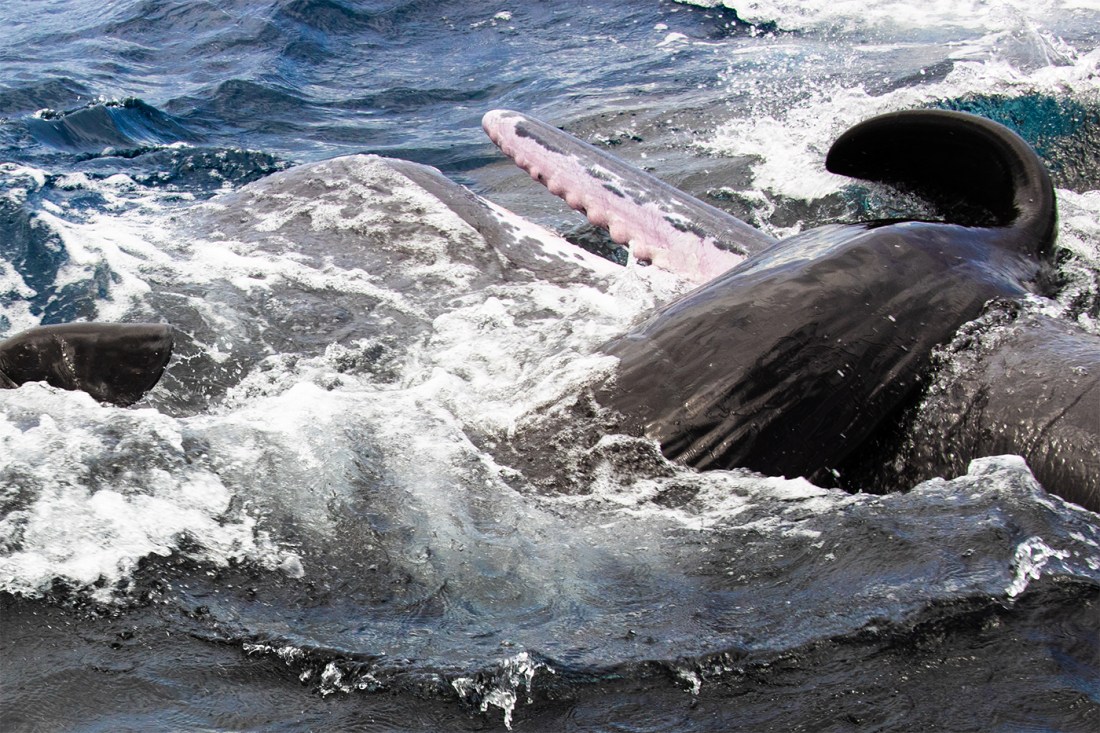
On July 8, 2023, researchers with Project CETI, a nonprofit focused on studying and translating whale song, captured the first detailed footage of a sperm whale birth. In analyzing the footage, they found that the group of 11 whales was actually from two different family units, or pods, that had come together to assist with the birth of a young calf.
This kind of cross-family communication is actually born out of a need for survival, said Giovanni Petri, lead of network science at Project CETI and a professor at Northeastern University’s Network Science Institute.
“For sperm whales, it’s particularly important because the calves, when they’re born, they basically sink,” Petri said. “This is not the Bambi case where Bambi is on the floor and just stays a little longer on the floor before walking.”
But for a baby whale, if it’s not kept out of the water, it will drown, he said.
Once the calf was born, whales who were not even related to the new mother leapt into action, slingshotting the calf to the surface. They then formed a makeshift raft with their bodies to keep it afloat until it was able to swim well enough on its own that it wouldn’t sink.
That non-related whales came to the assistance of another pod could provide further evidence that this behavior is an evolutionary survival response for the species, Petri said.
“[It could] represent one of the lynchpins for this hypothesis that the complexity of the communications we observe is really needed for species survival,” Petri said.
Project CETI captured the birthing process, which lasted for around four hours, during what was supposed to be routine fieldwork near the island of Dominica in the Eastern Caribbean. Using drones, microphones and cameras strapped to boats and buoys, they recorded this group of 11 whales.

Petri and his team took that footage and mapped the body of each whale and followed its movement throughout the birthing process. Once they did that, they could piece together a real-time view of the social systems at play within both pods to determine relationships.
That information allowed them to show that there is “a nontrivial, very pronounced interaction between groups of whales that are non-genetically related or non-kin, which is very uncommon and was thought to be just a human thing,” Petri said.
The more Petri and the Project CETI team studied the footage, the more they realized how miraculous this discovery was.
It’s long been known that sperm whales are highly intelligent. Sperm whale family groups, or pods, are tightly knit with complex cultural practices and communication strategies. Matriarchal by nature, pods are generally composed entirely of females. Males leave their families in adolescence to form “bachelor groups” or go solo.
“Sperm whales have the largest brain on Earth – nearly six times heavier than a human,” according to Chris Johnson, global lead of the World Wildlife Foundation’s Protecting Whales and Dolphins Initiative. “Each adult female carries in her extraordinary, accumulated wisdom about foraging grounds, migration routes and social traditions.”

But what Project CETI observed was a “very rich social behavior” that went beyond anything previously witnessed in the species.
Sperm whale pods typically live across dozens of miles of open ocean and rarely, if ever, interact with one another, let alone this closely. For them to be in the same spot at the same time meant that the unrelated family of whales knew what was about to happen well before the birth took place.
In fact, the whales had gathered hours in advance and stayed together for hours afterward to support the calf and protect both pods from predators, such as pilot whales and sharks, Petri said.
Editor’s Picks




Even more notably, all of this took place close to the ocean’s surface. A sperm whale’s typical day is divided into 15 minutes spent getting air at the surface before diving below for 45 minutes to an hour to forage for food.
“Staying at the surface is an extreme metabolic cost,” Petri said. “It’s a great investment in someone who’s not even your kin. From the pure evolutionary population theory, you shouldn’t do it.”
Beyond the evolutionary implications of this discovery, the sheer physical strength and ingenuity required by two whale pods to lift a recently born calf out of the water is a sight to behold, Petri said.
“These animals don’t have hands, and sperm whales are very slippery, so you need to do a good job of keeping something out of the water without hands and you’re basically a bunch of slippery masses moving in the water very slowly,” Petri said.
Like with humans, the birth process is an all fins on deck affair.
Adult and juvenile females assisted with the birth, while elderly grandmothers watched the perimeter to protect against predators. Meanwhile, predatory pilot whales arrived, alongside dolphins and other marine onlookers, and further analysis from Project CETI could shed light on those interactions, Preti said.
But someone was left out of all the hubbub.
Oddly, in the birth that Project CETI captured, there was a lone male sperm whale present, who the researchers nicknamed Allan. But his role in the birthing process was limited, at best.
He “really wanted to be involved,” Petri said. “But it turned out no one was paying attention to him. Everybody was turning away from poor Allan.”