Pregnant? Researchers discover that it may decrease your ‘fear memory’
Northeastern University researchers have discovered that chemical changes in the pregnant brain can soften subjects’ fear memories.
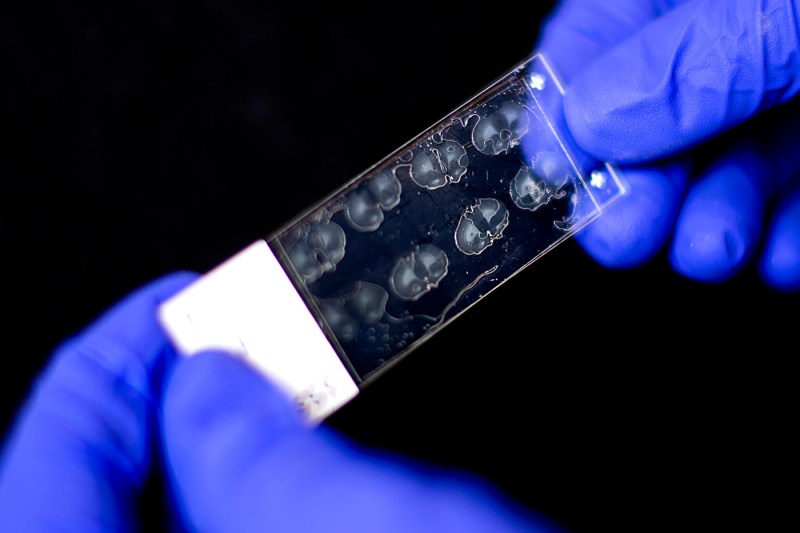
Recent Northeastern University research demonstrates how pregnancy’s hormonal milieu can change the responses to fear of pregnant subjects. Photo by Matt Modoono/Northeastern University

There’s a reason that the term “mom brain” exists. In recent years, research has shown that the forgetfulness and general fogginess that mothers can experience after giving birth, both immediately and in the long term, is likely because pregnancy does change the brain.
A new paper out of Northeastern University offers more clues as to why these changes may be happening. Specifically, the researchers identified that some postpartum rats displayed a reduction in their memories of fear that persists after pregnancy.
The researchers also identified a likely chemical culprit for the change, the steroid allopregnanolone, which the body produces in greater quantities during late pregnancy, in both humans and rats.
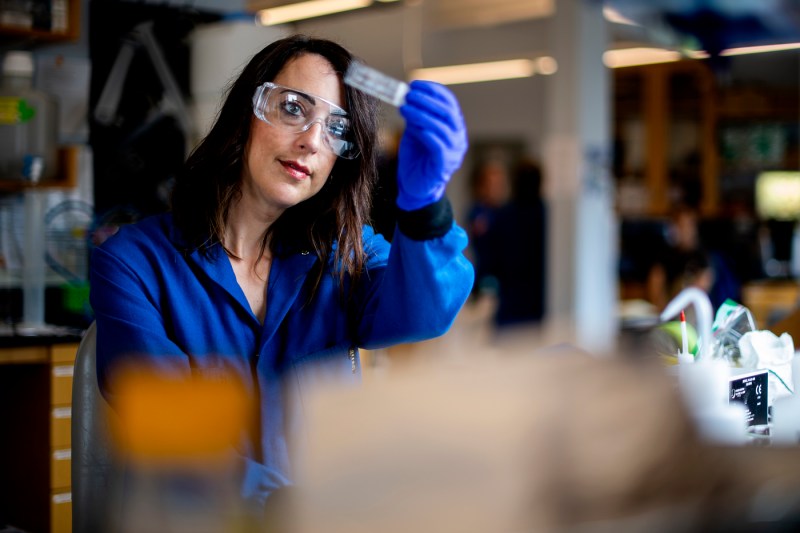
When most scientists study the postpartum brain, they look at the period immediately after pregnancy to study conditions like postpartum depression, says Rebecca Shansky, professor and chair of psychology at Northeastern.
“What’s cutting edge about our study is that it was conducted while the rats were pregnant, and not after the fact,” says Lindsay Vincelette, a graduate student in behavioral neuroscience and psychology at Northeastern. This ability to “manipulate pregnancy as it’s happening,” Vincelette continues, opens windows onto the hormonal milieu driving the neurological changes in pregnant subjects.
In their latest study, Shansky, Vincelette and a team of other graduate students trained rats to have a Pavlovian response to a series of sounds followed by a small electric shock. When some of the rats were impregnated, the team compared how both the pregnant and postpartum rats reacted to those sounds against a control group of rats that had never been pregnant.
They found that both the pregnant and postpartum rats seemed to forget their Pavlovian conditioning, while the control group continued to either flee or freeze.
Some rats, Shansky says, are “darters,” who flee in response to a fearful situation, while “non-darters” freeze. When the pregnant and postpartum rats heard the sounds they had been conditioned to fear, they were less likely to engage in the fear behavior that had been previously recorded.
“That’s a whole other branch of our lab, we look at the ways that animals, and often specifically females, respond differently in our fear paradigm,” Vincelette says.
Analyses of the rats’ brains showed changing activity in the medial prefrontal cortex, the area of the brain that controls executive function, Shansky says. Building off of this observation, they hypothesized that allopregnanolone, abundant in this part of the brain during late pregnancy, could be part of the explanation.
Allopregnanolone’s function during pregnancy has yet to be fully explored, Shansky says, though they know it can play a critical role in mood regulation.
The researchers administered a drug called finasteride to a different set of pregnant rats in the last six days of their pregnancy, when progesterone, a hormone found in high levels during pregnancy, would be metabolizing into allopregnanolone. Finasteride prevents this metabolization of progesterone from occurring. Their hypothesis was that a lack of allopregnanolone might cause those animals to retain their fear memories.
Editor’s Picks




The animals that had lowered allopregnanolone levels also had delayed births and smaller litter sizes, Shansky continues.
They found that decreasing the allopregnanolone did cause the rats to remember their fear responses — but only in the non-darters, suggesting that the difference between the two groups is deeper than learned behavior.
There is much work left to be done, both Vincelette and Shansky note, along with open questions about their method. For instance, given that finasteride prevents progesterone from breaking down, could the fear response in non-darting rats be a result of that increased progesterone?
Northeastern Global News, in your inbox.
Sign up for NGN’s daily newsletter for news, discovery and analysis from around the world.

To test this, Shansky and her team will, in a future experiment, use a custom-designed virus, that blocks the receptors in the brain that allopregnanolone typically bonds to. This way, they can let progesterone take its normal course, turning into allopregnanolone in its usual amounts. Gauging the fear response in this group of rats, the researchers can then compare those results to their earlier work.
Shansky can’t be certain whether these fear memory changes are truly permanent, but notes that the effects are longer lasting than they would be were they the result of exhaustion, from recently giving birth or caring for their pups. “That’s why we think that, at the very least, the experience of pregnancy is something that has” long-lasting, neurological effects, she says.
Shansky notes that, at the heart of their research, they want to ask a fundamental question: “How does being pregnant change your brain in a really long-term, stable way?”