The US says its war with Iran could last weeks. But what if Congress intervenes?
The escalation of attacks from both sides opens a volatile chapter of global uncertainty, raising the specter of a regional war, experts say. U.S. lawmakers may act to try and stop the war.
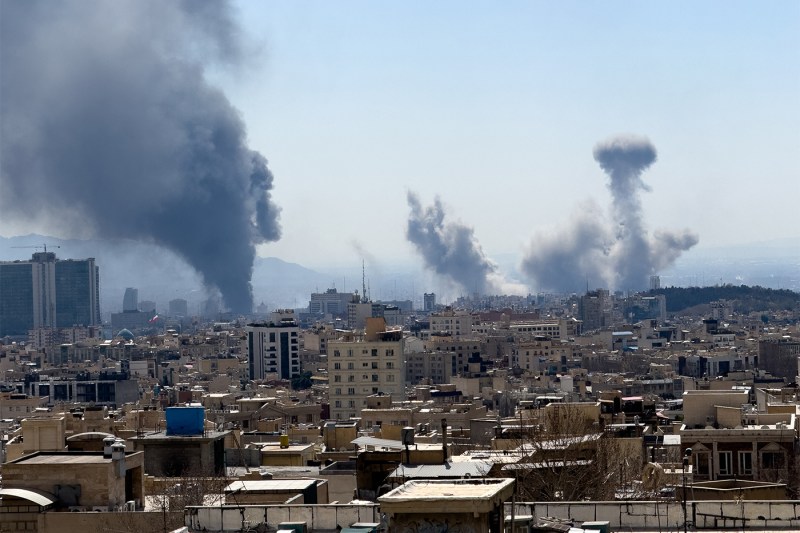

The United States and Israel have embarked on what they say could be a lengthy military campaign in Iran after unleashing strikes over the weekend that killed the country’s Supreme Leader Ayatollah Ali Khamenei and several senior military and political figures.
The escalation of attacks from both sides opens a volatile chapter of global uncertainty, raising the specter of a regional war, unbridled retaliation and broader great power entanglement that has already rattled markets sensitive to energy supply disruptions and geopolitical risk, experts say.
The spiraling hostilities also thrusts Congress into a debate over whether to rein in the president’s unchecked use of military force. The U.S. could be thrown into a constitutional crisis should lawmakers successfully pass a pending war powers resolution that could restrain Trump, the experts said.
Trump has been building up an armada of aircraft carriers, destroyers and air defense systems in the region in recent weeks as indirect nuclear talks between the U.S. and Iran over Tehran’s nuclear and missile programs, mediated by Oman, played out. Tehran has long been on a war-footing amid years of sanctions, covert strikes and simmering hostilities with the U.S. and Israel.
Northeastern Global News, in your inbox.
Sign up for NGN’s daily newsletter for news, discovery and analysis from around the world.

“Iran has been preparing for this eventuality for many, many years,” Pablo Calderon Martinez, an associate professor of politics and international relations, said of the war now underway. “They’ve been stockpiling ballistic missiles for years and years. For the Iranian regime, this is going to be a battle for survival.”
Martinez said the risk of Iranian retaliation — both through direct military confrontation and potential terrorist activity — rises in the wake of the strikes. He added that Trump’s military campaign could embolden Western adversaries and serve as a propaganda boon for extremist groups, bolstering recruitment efforts and justifying retaliatory attacks.
U.S. Central Command, a regional combatant command overseeing military operations in the Middle East, announced over the weekend that three U.S. service members were killed and five “seriously wounded” as part of the U.S.-Israeli military operation, dubbed Operation Epic Fury.
By Monday, the number of U.S. dead had increased to four. The Iranian Red Crescent, a non-governmental humanitarian organization based in Iran, reported at least 555 deaths in Iran since the strikes began.
“If the U.S. gets its nose bloodied with the Iranians creating some casualties on the U.S. side, then it’s very hard to see how you de-escalate the situation,” Martinez said.
Stephen Flynn, a professor of political science and founding director of the Global Resilience Institute at Northeastern University, said that the military operation elevates the risk that the U.S. will be less able to manage other global threats, such as Russia’s territorial ambitions in Ukraine and Europe, China’s expansionist aspirations in Asia and the ongoing danger posed by a nuclear-armed North Korea.
“This is a simple matter of logistics,” Flynn said. “As big and powerful as the U.S. military is — and it is big and powerful — it does not have bottomless capability to offset losses associated with major military operations and the possibility of an extended war in the Middle East, while also providing weapons to Ukraine and Europe.”
Flynn said that each missile launched and every air-defense system deployed further depletes an already stretched arsenal. Replacing downed aircraft or damaged ships could take years, he noted, adding that the U.S. defense industrial base was fragile even before the large-scale conventional assault on Iran began.
Everyday the fighting continues, he said, the strain on weapons stockpiles and production capacity is likely to intensify as the administration pursues Trump’s war aims.
Can Congress act to halt the war?
In the hours following Trump’s announcement of the early morning strikes, congressional Democrats and some Republicans began issuing urgent calls to convene in order to vote to curb the president’s authority, arguing that he launched the attack without congressional approval.
Even before this weekend’s escalation, members of Congress, including U.S. Reps Ro Khanna, a California Democrat, and Thomas Massie, a Kentucky Republican, were preparing to introduce a bipartisan war powers resolution to head off unilateral action by Trump in the Middle East, citing fears of another costly “endless” war that risks destabilizing the region and endangering U.S. citizens.
Dan Urman, director of the law and public policy minor at Northeastern University, who teaches courses on the Supreme Court, said the war powers resolution has never been tested on the merits in court. He added that courts “look for ways to punt and avoid lawsuits” as it pertains to the president’s use of the military.
A court could try to order a president to halt his actions, but courts do not have their own armed forces, Urman said, noting “What if Trump doesn’t comply? Then we can have a constitutional crisis.”
Is the U.S. seeking regime change in Iran?
Editor’s Picks




Martinez and other observers noted that the weekend strikes fit the long-term U.S. strategic objective of weakening and ultimately replacing Iran’s clerical leadership, even if successive administrations have stopped short of openly embracing regime change as official policy.
As for the prospect of achieving such a goal, Martinez said history teaches that Western interventions aimed at toppling foreign governments are “costly, messy and virtually impossible without boots on the ground,” he said.
In Iraq and Afghanistan, U.S.-led efforts to remake political systems after intervening to topple entrenched regimes evolved into prolonged, costly conflicts. Similar Western involvement in Libya after the fall of the country’s de facto leader Moammar Gadhafi also left a power vacuum that fueled years of instability.
But Trump and his allies have tried to paint the administration’s actions in a different light. In a speech at Mar-a-Lago on Saturday, Trump characterized the military operation as an attempt to protect U.S. “core national security interests,” arguing that Iran is the world’s leading state sponsor of terror.
He urged the Iranian Revolutionary Guards, an elite military force tasked with safeguarding the country’s clerical regime, to lay down their arms. Speaking directly to the Iranian population, Trump told the country’s citizens to “take over your government,” adding that “it will be yours to take.”


