These researchers flew a particle detector above Antarctica, hoping to find evidence of mysterious matter
Tsuguo Aramaki has spent 20 years developing a weather balloon-borne particle detector to record indirect traces of dark matter. It recently launched in Antarctica.
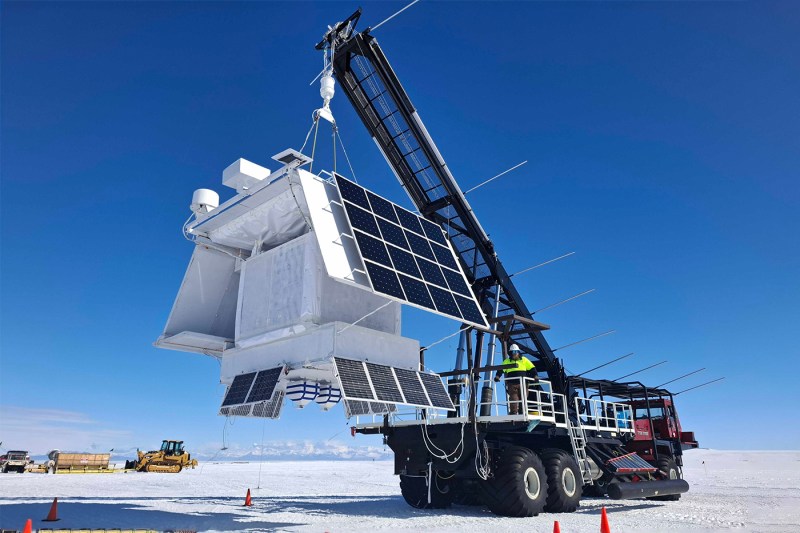

A cube, about 13 feet to a side, lifts off a sheet of Antarctic ice. It’s tethered to a huge weather balloon filled with helium. Inside that cube is a highly advanced particle detector, designed to record the presence of exotic particles (antiparticles, to be precise) that careen toward Earth from deep space.
The balloon carrying the particle detector was recently lifted into the stratosphere to search for evidence of dark matter.
This project, called the General Antiparticle Spectrometer, has been under development for over 20 years. Its results should give scientists a peek into how dark matter does — or doesn’t — function. It has taken one professor 20 years to reach this point.
Tsuguo Aramaki, assistant professor of physics at Northeastern University, says that, when he was in graduate school, he wanted to find a path that would take him between theory and experimental practice.
His work on what would eventually become the General Antiparticle Spectrometer, or GAPS, began in 2005, a difficult-to-pull-off experiment in search of particles theoretically produced by dark matter interactions.
It would take Aramaki 21 years to see GAPS fly.
GAPS’ goal is quick to describe, if complex in execution: Capture evidence of low-energy antinuclei, like antideuterons. To accomplish this, scientists need to deploy the particle detector as high in the stratosphere as possible without going into space, and because antideuterons are relatively rare, they need to keep it in the atmosphere for extended periods. To increase their odds, they also need to repeat this over multiple flights.
Northeastern Global News, in your inbox.
Sign up for NGN’s daily newsletter for news, discovery and analysis from around the world.

Hold up, what’s an antideuteron?
A deuteron, before we get to its anti-counterpart, is a kind of particle that consists of one proton and one neutron bound together. An antideuteron is a kind of antimatter, Aramaki says, which has opposite charges to the particles found in the matter that surrounds us in daily life.
The difference between matter and antimatter is stark. For instance, when protons, which carry a positive charge, encounter antiprotons with their negative charge, they annihilate one another, Aramaki continues.
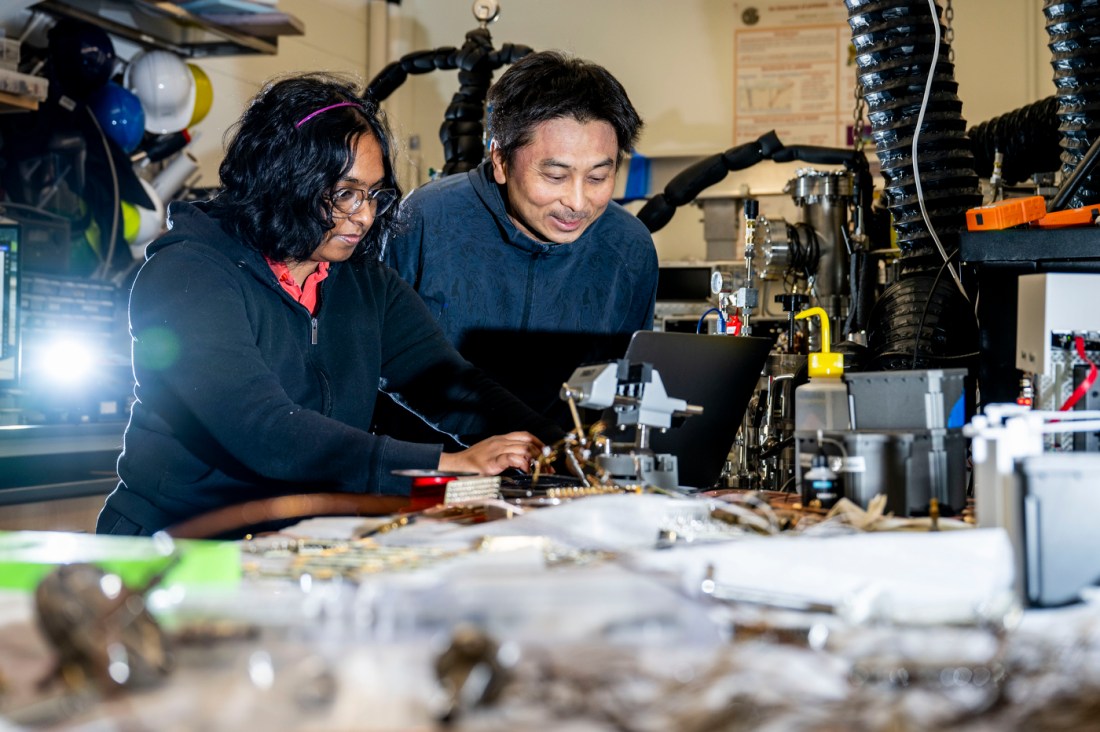

But GAPS isn’t just interested in any old antideuteron; the “low-energy” state is important, Aramaki says, because high-energy antideuterons can be formed in other astrophysical events, like supernova remnants and high-energy particle interactions. Scientists have also created antideuterons in particle colliders.
These types of antideuterons, however, are high-energy, according to Arathi Suraj, a Ph.D. student working on the project with Aramaki. High-energy antideuterons, she says, would measure in the 10s of gigaelectronvolts (GeV), a unit of a particle’s kinetic energy. The antideuterons they’re searching for, she continues, could come in at under a tenth of one GeV.
Low-energy antideuterons, scientists hypothesize, could potentially come from dark matter. When dark matter particles collide with one another, they “annihilate,” creating antideuterons that normal high-energy particles aren’t able to generate. This is the situation that scientists think could lead to the creation of low-energy antideuterons, says Jiancheng Zeng, a Ph.D. candidate involved in the project since early 2021.
This is all speculative, however, due to dark matter’s inherent strangeness. Aramaki notes that, while scientists postulate that dark matter makes up a quarter of our universe, it’s invisible and, under normal conditions, has almost no interaction with regular matter.
However, scientists know it’s out there.
“There are many phenomena indicating some invisible, missing mass should exist,” he says. “So if we detect antideuterons, that could be a clue of a property of dark matter.”
Gotta catch ‘em all
Aramaki says that there are three ways to search for dark matter: direct detection, indirect detection or collision. Often referred to as “make it, shake it, break it,” he says with a laugh.
Direct detection — the “shake it” method, alluding to a particle striking the sensor — requires a detector placed deep underground, using the Earth itself as shielding to avoid picking up stray particles.
Particle colliders, the “make it” method, fire two particles together at incredible speeds to create new particles. Antideuterons were first created in a collider in 1965.
Finally, the indirect method, “break it,” looks for so-called “daughter particles” produced through collisions in space, which is the GAPS project’s method, detecting dark matter through its effects rather than directly.
“Antiparticles are very rare,” Aramaki says. Low-energy antideuterons, however, would be a “smoking gun,” Suraj says.
Rather than detecting particles on a straight trajectory from space, GAPS uses an ingenious tool to collect them: the entire planet.
Or, rather, the planet’s geomagnetic field, Aramaki says. Enveloping the Earth a bit like a paper lantern, with “holes” at the top and bottom, the geomagnetic field catches wandering low-energy particles and antiparticles and funnels them either north or south to the poles.
This is why the GAPS project needed to launch from Antarctica, Aramaki continues, not because of FAA clearances or special weather needs, but because the Earth itself sends the particles the scientists hope to detect to the southernmost continent.
An unlikely flight
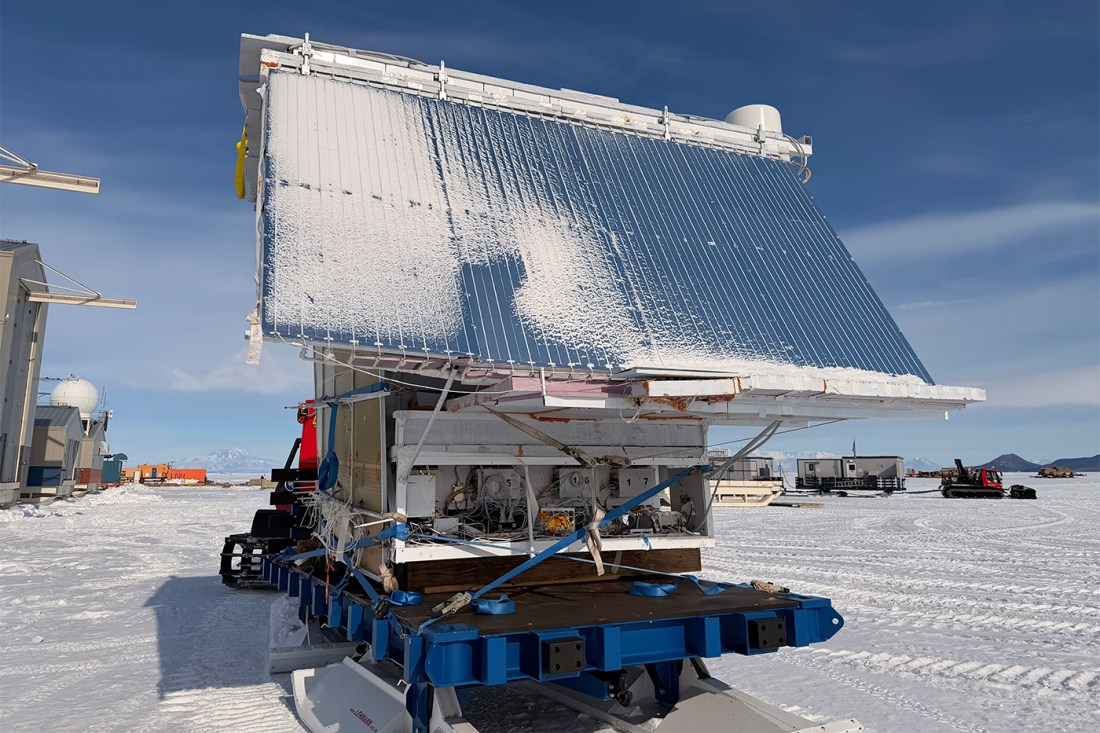
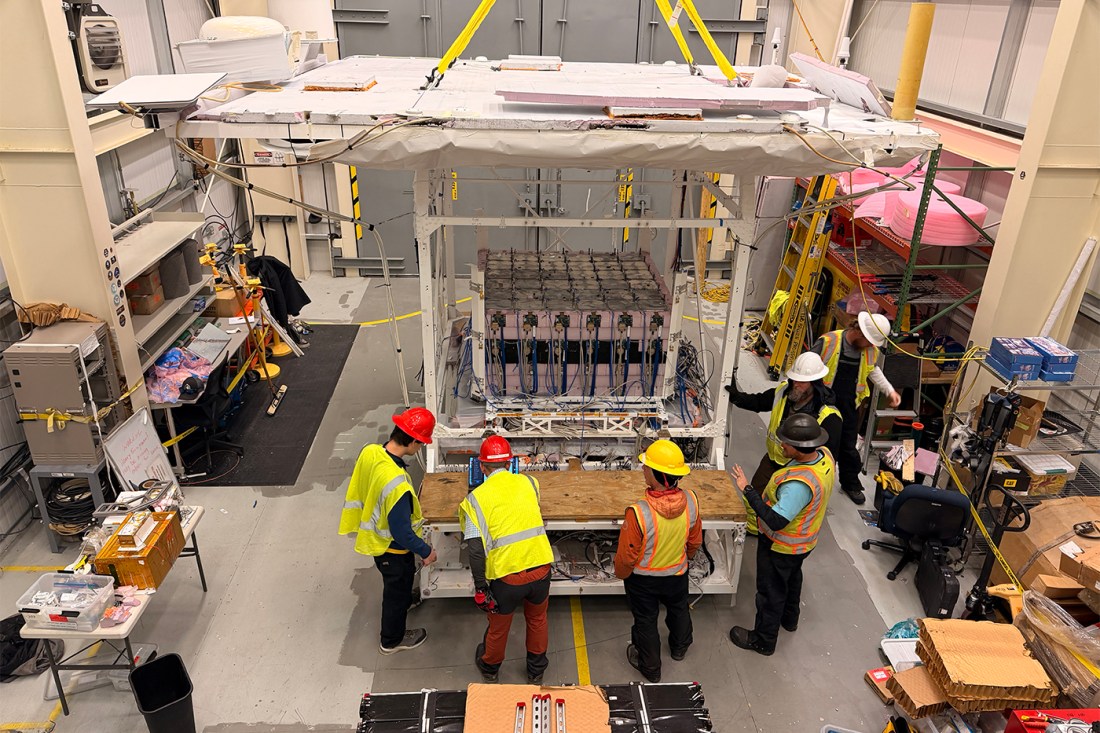
Aramaki says that their payload, carrying the detector, a solar array to power the device and an ingenious cooling system, first arrived in Antarctica in late 2024, where it waited for an open weather window.
Editor’s Picks




And waited, and waited. Aramaki says that, during that Antarctic summer, they had seven potential flight opportunities that were cancelled due to inclement weather.
Zeng, who also assembled the cooling system for the detector, says that he delayed his graduation in the hopes that the 2025-26 season would yield a successful launch window.
When the balloon launches, Aramaki says, it goes approximately 35 kilometers into the stratosphere, about 22 miles. The payload itself weighs around 3 tons. The balloon’s first flight, which launched on Dec. 16, lasted almost three weeks.
Conor Earley, a master’s degree student in physics at Northeastern, was part of the payload recovery team in Antarctica, where, he says, they put in over 12 hours a day “to get the payload disassembled, packed and arranged in shipping containers to ship overseas.”
Living in Antarctica was surreal, Earley says, with its unending sunlight during the southern hemisphere’s summer, but he also describes how rewarding it was to target “a really compelling gap in our search for new physics.”
The first step for GAPS, Aramaki says, is to detect antiprotons, one of the particles that make up antideuterons and which are far more prolific in the universe than the latter. The GAPS payload will return to the U.S. in preparation for its next Antarctic flight.
The team is still collecting data from their initial flight and will be analyzing their findings for months to come. Only time will tell if antideuterons are among their discoveries.
The collaborative endeavor included Columbia University, Oak Ridge National Laboratory, UCLA, the University of California Berkeley Space Sciences Laboratory, the University of Hawaii and international collaborators from Japan, Italy and China. The project received primary funding from NASA and several international space agencies, including the Japanese Aerospace Exploration Agency, the Italian National Institute for Nuclear Physics and the Italian Space Agency, with substantial support from the Heising-Simons Foundation and the National Science Foundation.