What is an exoplanet? An astrophysicist explains why they are vital for finding alien life
The discovery of a more Earth-like planet beyond our solar system reveals how these objects can help us “understand where we came from and whether we’re also alone,” astrophysicist Jonathan Blazek said.
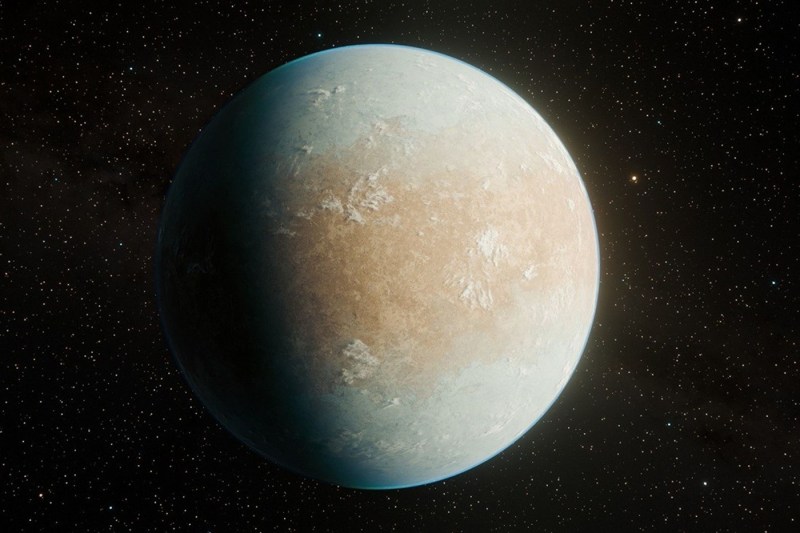

Scientists might have just found Earth’s icy, distant cousin a few hundred million light years away.
HD 137010 b is one of thousands of exoplanets, or planets that orbit other stars, and is potentially the first Earth-like one that also orbits a Sun-like star. Initially observed in 2017 with data from the National Aeronautics and Space Administration (NASA) and its Kepler Space Telescope, further details about HD 137010b came out this year.
Unlike many previously discovered exoplanets, it is also shockingly similar to Earth in terms of its size and the pattern of its orbit around its local star. Where it differs is its surface temperature: Whereas Earth tends to be, on average, closer to 60 degrees Fahrenheit, or 15.5 degrees Celsius, HD 137010 is a cool minus 90 degrees Fahrenheit, the equivalent of minus 68 degrees Celsius.
Exoplanets are valuable interstellar discoveries, researchers say, but HD 137010 could ultimately help answer some of humanity’s most profound questions, according to Jonathan Blazek, an assistant professor of physics at Northeastern University.
“Knowing that there is life not just on other planets here but [also] around other stars, that would be very, very important,” Blazek said. “We want to understand where we came from and whether we’re alone.”
Scientists have discovered 6,107 exoplanets to date, mostly in a relatively small section of the Milky Way, the galaxy that Earth and the Solar System sit in, according to NASA. The closest known exoplanet to Earth is Proxima Centauri b, which is still close to four light-years away, approximately 23.5 trillion miles or 37.8 trillion kilometers away.

Why should these distant exoplanets matter to Earthlings? There is the obvious implication that other planets could also have other forms of life. The potential discovery of an alien civilization is tantalizing, but Blazek said it’s more plausible for scientists to find “biomarkers,” signatures of more basic forms of life.
It’s more likely that the composition of an exoplanet’s atmosphere has trace elements that indicate the presence of algae rather than a sentient alien race, Blazek explained.
Exoplanets also help scientists better understand how the Solar System formed and, in turn, how life formed on Earth.
Editor’s Picks




“When we’re looking at just our solar system, it’s hard to say whether we were special or lucky or whether indeed we’re more typical,” Blazek said.
It’s still difficult to say what a typical exoplanet looks like, according to Blazek. Most of the exoplanets discovered so far are so-called hot Jupiters, large planets that are extremely hot because of their proximity to their respective stars.
Historically, it has been much easier to find large exoplanets that are close to a star, Blazek said. In what’s known as the transit method, used to discover almost 3,000 exoplanets, according to the Planetary Society, anyone using a telescope can easily identify such planets because of how they block light when passing in front of a star. Large exoplanets can even exert a little gravitational tug on their own star, which changes the velocity of a star just enough for scientists to detect it.
These kinds of exoplanets, however, are “not consistent with life as we know it,” which makes the discovery of HD 137010 even more exciting, Blazek said.
Unlike the hot Jupiters astronomers are used to finding, HD 137010 is just slightly larger than Earth and has a similar orbital period, around one year. Previously discovered exoplanets have orbits that range hours to almost 1,000 years. Its temperature is far below Earth’s because its star, although of a similar type to the Sun, is much cooler and dimmer. But this exoplanet also falls just within the edge of its star’s habitable zone, the area in a star’s orbit where a planet could have liquid water and potentially form life, according to NASA.
It’s also relatively close, intergalactically speaking: HD 137010 is around 146 light-years away from Earth. That’s just a short 858 billion mile or 1.4 quadrillion kilometer jaunt.
Even though that’s more than 36 times farther away from Earth than Proxima Centauri b, “We’re in the same town even if we’re not on the same block,” Blazek said.
Given its size, orbit and likely surface conditions, HD 137010 is an anomaly based on previously known exoplanets. But with advancements in telescopic technology and data analytics, it could mark the beginning of a new era in exoplanet discovery.
“I would expect this is not the last planet that is Earth-similar that we’re going to find soon,” Blazek said.