State of the Union 2026: Trump delivered ‘a vintage pep rally,’ but is unlikely to sway midterm voters, experts say
For nearly two hours — the longest such address on record — he alternated between praising loyal supporters, taking aim at congressional Democrats and offering a running commentary on his own record.
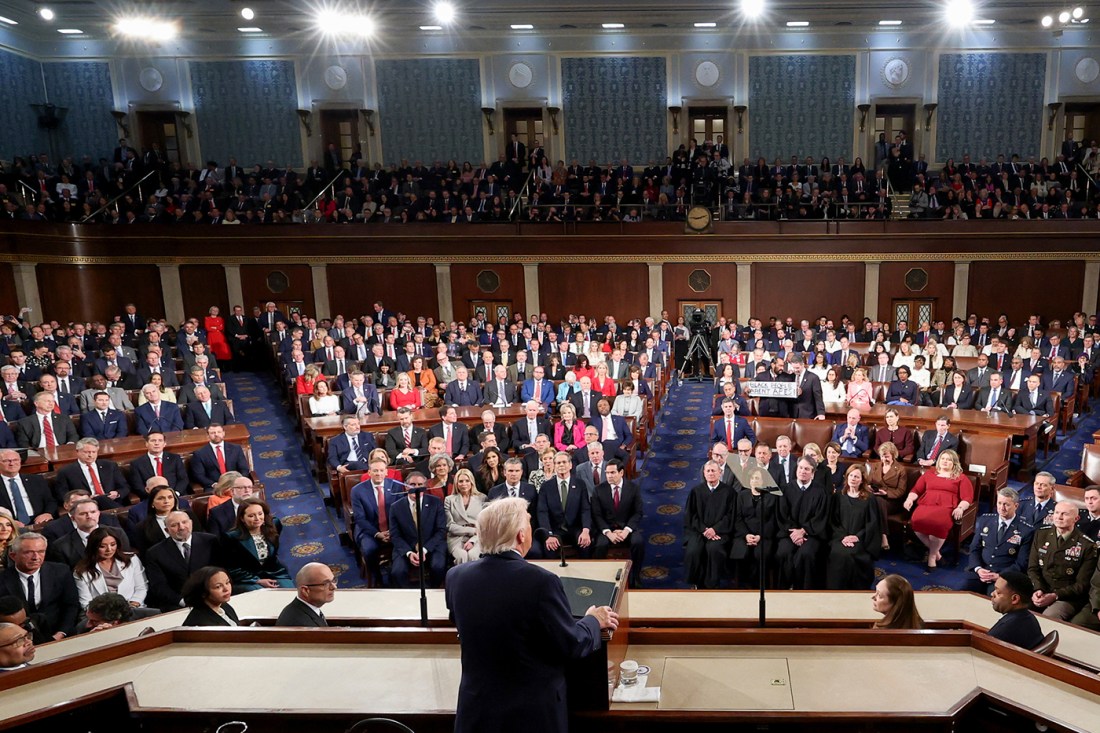

President Donald Trump, in his first State of the Union address since taking office a second time, staged a boisterous, campaign-style speech that experts said mirrored the nation’s political fault lines.
For nearly two hours — the longest such address on record — he alternated between praising loyal supporters, taking aim at congressional Democrats, and offering a running commentary on his own record. During the sprawling, often meandering address he at times nearly blew out the microphone. Republicans frequently leapt to their feet in applause, while Democrats remained largely seated, their expressions ranging from deadpan to visibly scornful.
Trump cast his first year back in office as an economic renaissance, boasting that inflation was “plummeting.” He touted sweeping tax cuts, new tariffs and what he described as trillions of dollars in fresh investment commitments as evidence of a “roaring” economy — though fact-checkers highlighted that several of his claims were overstated or mischaracterized.
Costas Panagopoulos, distinguished professor of political science, called the evening a “vintage Trump pep rally, playing fast and loose with the facts.”
“These claims will likely fall flat for many Americans for whom there is a major disconnect between what the president is saying and what they’re feeling every day,” Panagopoulos said.
Tuesday’s speech, which was set to focus on affordability and the economy, comes at a delicate moment at home and abroad for the U.S. president. On the domestic front, Trump’s approval rating has fallen to its lowest level since taking office. Meanwhile, his foreign policy agenda has sought to disrupt the international world order, diminishing ties with European allies and cooling on the North Atlantic Treaty Organization, NATO, and embracing strongman-style diplomacy.
Tensions between the U.S. and Iran continue to simmer, with the administration repositioning military assets in the region amid warnings of potential escalation. The postering comes as a partial government shutdown, now in its second week, sidelines some federal employees and halts certain government services.
At points, the evening, which took place just two days after the end of the 2026 Winter Games, included a mix of tributes to a hero in the July 2025 floods that ravaged parts of central Texas and claimed more than 130 lives, the U.S. men’s hockey team, and others.
U.S. Rep. Al Green, of Texas, was swiftly escorted out of the chamber after holding up a sign reading, “Black People Aren’t Apes.” As he was led out, chants of “USA” rang out across the chamber.
At about the 30-minute mark, players from the gold medal-winning Olympic hockey team filed into the press gallery overlooking the president’s seat, drawing a sweeping standing ovation.
Throughout his address, the president chastised congressional Democrats for not standing and applauding. At one point, he pointed to their section and said: “These people are crazy.”
Gradually, some Democrats got up and left the chambers. All the while, the president doled out several congressional medals of honor.
“It’s hard to reconcile calling a group of people crazy in one breath, and then asking them to work with the GOP to pass bipartisan legislation in the next,” Panagopoulos said.
Nick Beauchamp, an associate professor of political science at Northeastern University, described the speech “as a loosely connected sequence of personal stories, dozens of which involved grotesque descriptions of war and violence, and most ending with medals.”
Editor’s Picks




“It was lurid and hateful and had even less policy content than his 2025 speech,” Beauchamp said.
As expected, Trump spurned Friday’s tariff decision in front of the four Supreme Court justices in attendance, adding that he will continue to pursue the taxes on imports — and that “congressional action won’t be necessary.”
The justices — John Roberts, Brett Kavanaugh, Amy Coney Barrett and Elena Kagan — sat stone-faced.
“Trump called the decision ‘unfortunate,’” said Jeremy R. Paul, a professor of law and former dean of the Northeastern University School of Law, adding that the comment is “somewhat measured” and was reminiscent of former President Barack Obama’s criticism of the Citizens United decision, a landmark ruling pertaining to campaign finance laws, during his 2010 State of the Union address.
It had been an eventful first year of Trump’s second term. Upon taking office on Jan. 20, 2025, the president immediately implemented his tariff policy, unleashing a sweeping set of import levies that rippled through the global economy before financial markets and trading partners began adjusting to the new reality. With Friday’s ruling, uncertainty over Trump’s tariff regime and its effects persist, though the president has vowed to find new legal methods to continue pushing the tariffs through.
Trump’s foreign policy agenda took the form of what some experts describe as extrajudicial targeting of alleged drug-trafficking vessels in the Caribbean, renewed threats to annex or otherwise assert control over Greenland, and a dramatic nighttime raid in the Venezuelan capital of Caracas that resulted in the capture and arrest of the country’s leader, Nicolás Maduro.
Then came the administration’s deployment of Immigration and Customs Enforcement, or ICE, officers in Minneapolis and the wider Minnesota area in recent months, leading to the officer‑involved killings of Minnesota residents Renée Good and Alex Pretti in two separate incidents. Both were U.S. citizens.
Overall, the administration had hoped to strike an optimistic tone Tuesday amid what it characterizes as a robust economy powered by AI investments, even as many Americans continue to struggle with rising everyday costs, including housing, health care and child care.
Instead, the president came off “as divisive as ever,” Panagopoulos said.
Trump made a series of claims that have been challenged by fact-checkers. He repeated his assertion that he had implemented “no tax on Social Security,” though his signature domestic policy law — the One Big Beautiful Bill Act — did not eliminate income taxes on those benefits.
He also claimed to have secured more than $18 trillion in new investment commitments in a single year — a figure that exceeds even the White House’s own tally. And he described last year’s tax package as “the largest tax cuts in American history,” though independent analyses rank it the sixth-largest as a share of the economy.
Trump’s approval rating had been sagging coming into Tuesday’s speech. Fewer than four in 10 Americans — 39% — say they approve of Trump’s performance in office, according to a Washington Post-ABC News-Ipsos survey released Sunday. Nearly half of respondents, roughly 47%, said they “strongly disapprove” of the way he is handling the presidency.
Even on issues that have long been political strengths for him, Trump appears to be losing ground. An Economist/YouGov poll released this month showed that just 37% of Americans said they approve of Trump’s job performance, compared with 56% who disapprove.
While immigration remains one of his strongest issues, approval of his handling of it has fallen to a record low. Only 40% of Americans approve of how Trump is handling immigration, compared to 53% who disapprove, according to the Economist/YouGov poll.
Women who suffered abuse at the hands of convicted sex offender Jeffrey Epstein held a press conference before the speech to bring attention to ongoing efforts at achieving transparency and accountability for those they believe committed wrongdoings through revelations in the Epstein files.
Some congressional Democrats, such as U.S. Reps. Jamie Raskin, of Maryland, and Robert Garcia, of California, used the occasion to help highlight the stories of the victims amid what they and others describe as inaction on the part of the Department of Justice and the administration to bring potential abusers to account. Trump did not mention the Epstein files.
Virginia Gov. Abigail Spanberger delivered the Democratic rebuttal, arguing that the president “lied, scapegoated and distracted” throughout his speech.
“He offered no real solutions to our nation’s pressing challenges, so many of which he is actively making worse,” she said. “He tries to divide us. He tries to enrage us, to pit us against one another, neighbor against neighbor.”