After hitting the 50,000 milestone, how quickly can the Dow reach 100,000?
Since 1900, it has taken an average of 2,804 trading days, or just over 11 years, for the Dow Jones Industrial Average to double.
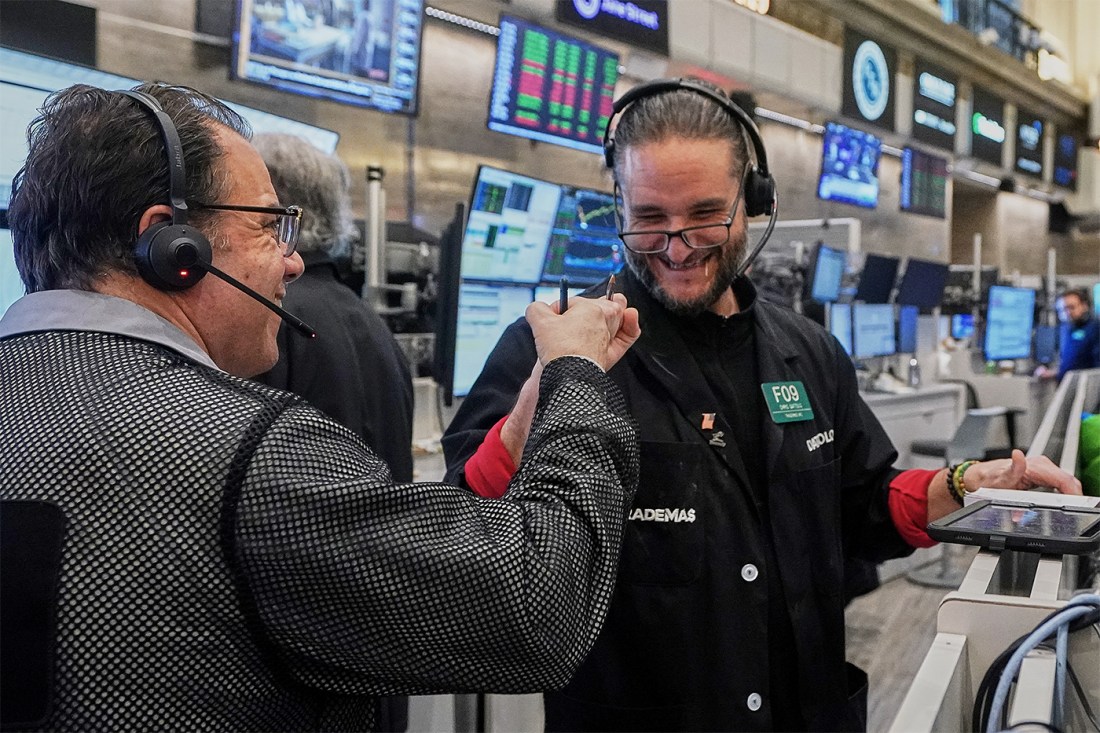

The Dow Jones Industrial Average hit a record of 50,000 points this month. President Donald Trump said another milestone would come soon.
The blue chip index plunged to about 6,600 during the recession in early March 2009, but has been steadily climbing since. In 2018, the Dow, which measures the performance of 30 large, publicly owned U.S. companies, hit 25,000 for the first time. Now, nearly eight years later, it has reached a new milestone, and the president is forecasting faster growth over the next four years.
“I am predicting 100,000 on the DOW by the end of my Term,” the president posted on his social media site Truth Social. “REMEMBER, TRUMP WAS RIGHT ABOUT EVERYTHING!”
Not so fast, Northeastern University economists said.
“Four years to 2030 and 100,000 seems unlikely,” said David H. Myers, associate teaching professor and director of the Business Sustainability Initiative at Northeastern.
Da Huang, assistant professor of finance at Northeastern, said that even the most transformative industries of the past decades couldn’t double the Dow in the time period Trump outlined.
“Neither the proliferation of the internet since 2000 nor the AI rush since 2016 was strong enough to push the Dow to double within the period that equals where we are today to the end of Trump’s second term,” Huang said.
The Dow rose 1,206.95 points, or 2.47% on Friday, Feb. 6, to surpass the 50,000-point milestone and close at a record 50,115.67 points.
Two days later, Trump credited his tariffs with the market’s surge, and predicted a doubling of the blue-chip index by 2029.
But the stock market is fickle.
On Friday, Feb. 20, the Supreme Court struck down Trump’s tariffs as unconstitutional. Trump responded by announcing a new 10% global tariff, and then a 15% global tariff.
The Dow Jones sank 1.7% on Monday, the next trading day.
Myers said that the ruling and reaction increases uncertainty and risk, corresponding to a fall in prices.
Huang added that any drop in prices makes the 100,000 goal more challenging.
Editor’s Picks




Might Tuesday evening’s State of the Union speech provide an opportunity to jolt the market?
Trump may use the speech to announce new tariff policies, Huang acknowledged, “in which case, that may cause a meaningful reaction in the Dow” even though the State of the Union speech is usually highly scripted and rarely contains economic policies that aren’t already anticipated by the market, he added.
“As far as the historical patterns go, we usually don’t see significant reactions in the Dow to the State of the Union speech,” Huang said.
Instead, time is the major factor for the Dow to double by 2030.
Huang said that, since 1900, it has taken an average of 2,804 trading days (just over 11 years) for the Dow to double. That average has decreased when looking at smaller and more recent time periods – Huang counted an average of 1,808 trading days for the Dow’s doubling in the last decade, for instance.
Huang said that there are about 740 trading days to achieve the 100,000 milestone.
That being said, both Huang and Myers noted that the Dow has doubled in fewer than 740 days before.
That was between the lows of the Asian Financial Crisis in July/August 1997 to the near-peak of the dot-com bubble in May 1999.
“If history is any indication, I am not sure that it is such a good thing even if the Dow actually doubles this fast,” Huang said. “Because what followed last time was the burst of the bubble.”