What different shaped skis do and do not influence
Physicist Stefan Kautsch said ski shape is all about providing a stable platform to best maneuver over the snow.
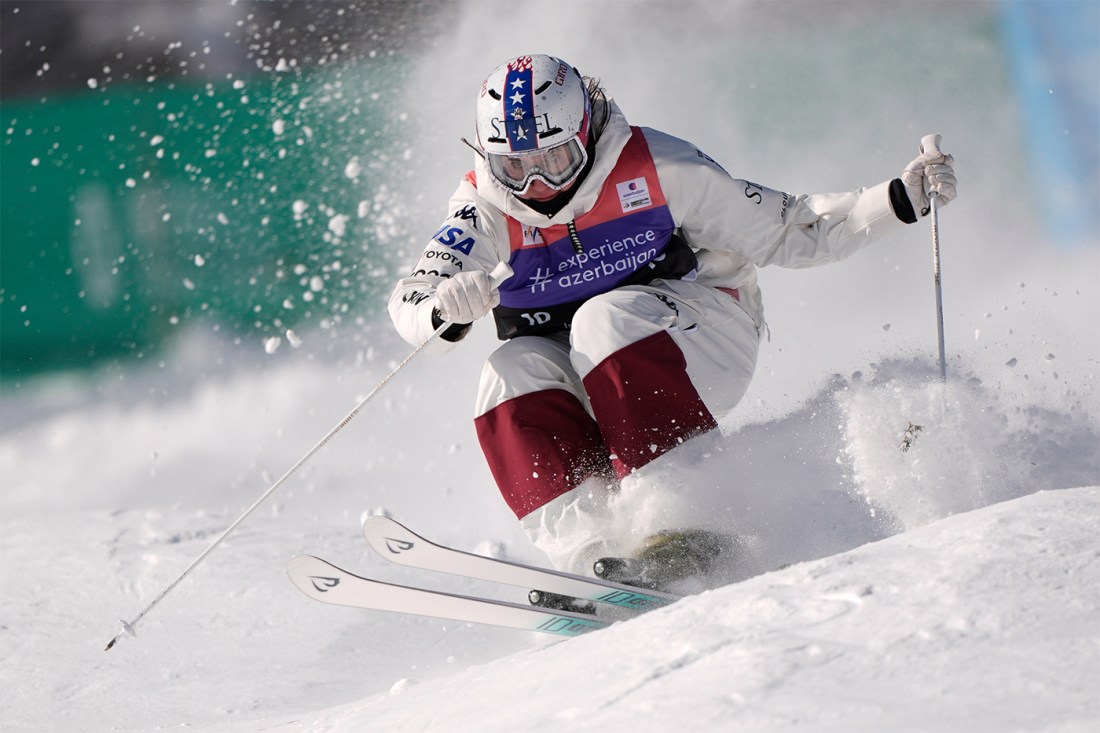

From the biathlon to the slopestyle to the giant slalom, raising a ski above your head after crossing the finish line is the triumphant Olympic skier’s standard celebration.
But why do the skis of the competitors in each event look so different?
Northeastern University physicist Stefan Kautsch said ski shape is all about providing a stable platform that can best maneuver over the snow-covered terrain and not — as many might think — about speed.
“The shape determines stability and the maneuverability of the ski,” said Kautsch, teaching professor and education and public outreach manager in the university’s physics department.
Kautsch, who earned his Ph.D. in physics, explains that skiing at its most fundamental involves getting from point to point while maintaining contact with the snow. Usually — with the exception of certain aerial events — it’s also the faster the better, he adds.
In addition, as the mantra goes: “Records are meant to be broken.”
While variability in racecourse length and snow conditions make time comparisons difficult, the gold medalist in the 1964 Olympic downhill event would have been beaten by the entire 47-person field who competed in the Sochi Olympics 50 years later. In fact, the winning time in Sochi was 12 seconds faster than in 1964.
Ski shape has also changed significantly since 1964.
Snowboards, sidecuts, shaped skis, rockers, dual-tips — all entered into the mountain-sports lexicon over the years as skiers and riders demand equipment that offers greater maneuverability, responsiveness to snow conditions, and even flexibility to perform certain types of skiing — for example, moguls and slopestyle.
And even among alpine ski events, ski shape varies.
A ski racer uses longer, straighter skis for the long wide turns on a super giant slalom, or super-G event, compared with the short, more shapely skis that he or she will use in a slalom course where quick, short turns are required.

But speed on a slope such as a snowy mountain depends on friction.
“It’s all about the friction,” Kautsch said. “The lower the friction coefficient is, the faster the person can go.”
Editor’s Picks


So wouldn’t skis that are shaped wider and have more contact with the snow, thus creating more friction, move at a different speed than those with less contact? Wouldn’t more surface area mean more friction and slower speeds?
Kautsch set up an experiment in an introductory physics lab in Churchill Hall on Boston’s Northeastern campus recently to see.
He placed differently sized Lego blocks at the top of an inclined wooden board and released them simultaneously. They reached the bottom at the same time.
He repeated the experiment on a smoother plastic surface. Again, the blocks reached the bottom at the same time — the only difference is they all slid a little more quickly.
“Simply, the smoother the material is, the less granulated the surfaces, the lower the friction coefficient is and the faster the person can go,” Kautsch said, noting that skiers use different waxes on the bottom of their skis or snowboards according to different snow conditions in order to increase that smoothness.
Of course, ski racers Mikaela Shiffrin and snowboarder Shaun White won’t have the exact same time in a head-to-head race.
But that’s because of their different athleticism, course conditions, and many, many minute, split-second decisions they make as they travel down a course — not because one is on skis and the other is on a snowboard.