Will the Winter Olympics run out of snow?
Because of climate change, organizers will have to be careful about future venues and host events at locations of various altitudes, experts say.

When the Winter Olympics kicked off in 1924, Chamonix, France, had the glacial temperatures and heavy snowfall needed to host the Games.
In fact, just weeks before the games kicked off, a massive snowstorm brought more than 5.6 feet of snow in 24 hours, requiring crews to urgently shovel out the area to ensure the Games could still take place.
But in the coming decades, Chamonix will likely be one of many former host cities unable to host the Winter Olympics ever again because rising global temperatures are reducing the amount of snowfall, according to climate scientists.
The evidence is in the data.
The average snow depth in the European Alps, for example, has fallen 8.4% per decade since the 1970s, according to a report from the European Geosciences Union, a nonprofit organization based in Munich, Germany, that conducts climate science research.
In fact, only 52 out of the 93 cities and regions that currently have the infrastructure to host the Winter Games and Paralympic Games will “remain climate reliable” by the 2050s, according to a study commissioned by the International Olympic Committee.
Samuel Muñoz, a Northeastern University professor in the Department of Marine and Environmental Studies and the Department of Civil and Environmental Engineering, said these changes are just the latest example of climate change’s impact on society.
But “it’s useful to connect climate change to something tangible in people’s lives, like winter sports and activities, including the Olympics,” said Muñoz.

Changes to our planet “can sometimes feel abstract,” he said. People may not understand what climate scientists are talking about when they warn about the Earth’s overall temperature rising.
“But discussing climate change in terms of something like winter sports, with direct personal or economic implications, can help to ground the issue for people,” he said.
Climate change skeptics have long denounced the existence of global warming. In Italy, Matteo Salvani, the country’s deputy prime minister, has argued that the melting alps “are a natural recurring phenomenon.”
Editor’s Picks





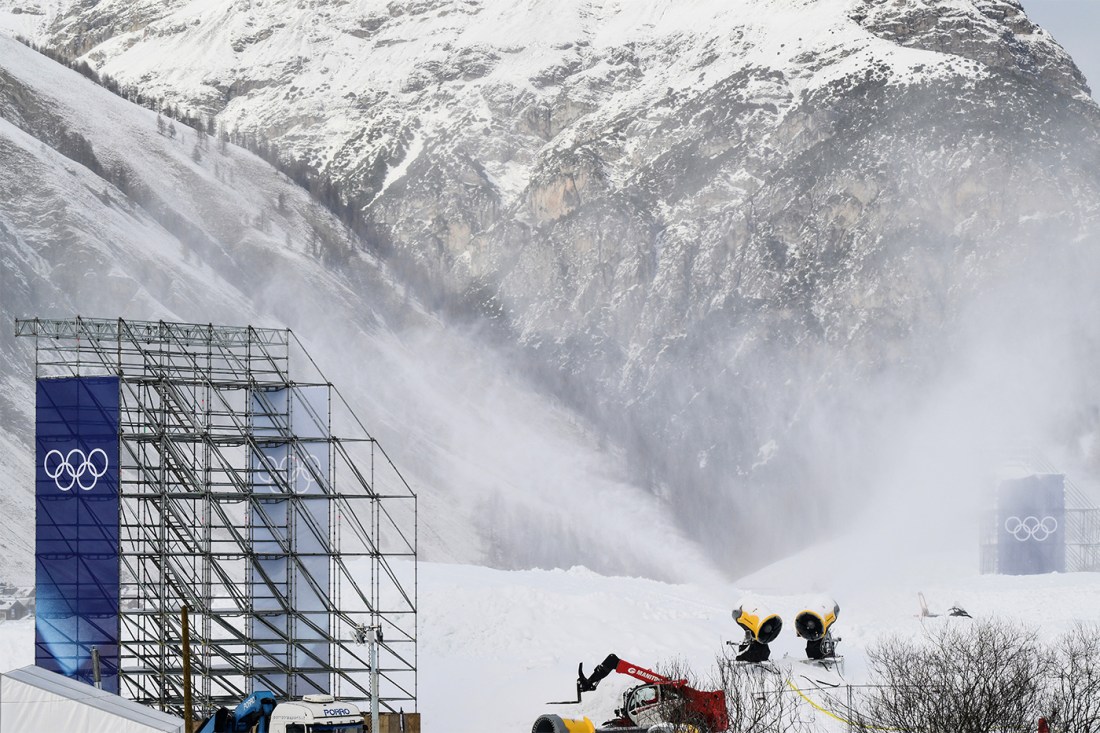
But during this year’s Winter Olympics, which is being held in Milan and Cortina d’Ampezzo, Italy, organizers are using about 2.4 million cubic meters of artificial snow and are hosting several events in the high altitude and alpine regions of Bormio and Livigno, which are more resistant to the effects of climate change, according to the Milano Cortina 2026 Foundation, the organizing body of this year’s Winter Olympics.
But what exactly is causing a drop in snowfall?
“The type of precipitation that occurs – snow or rain — has to do with the air temperature between the clouds and the ground surface,” Muñoz said.
As Earth’s atmosphere gets warmer as a result of greenhouse gases, it’s more likely that we will see more rain than snow, he said.
“This does not mean that it will never snow, just that it’s more likely that precipitation will be rain instead of snow,” he said.
Earth’s temperatures are expected to increase in the years to come, explained Auroop Ganguly, a Northeastern professor in the Department of Civil and Environmental Engineering.
According to the National Oceanic and Atmospheric Administration, 2025 was the third warmest year on record, with annual global surface temperature 2.11°F (1.17°C) above the 20th century average.
A 2025 Emissions Gap Report from the United Nations Environment Programme notes that current global projections put the Earth’s overall temperature rising “as much as 2.8 °C by 2100.”
As a result, the number of cities that will be able to host the Winter Games will continue to shrink.
So what is the best move for organizations in the near future? They’ll have to be more careful about future venues, host the games at multiple locations of various altitudes, and potentially start earlier in the year, experts say.
“It may mean we have to go even further north, maybe some places in Scandinavia, places in Russia,” said Ganguly. “Those may work together with some artificial snow.”
Ideally, larger systemic changes should be put in place to prevent the situation from getting worse, including through the adoption of more renewable energy sources, reducing our burning of fossil fuels, and cutting down on deforestation, he added.
“But we will just have to be prepared for these scenarios that are already happening but may exacerbate,” he said. “We’ll see this more and more over the years.”