‘Let us help you.’ How Undergraduate Research and Fellowships advisers help students find purpose and pathways to impact
The Undergraduate Research and Fellowships office helps Northeastern students turn interests into research, awards and meaningful career paths.

Leah Fitzpayne knew early that she wanted to dedicate her life to public service. She grew up in Washington, D.C., where both of her parents worked as public servants.
When she was in eighth grade, her father was diagnosed with Stage 4 lung cancer. That experience sparked her interest in health policy and serving people facing similar hardships.
“In my opinion, the best way to do that was through government,” said Fitzpayne, now a senior at Northeastern University studying political science and law and public policy.
When Fitzpayne learned about the Truman Scholarship, one of the nation’s most prestigious graduate fellowships for students pursuing careers in public service, she knew she wanted to apply. So she reached out to Northeastern’s Undergraduate Research and Fellowships office for guidance.
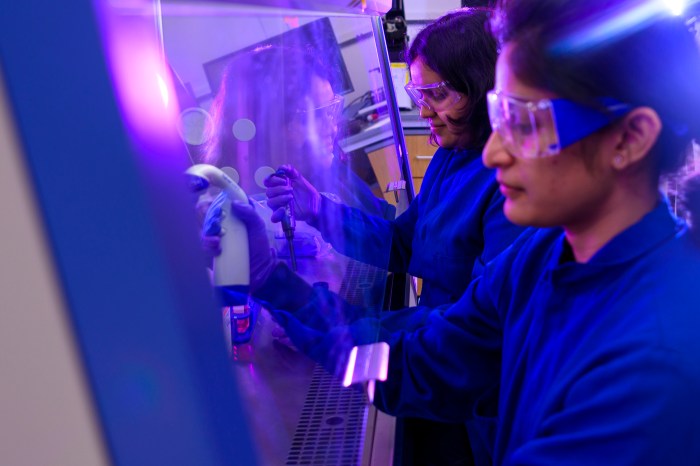
The Undergraduate Research and Fellowships office guides and supports students interested in engaging in research and creative projects, from connecting with mentors and securing funding to sharing their work. Advisers help students from any Northeastern campus identify and apply for appropriate fellowships for advanced study in the United States and abroad.
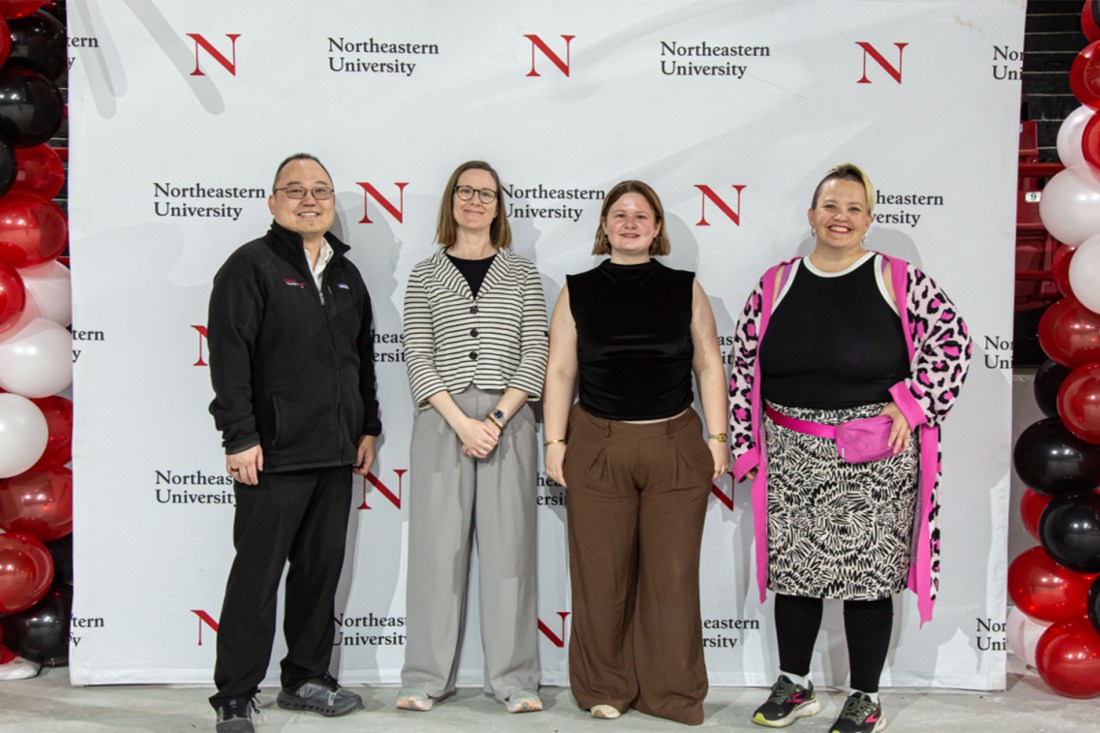
Anne Moore, director of Undergraduate Research and Fellowships, said the office’s core mission is to expand access to opportunities for students as much as possible.
“We offer support to help students frame their interests and experiences in ways that are going to be legible to funders,” she said. “But we also help them identify for themselves what are the things that make the most sense for them to do, so they can be making the mark on the world that they want to make.”
Fellowships and scholarships
Research experience, co-ops and public service work help students clarify their long-term goals, Moore said.
She advises students to reflect on their interests and the impact they want to have, then seek ways to engage with those interests through student organizations or independent research.
“Part of what we do is try to help students identify the opportunities that are going to be a really good fit for their experience,” Moore said.
Highly competitive awards such as the Truman, Rhodes and Knight-Hennessy scholarships have rigorous selection processes, Moore said, but grades alone do not determine eligibility for other opportunities. Commitment to public service, leadership experience and academic performance in relevant fields often matter more than overall GPA.
“Northeastern students are uniquely prepared to really do well with fellowships because they have so much experience outside of the college setting,” Moore said.
By the time Fitzpayne connected with Undergraduate Research and Fellowships, she had built a strong record of public service. In high school, she interned with the Lung Cancer Action Network. Since enrolling at Northeastern, Fitzpayne has interned in the U.S. Senate and the Department of Veterans Affairs, worked for the Office of Massachusetts Gov. Maura Healey and U.S. Rep. Katherine Clark, and completed a co-op with the U.S. attorney’s office for the Southern District of New York.
She began working on her Truman application in October of her junior year. The Undergraduate Research and Fellowships office helped her secure a nomination from Northeastern and refine her materials.
In February, she was named a finalist and began preparing for the final interview stage.
Undergraduate research opportunities
The Undergraduate Research and Fellowships office introduces students to programs such as Project-Based Exploration for the Advancement of Knowledge Fellowships, or PEAK.
“A PEAK fellowship is a common on-ramp to awards,” Moore said.
Programs like PEAK help students explore whether graduate study and academic research align with their interests and career goals, Moore said. PEAK offers multiple funding levels for starting, intermediate and advanced student researchers.
Northeastern undergraduates frequently present their findings at conferences, publish in scholarly journals and share their work at the university’s annual Research, Innovation, and Scholarship Expo, known as RISE.
How to get started
Not all students arrive knowing what research they want to pursue or which scholarships to target.
“If a student gets referred to me by a faculty member, we’ll often start to talk about what research or leadership opportunities are available to them or how they can think about connections between their existing experiences and their academic life,” Moore said.
She encourages students to pay attention to where their energy naturally goes and where their interests, skills and values overlap.
“It’s that sweet spot,” Moore said. “That’s where you start to win things.”
For example, a student interested in environmental justice with strong coding skills can look into research opportunities on decay of coral reefs, where their computer science skills would come in handy.
Editor’s Picks


Not everyone wins, and that’s OK
Although Fitzpayne did not receive the Truman Scholarship, she said the application process was well worth the effort.
“You really had to be able to articulate what the next five to even 10 years of your professional life could look like,” she said. “That exercise was really important for me, especially now that I’m about to graduate.”
She also valued meeting other like-minded finalists committed to public service.
“I’m excited to keep in touch with them,” Fitzpayne said.
Moore said she never guarantees students will win a nationally competitive award, but she sees lasting value in the application process.
“There’s a profound pedagogical value in the act of applying because what you have to do in those applications is explain to someone why what you’re doing matters to you, why it matters to the world, and why you’re the person who’s best prepared to do it,” she said. “If you can articulate those things, even if you don’t want a Fulbright, I bet you’ll have a much better chance of getting into grad school or getting a good job.”
She encourages students not to disqualify themselves prematurely.
“Don’t decide ahead of time that you’re not competitive,” Moore said. “Let us help you figure out what you’re competitive for.”