As wars drag on in Ukraine and Gaza, tallying up the dead becomes a delicate, difficult task
War inevitably exacts a toll in human lives. But quantifying loss has become one of the most contested and consequential questions in many of today’s conflicts.
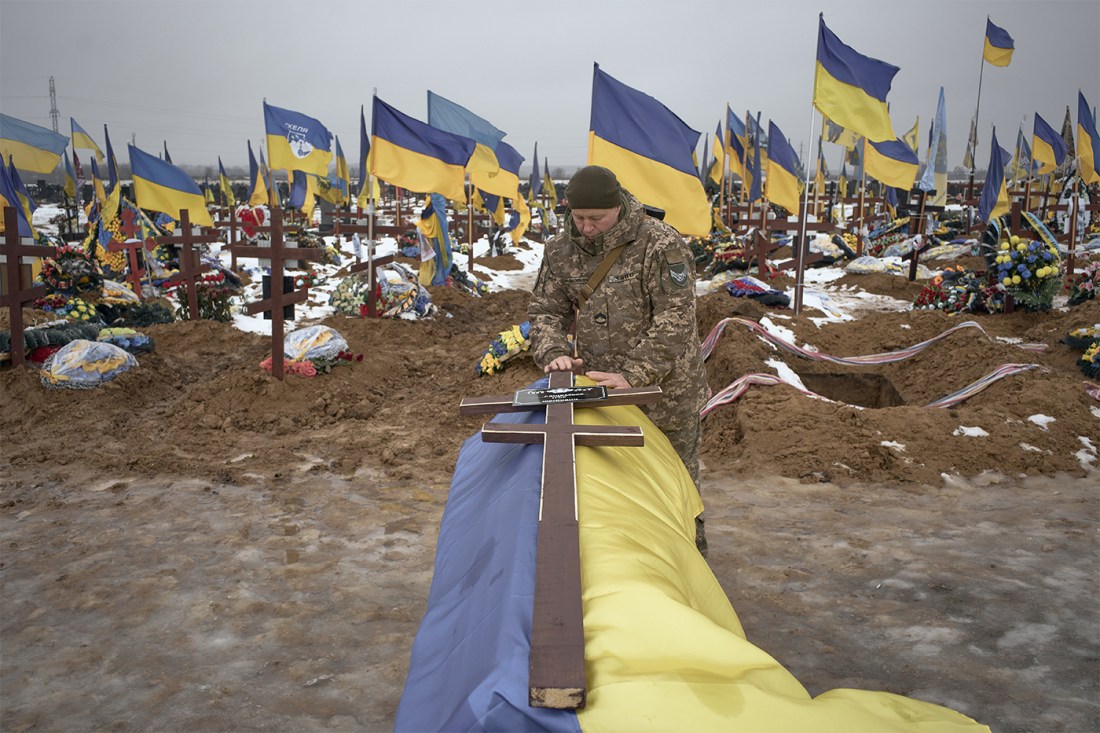

War inevitably exacts a toll in human lives. But quantifying loss amid new technologies, vast streams of data and competing online narratives has become one of the most contested and consequential questions in many of today’s conflicts.
From Ukraine to Gaza, governments, armed groups, independent analysts and newsrooms around the world are wrestling for control over those narratives: whose statistics are credible, and how to frame the sheer scale of human loss in an information environment swarming with bad actors, Northeastern University experts say.
“In many ways, war statistics are a battleground themselves in the information space,” said John Wihbey, an associate professor of journalism at Northeastern University and co-founder of the Internet Democracy Initiative.
Take the war in Ukraine, for example. Russian authorities have released almost no official casualty figures since September 2022, when the Kremlin reported roughly 6,000 of its troops had been killed. By contrast, Ukraine and think tanks such as The Center for Strategic and International Studies, estimate Russian losses at over 1.2 million, including up to 325,000 deaths, while Ukrainian military casualties total around 600,000, with roughly 140,000 killed.
Determining how many people have been killed in a war depends less on any single source than on what reliable information is available at a given moment, said Alexandra (Xander) Meise, an associate teaching professor in the School of Law at Northeastern.
Sources can vary widely depending on the nature and location of the conflict, the availability of photographic evidence and identification records, the existence and condition of human remains, the presence of survivors or other witnesses, and even geological factors, such as access to sites and weather conditions, Meise said.
Looking at past wars, experts say deaths are more often undercounted, particularly in the earlier stages of conflict. That pattern applies both to “direct” combat deaths and to “indirect” fatalities, such as those caused by displacement, hunger, disease or the collapse of infrastructure, Meise said.
After the conclusion of the Iraq War, for example, the U.S. military noted that there had been upwards of 77,000 civilian deaths. But in 2006, a study in the journal Lancet had already estimated that there had been more than 600,000 excess deaths — roughly 2.5% of the population studied — most from indirect causes like disease and disrupted infrastructure.
Editor’s Picks





Variations between government figures and estimates produced by humanitarian organizations or independent researchers often reflect differences in access, methodology, reporting or evidentiary thresholds and various institutional incentives, Meise said.
Indeed, Wihbey and Meise both noted that underlying motivation matters when evaluating casualty reports, especially given that information moves instantly without the traditional gatekeeping. Social media, Wihbey said, has intensified the pressure on governments and other actors to establish their version of events early and repeatedly, even as verification lags behind.
“Governments, non-state actors and civil society groups understand that cementing their narrative on social media is incredibly important, so they invest a lot of effort in reinforcing their particular point of view on statistics,” Wihbey said.
And, for human rights groups, aid workers and those civil society groups, those tallies are “incredibly important because they help dramatize and draw attention to places that need aid,” he said.
But, if the goal is legal accountability, such as for future war crimes prosecutions, then casualty figures must be supported by evidence that can withstand judicial scrutiny, according to Meise. “That is a very rigorous standard to meet,” she said. “It may not be possible in the short term, if ever.”
Those tensions — between rigor, access and motivation — are playing out in real time in Ukraine, where official claims, independent estimates and outside analysis often diverge sharply.
Both sides have been known to peddle propaganda to bolster their own military position, analysts who track the conflict have said.
Speaking at the World Economic Forum in January, Ukrainian President Volodymyr Zelenskyy claimed that Russian losses, more recently, “are the biggest they’ve ever had,” with some 35,000 Russian soldiers dying every month. He added that around this time last year, those casualties stood at about 14,000 per month.
“Russia is not thinking about it, but we think about it,” said Zelenskyy, who attributed the military successes he characterized at the meeting to Ukraine’s innovative use of drone technology.
On Wednesday, the Ukrainian president told the French television broadcaster France 2 that some 55,000 Ukrainian soldiers had been killed on the battlefield in the four years of war with Russia.
For its part, the Kremlin has kept statistics about its own losses largely secret, focusing instead, in speeches given by Vladimir Putin and other interviews with Russian officials, on losses incurred by Ukraine. The Russian state news agency TASS said in December that it estimates Ukrainian army losses at around 1.5 million people killed and wounded since the war began. There’s no way to determine how the news outlet arrived at that figure.
That has meant that organizations that track wartime developments, such as Russia Matters, an academic research outfit that issues monthly reports on the war, and Institute for the Study of War, a nonprofit public policy research organization, for example, have to rely on sometimes wildly different figures to provide a window into the conflict.
Other outfits, such as the Ukraine War Losses Project, use data aggregation to produce their own estimates, compiling and cross-referencing information from obituaries, funereal announcements and official records to generate a live tally, which is publicized and updated periodically on their website. The project pulls from a variety of public sources on either side of the conflict, including Russian social media platforms and networks, such as VKontakte, or VK, and Odnoklassniki, in addition to independent Russian media outlets.
The nearly 1.2 million Russian casualties, including “killed, wounded or missing,” cited by the Center for Strategic and International Studies, is the highest figure sustained by any major power since World War II, according to the think tank’s report.
The center did not elaborate on its own methodology for its estimates, but acknowledged that coming up with an authoritative tally is “difficult and imprecise.” To arrive at their own figures, its experts cobbled together data from a variety of sources, including the UK Ministry of Defense, Russian news outlet Mediazona, the BBC Russian Service and interviews with “U.S., European, Ukrainian and other government officials.”
The report also noted that Putin has been engaged in “an aggressive disinformation campaign” in order to shore up support for the Russian cause — and convince foreign observers and policymakers that a “Russian victory is inevitable.”
In a conflict such as the war in Gaza, experts said the challenges of quantifying casualties is compounded by restricted access for reporters, the absence of independent civilian agencies that normally record deaths and the sheer scale and density of urban destruction.
Official tallies of the dead in Gaza are reported by the Gaza Health Ministry, whose figures have become the primary source for international media reporting on the war. At last check, Gaza’s health ministry said that about 70,000 people have been killed during Israel’s war in Gaza — a figure Israeli military officials appear to accept, according to multiple news outlets.