Her path to political activism was forged by a literature class
An English literature student secures results on contaminated land after being inspired by Northeastern course.
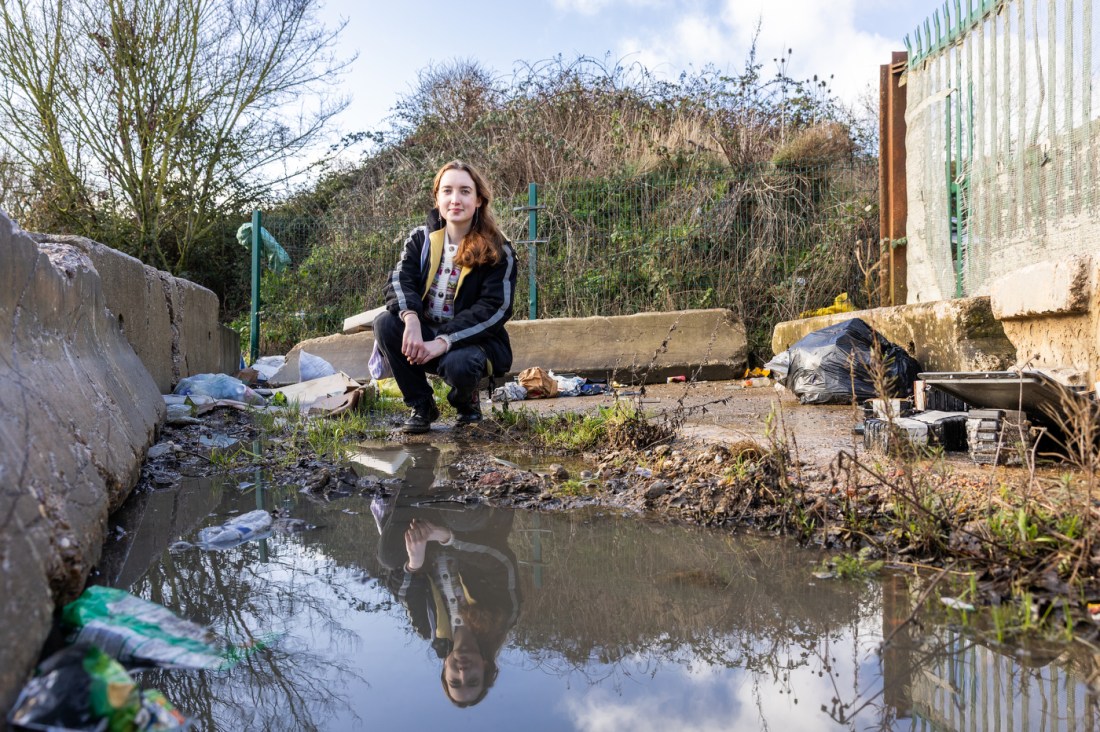

LONDON — It was the billowing smoke she spotted while on a bus home that made Lily Sims sit up and take notice.
As part of an English literature course at Northeastern University in London, Sims had been tasked with finding a local environmental issue to lobby on. The third-year student decided she wanted to find out more about where the smoke was coming from.
That decision would see her morph into an environmental activist, with her first victory to her name only weeks later.
The land in question is Arnolds Field on Launders Lane in Rainham, east London, a site that the local authority, Havering Council, has said is contaminated. Locals dub it “Rainham volcano” due to the tons of dumped toxic waste that smolder underground and break out into fires at the former landfill during the warm summer months.
“Around the site, there are burnt trees, which are just horrible, and you see these plumes of gray and black smoke — it just looks toxic,” said Sims. “When it’s proper fire season, you see hordes of huge firetrucks rushing past. You just think, ‘Oh God, that looks horrendous.’”
Since the outbreaks worsened in 2018, the London Fire Brigade said it had been summoned to the site more than 100 times, and last year alone, Havering Council spent £1 million ($1.3 million) dealing with the fires.
Clear the Air in Havering, a local campaign group set up by three mothers, has been pushing for more action, including regular air monitoring, on the privately owned land. Sims, who moved to a house 18 months ago with her family that is less than a mile from the burning field, was inspired to do her own bit after digging into the issue.
After lobbying her local lawmaker, Sims secured funding for a neighborhood newsletter to be sent out so that residents, especially older people who are less internet-savvy, are kept up to date with action being taken.




As an asthma sufferer, Sims’ main complaint was that residents were not regularly informed enough about how the fires were impacting their health.
A report by Havering Council found that people who suffer with long-term respiratory conditions such as asthma and live within a two-mile radius of the field were more likely to require extra doctor’s appointments as a result of the smoke inhalation.
“I personally do feel that in the past year, my asthma has gotten worse, which is quite concerning,” said Sims. “My asthma always used to be quite well managed, but I’ve had to rely on my inhaler more and more. I do wonder if it has been exacerbated by living so close to the site.”
Sims emailed Margaret Mullane, her Member of Parliament, to suggest that a regular physical newsletter would help residents stay informed about when it is best to keep their windows closed and what the latest updates are on tackling the fires.
Mullane has agreed with the idea and, in an email response to Sims seen by Northeastern Global News, said she had the budget to help make it happen.
A spokesman for Mullane told NGN: “Margaret does agree that there should be an official ‘newsletter’ to local residents and will be putting this to Havering Council.”
Sims was motivated to act on Arnolds Field, roughly about 42 acres, as part of her participation on the Literature, Land, and the Environment course led by associate professor Daniel Swift.


The course focuses on the changing relationships between humanity and the natural world over the past three centuries by delving into the ways that literature has touched upon the matter.
Swift tasked his students with identifying a local environmental issue before contacting their Member of Parliament or local authority to provide their own suggestions for positive change. The issue of climate change and environmental damage have global implications but Swift said a way of engaging with them is to “start by thinking locally.”
“I don’t think it’s naive to believe that each of us can make a difference,” said Swift. “I’m thrilled and proud that this seems, even in an extremely specific and local way, to be having some effect. The world is a better place for having students such as Lily in it.”
Sims said she had “never thought of myself as particularly political” but “then you get a course like this, which literally forces you to be politically engaged.” She said researching and lobbying on an issue that meant something to her and her local area was exciting.
“It is the best thing I could have done because … now I’m writing letters to my local MP and campaigning for change,” said Sims. “I’m like, ‘I don’t recognize myself,’ but it’s incredible. I honestly can’t praise the course enough.
“It’s been so encouraging to actually go out and try and make a difference, even if that change is small. Even if just a couple of newsletters get sent around, I’ll be quite happy with that.”
After a judicial review in 2025, Arnolds Field was determined to be “contaminated land” under the definition in the Environmental Protection Act. Following a study, Havering Council proposed that a “cement polymer covering” be placed over the portion of the site that experiences the most fires in order to prevent flareups.
A spokesman for the local authority said options to act on Arnolds Field had been restricted due to it being privately-owned land. He said councilors hope the cement covering, paid for with taxpayer money, would act as a short-term solution while it continues to “put pressure on the landowner to find a permanent solution.” The cement is due to be laid in the spring.
In the past five years, residents have been kept up to date through public meetings, 18 newsletters and a WhatsApp channel, the spokesman continued.
“We welcome any support from local residents in raising awareness of the potential dangers, as long as the information is correct, factual, and not politically motivated,” he added.