70 years after execution, Northeastern helps clear wrongfully convicted Black man
The Civil Rights and Restorative Justice Project (CRRJ) at Northeastern University offers teaching, research and policy analysis on race, history, and criminal justice.
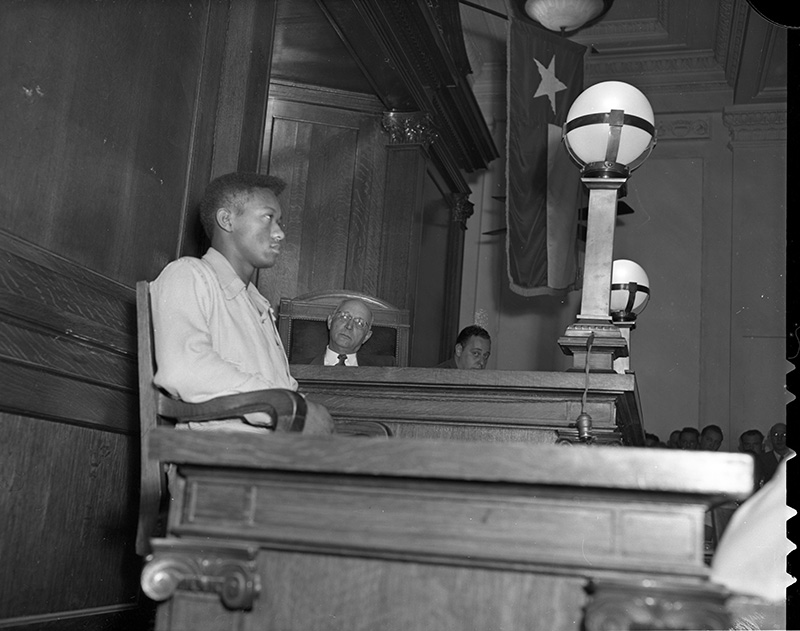
Tommy Lee Walker is sentenced to death. Credit: WBAP-TV, University of North Texas Libraries, The Portal to Texas History; crediting UNT Libraries Special Collections.

Almost 70 years ago, Tommy Lee Walker was convicted and executed for a rape and murder he didn’t commit.
The Dallas County Commissioners Court of Texas corrected the injustice last month, thanks to a collaboration that included the Civil Rights and Restorative Justice Project (CRRJ) at Northeastern University.
“At the end of the day, our criminal justice system must address its fatal errors, no matter how long ago they occurred,” said Margaret Burnham, university distinguished professor of law and director of the CRRJ at Northeastern as well as co-counsel to Walker’s son, Edward Lee Smith. “Clearing Mr. Walker’s name acknowledges him as a legally cognizable being, entitled — even after death — to justice, brings a measure of peace to his loved ones, and salutes those who, 70 years ago, fought to obtain justice for him — and for themselves.”
The exoneration was the result of a years-long joint reinvestigation of the Walker case by the Dallas County District Attorney’s Conviction Integrity Unit, the Innocence Project and the CRRJ.
All three organizations review cases involving alleged instances of wrongful convictions.
The CRRJ also offers teaching, research and policy analysis on race, history, and criminal justice. The program also uses restorative justice — a process to repair harm caused by criminal behavior — to acknowledge and memorialize victims and offer healing, honor and reconciliation to the descendants of racial terror.
“Acknowledgement isn’t necessarily just a gesture or a statement, but that it can be the first step of a process that actually has a really material impact in people’s lives,” said third-year Northeastern law student Talia Lanckton. Lanckton researched the case while working with CRRJ this past summer. “This experience has given me an appreciation for that.”
The case against Tommy Lee Walker
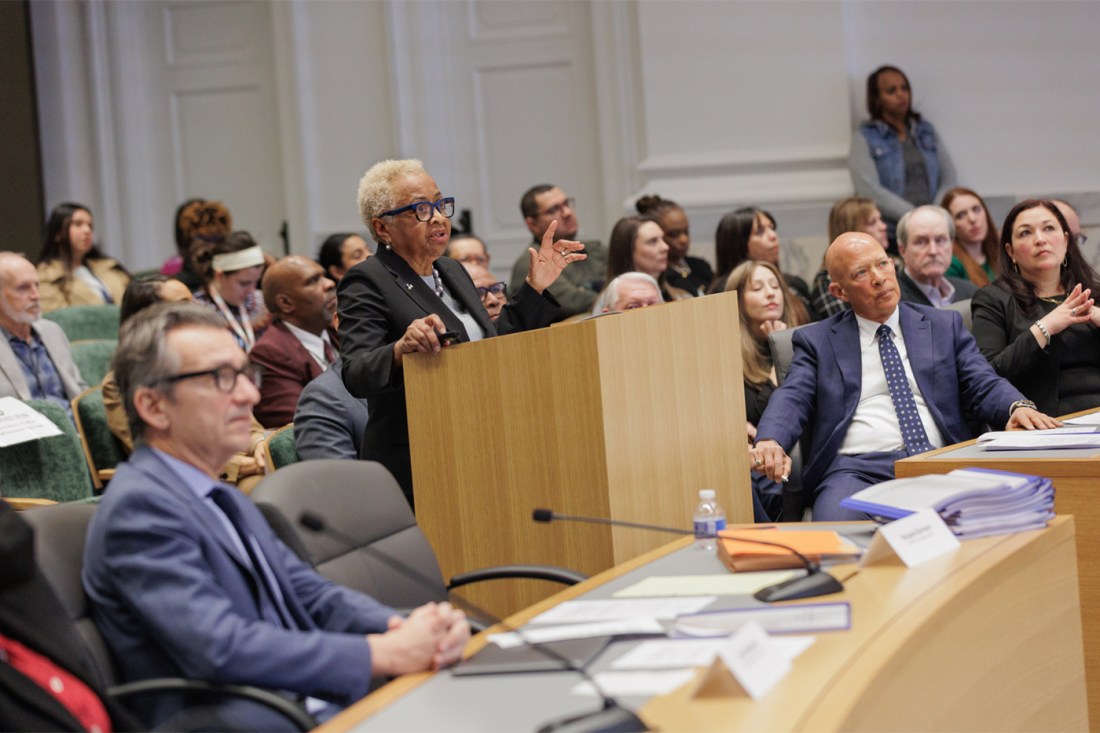
At the Jan. 21 special session of the Dallas County commissioners court, Burnham presented an overview of the initial case against Walker and the results of the joint reinvestigation.
Burnham explained that, around the time of Walker’s arrest, Dallas was in “hysteria” as police searched for a “Negro prowler” who was allegedly breaking into homes and sexually assaulting women at night.
At the height of this scare on Sept. 30, 1953, Venice Parker, a white store clerk and mother, was raped and fatally stabbed at a bus stop.
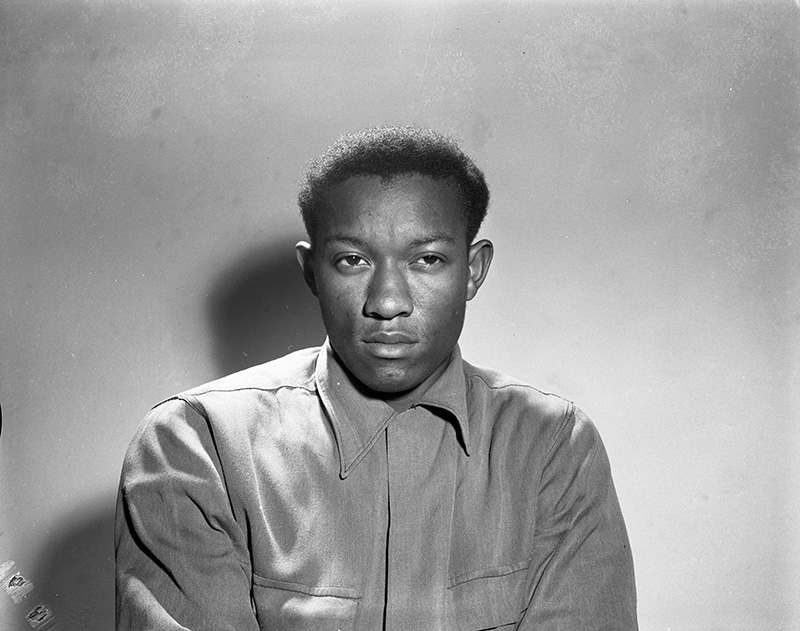
Walker, 19, was arrested four months later and charged with the alleged crimes.
“It was a dragnet-style investigation based solely on the race of the alleged perpetrator and Tommy Lee Walker unfortunately got swept up,” said Kaelin Mealey, a second-year law student who researched the case with CRRJ.
From the start, however, the case against Walker was “compromised,” the reinvestigation found.
“We have learned what the leading contributing factors to wrongful convictions are: racism, false confessions, eyewitness misidentification, junk science, prosecutorial misconduct,” Chris Fabricant, one of Smith’s Innocence Project attorneys, told the county commissioners. “All of these factors are present in the prosecution of Tommy Lee Walker.”
I feel that I have been…tricked out of my life.
Tommy Lee Walker
For instance, Burnham said that multiple witnesses testified that Parker was unable to speak due to her injuries. But the white police officer who first arrived at the scene claimed that, before she died, Parker said her attacker was a Black man.
Walker maintained his innocence from the start and also had an alibi, Burnham told the court. In fact, nearly a dozen witnesses testified at trial that Walker was with his girlfriend as she gave birth to their child — Smith — around the time of Parker’s murder.
The reinvestigation also found several concerns with the police investigation, including that it was led by an officer who was, at one time, a member of the Ku Klux Klan.
During interrogation, officials also lied to Walker about existing evidence and coerced him to sign two written “confessions,” Burnham said. The first included factual inaccuracies that made the confession implausible, while the second — which Mr Walker signed and then immediately recanted — was “fixed” by police to fit the details of the crime, the distinguished professor told the court.
“These confessions should not have been admitted at the time the case took place,” Burnham told the Dallas court.
Meanwhile, Burnham called the witness identifications that the prosecutors presented as “utterly untrustworthy.”
“What we have here is an arbitrary arrest, bad confessions, a bad polygraph, bad eyewitness identifications,” Burnham told the Dallas court.
Editor’s Picks




The problems only continued at Walker’s trial.
The district attorney — who reinvestigations have found oversaw 20 wrongful convictions of innocent Black men in his career — did not turn over potentially exculpatory evidence to the defense, Burnham reported. Most egregiously, the DA took the witness stand and testified to his own personal belief of Walker’s guilt. Reassuming his role as prosecutor, the DA told the jury in closing arguments that he’d happily ‘pull the switch’ on Walker himself — actions that would result in a mistrial today, Burnham noted.
Despite public outcry over the case — Burnham called it a case that “gripped” the African-American community both in Dallas and nationally — an all-white jury convicted Walker after only a few hours of deliberation.
Walker was executed on May 12, 1956.
Restorative justice in action
Nearly 70 years later, the Dallas County Commissioners Court unanimously concluded that “Mr. Walker’s arrest, interrogation, prosecution and conviction were fundamentally compromised by false or unreliable evidence, coercive interrogation tactics, and racial bias.”
Walker’s son, Smith, cried as he told the court about the impact that injustice had on his life.
“Growing up without a father was hard for me,” Smith said. “It hurts every time I talk about it. Because I miss my father, I miss him dearly. It’s been 70 years.”
But Smith said witnessing his father’s public exoneration affected him in “a positive way, a spiritual way.”
“This restores my Daddy’s name,” Smith told the court.