First Las Vegas, now Maryland. What is driving the Sphere expansion?
Northeastern University professor Andrew Mall said much of the Sphere’s success has to do with the novelty factor.
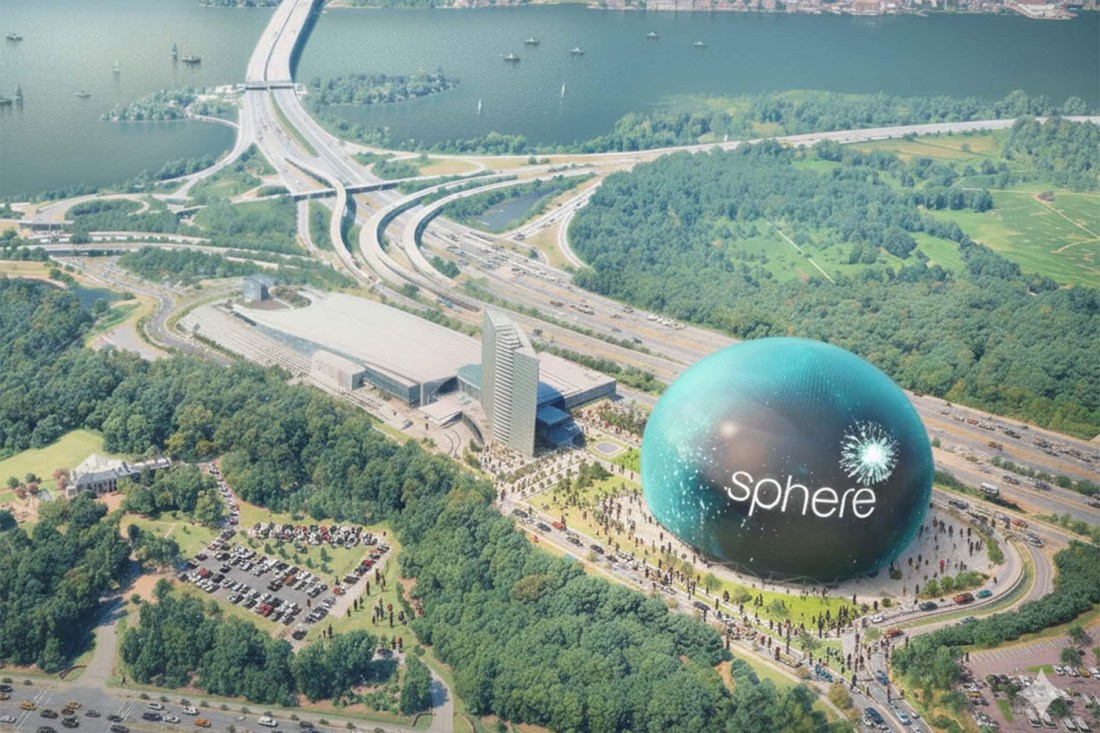

The Sphere entertainment venue sold out 40 straight U2 shows after it opened in Las Vegas in September 2023.
A little more than two years later, the Sphere Entertainment Co. has announced plans to build a similar but smaller 6,000-seat venue in National Harbor in Maryland, a waterfront convention center hub located just 20 minutes from Washington, D.C.
The second U.S. venue is a sign that the immersive-experience model is working, explained Andrew Mall, a professor at Northeastern University who studies the music industry.
“I think the story is partly about the success of Sphere in Las Vegas,” Mall said.
The Maryland Sphere would be roughly one-third the size of the Las Vegas Sphere, which can seat 17,600 people, but would feature a similar Exosphere outer dome and a wraparound LED inner screen used for immersive films, live musical performances and other Sphere-exclusive experiences.
In 2025, both Billboard and Pollstar ranked the Las Vegas Sphere as the top-grossing venue in the world. In 2024, the venue generated a total of $420.5 million, beating Madison Square Garden, whose parent company also owns the Sphere, for the top spot, which generated a total of $294.8 million, according to Billboard.
The Wizard of Oz at Sphere, a 4D, AI-enhanced version of the original 1939 film, has also been a success for the venue.
Since Oz’s debut in 2025 — which has multiple showings a day — the venue has sold more than 2 million tickets and collected $260 million in ticket sales. Due to the success of the film, the venue is selling tickets out to December 2026.
That’s not to mention the millions of dollars raked in from performances by the likes of U2, Dead & Company andthe Backstreet Boys.


To be sure, it’s not all rosy. Operating and maintenance costs remain high for the venue — which cost approximately $2.3 billion to build, part of the reason it is still operating at a loss.
With the Maryland Sphere, the company is thinking smaller. The venue is projected to cost $1 billion, $200 million of which is expected to come from “state, local and private incentives,” according to the company.
But the Maryland expansion is part of the company’s broader global push, it said. In 2024, it announced plans to build a Sphere in Abu Dhabi that would be the same size as one in Vegas. It was also aiming to build one in Stratford, London, but that was rejected by local officials.
“Our focus has always been on creating a global network of Spheres across forward-looking cities,” James L. Dolan, executive chairman and chief executive officer at Sphere Entertainment, said in a statement. “Sphere is a new experiential medium. With a commitment to bringing innovative opportunities to residents and visitors, Governor [Wes] Moore, County Executive Braveboy, the State of Maryland, and Prince George’s County recognize the potential for a Sphere at National Harbor to elevate and advance immersive experiences across the area.”
Mall said much of the Sphere’s success has to do with the novelty factor. It exists within a different live entertainment sector than a typical band performance or movie-going experience.
“Many people have a basic understanding of what a 4D could be and maybe are interested in seeing when it’s this expansive and immersive, how exciting can it be,” he said.
The Sphere, or Spheres if you include the future venues in development, are more of a supplement to traditional live music venues rather than eventual replacements, he said.
“I think for most people it’s going to be a multimedia experience primarily,” he said. “Maybe now and then there’s going to be an opportunity to see an artist with an expansive artistic vision. … In a lot of ways, it sits outside of the live music sector.”
It’s also a medium that some artists would take more advantage of than others, he said.
While it might make sense for a band like U2 — which likes to incorporate giant stage productions in its performances — it might not make sense for Bruce Springsteen, who is more low-key, he said.
“It’s not only about if you are a big artist or a popular artist that routinely tours large venues, but also does your artistic vision include all these different production elements,” he said.
Celia Pearce, an art and design professor at Northeastern University who studies virtual worlds, said people have been trying to make venues like the Sphere happen since the 1950s.
But the past few years have been a great age for “location-based entertainment” due to the reduction of costs of immersive technologies and a surge in interest for people to have in-person experiences after the pandemic.
“The dome idea is really strong because you can get a lot of people in there to have a shared experience,” she said.
Immersive experiences in general are having a bit of a moment right now, she said. Escape rooms, for example, have surged in popularity in the past few years, she explained. But people are also engaging more in activities like playable theater, where audience members are invited to take part and influence the story.
“I think there is a growing appetite for all types of immersive and participatory experiences,” she said. “People want to get out with their friends and do interesting and fun things. They want to have a little more agency than they used to have.”