A ‘stunning’ new map of dark matter reveals insights into this mystery of the universe
Using NASA’s James Webb Space Telescope, researchers created the most high resolution map yet of dark matter, the virtually invisible material that makes up 80% of matter in the universe.
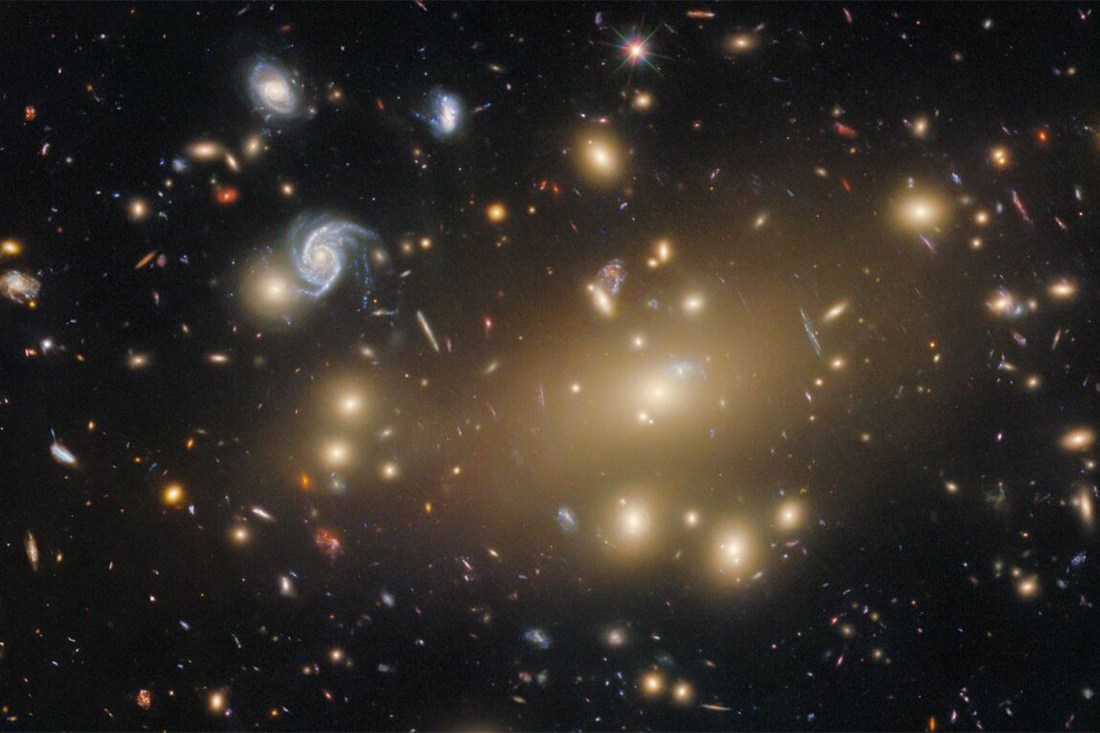

Mapping dark matter, one of the most mysterious but essential parts of the universe, is like trying to chart Earth’s surface with no understanding of the ocean.
It’s called dark matter for a reason. It doesn’t absorb, emit or reflect light, so it is essentially invisible to telescopes despite making up about 27% of the universe and 80% of all matter, according to NASA. The only reason scientists know it exists is because of the gravitational influence it exerts on galaxies and stars.
Yet scientists recently created the most detailed map of dark matter yet, with some help from NASA’s powerful James Webb Space Telescope, or JWST.

“Thanks again to the power of JWST we were able to map out the distribution of dark matter in this field in stunning detail,” said Jacqueline McCleary, an assistant professor of physics at Northeastern University who worked on the project. “It’s a snapshot of what the universe looked like in high detail when it was about half of its current age. This is a feat that other telescopes may have come close to but never fully approached.”
Published in a recent Nature Astronomy paper, this high-resolution cosmic cartography confirms the role dark matter is playing throughout the universe. It also provided the foundation for work that will shed light on some of the universe’s greatest mysteries.
This endeavor uses data and images pulled from COSMOS-Web, the largest survey using JWST to date. JWST is NASA’s highly powerful infrared telescope that is designed to spot distant galaxies with greater detail than ever before.
“Normally, the more distant a galaxy, the smaller and noisier it looks, so the harder it is to measure its shape,” McCleary said. “JWST’s [camera] allows us to map those shapes very carefully.”
That level of detail is an asset when mapping galaxies, which are bright and easily visible, and especially dark matter. Like with dark energy, a similarly mysterious and omnipresent force but one that is responsible for the accelerating expansion of the universe, scientists have been able to confirm the presence of dark matter through its gravitational effect on objects they can see, like galaxies, stars and visible matter. All of them behave and move “as if there were about four times as much matter as what you can actually detect,” McCleary said.
With the highly detailed galaxy shapes that JWST captured in a particular patch of sky, known as the Cosmological Evolution Survey (COSMOS) field, researchers were able to reconstruct an effect known as gravitational lensing that proved key to mapping dark matter, McCleary said.
This distorting effect occurs when massive structures in the foreground of a telescope’s view bend the light from distant galaxies behind them. Measuring that distortion allowed the researchers to measure the matter responsible for it in the first place.
“There is just the observational feat of being able to map out this invisible dark matter … using an extremely subtle signal that the dark matter imparts on images of galaxies, something that we can directly observe,” said McCleary, who worked on the project’s gravitational lensing group.
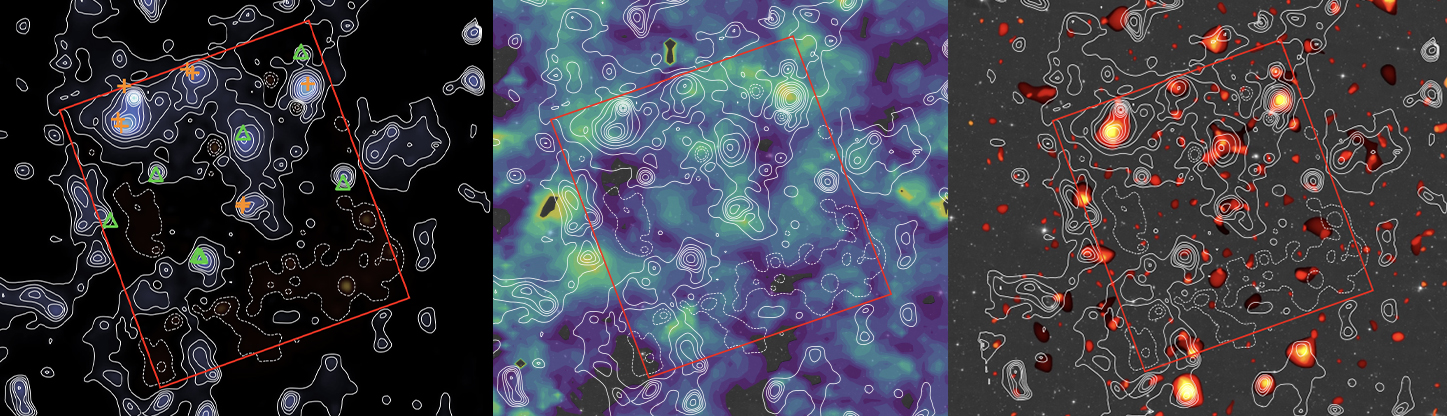
With their gravitational lensing technique, this team of researchers created an in-depth map of dark matter distribution in this patch of sky. They also created similar maps for hot gas emissions and galaxy distribution and found that all three tended to cluster together.
Editor’s Picks





“The fact that where you see a ton of gas and/or a ton of galaxies you also see a ton of dark matter means that dark matter, as mysterious as it is, does interact gravitationally with gas and stars,” McCleary said. “Gravity pulls all of these structures together, and in fact, dark matter is the scaffolding about which gas and galaxies are arranged.”
This is not the first experiment to prove the connection between dark matter and its more easily spotted cosmic relations. But it does reveal this relationship extended well into the universe’s distant past, McCleary explained.
The true nature of dark matter remains “one of the big open questions in all of science today,” McCleary said. Such a detailed map does open up a lot of opportunities to answer that question, along with some of the universe’s other nagging mysteries.
McCleary’s team will be using the maps they’ve created to investigate how much dark matter there is in the universe, how galaxies assemble and how much the universe is expanding.
“The creation of the catalog of galaxy shapes used to obtain this result is not just interesting in and of itself but also enables a whole bunch of other science investigations,” McCleary said. “As you might imagine, being able to map out the dark matter with high resolution in a patch of the sky is really useful.”