What is dark energy? Scientists shine new light on outer space’s biggest, invisible question
The final results from the six-year Dark Energy Survey show there are still more questions than answers but will impact astrophysics for decades, Northeastern’s Jonathan Blazek said.
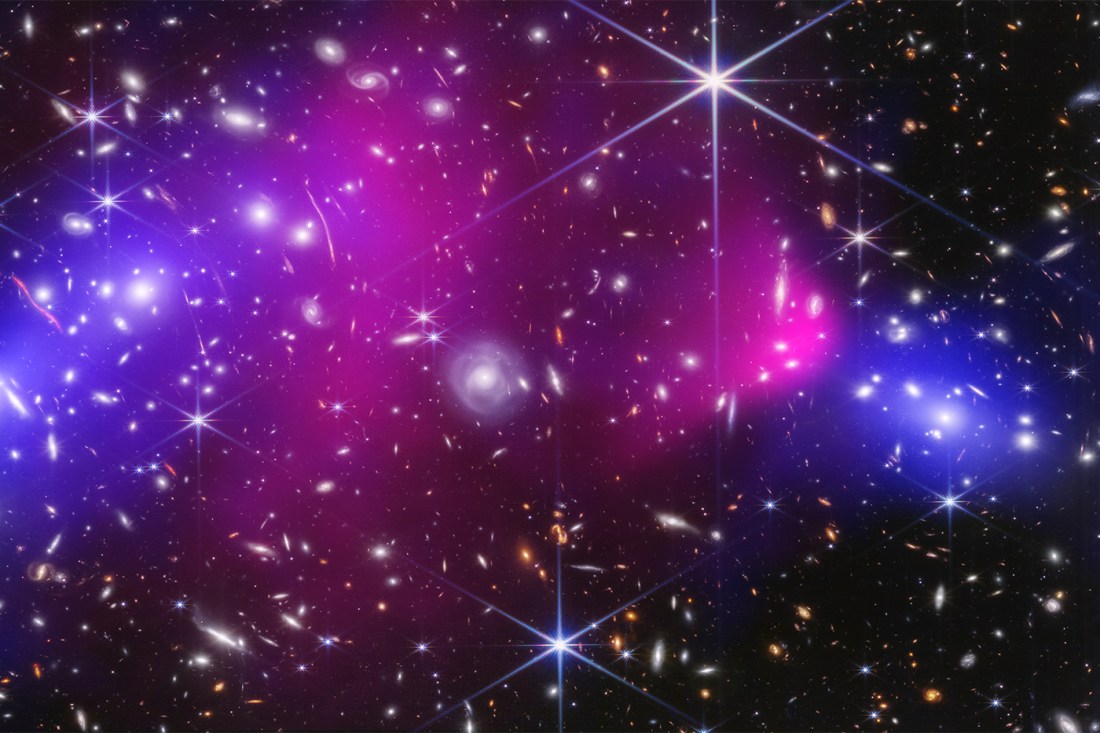

Dark energy is still one of the greatest cosmic mysteries. For all the time, money and telescopes that humanity has used to uncover its nature, scientists are still asking a fundamental question: What is dark energy?
With the Dark Energy Survey, a six-year international collaboration between over 400 scientists that carried out one of the deepest wide-area surveys of the sky, coming to an end, astrophysicists are getting closer to the answer. This week, scientists working on the Dark Energy Survey published their final results. While they don’t crack open the mysteries of the universe, they get humanity one step closer to understanding dark energy.
“We have not answered all these questions. We have some hints,” said Jonathan Blazek, an assistant physics professor at Northeastern University and co-lead on the project’s modeling and analysis team. “We know better than ever what we should be asking and how we should be trying to answer those questions, but we don’t have the answers yet.”
Around 13.8 billion years ago, the universe started rapidly expanding in what is commonly called the Big Bang. After that initial explosive expansion, gravity slowed down the growth of the universe. The basic laws of the universe hold that what goes up must come down. But that’s not exactly what happened.
In 1998, two teams of scientists studying exploding stars discovered that 9 billion years after the universe began, it actually started to grow more quickly. The culprit is a largely unknown force that scientists have termed dark energy.
“We can’t see it directly or at least we can’t easily see it directly, so we call it dark and … it acts like another kind of energy in the universe,” Blazek explained. “But what it seems to be doing is pushing stuff apart, which is really weird because most things with gravity pull things together.”
Scientists still know relatively little about dark energy, except that it’s all over the universe. According to the National Aeronautics and Space Administration, approximately 68.3% to 70% of the universe is made up of dark energy.

After the discovery of dark energy, scientists started experimenting with ways to study it, including with the Dark Energy Survey.
America’s Fermi National Accelerator Laboratory built a hypersensitive digital camera, DECam, and strapped it to a telescope operated by the U.S. National Science Foundation in Chile. Over the course of 758 nights, scientists with the Dark Energy Survey recorded information from 669 million galaxies that are billions of light years from Earth, covering an eighth of the sky.
The scope and detail of what the Dark Energy Survey captured is unprecedented. It gave hundreds of scientists a rare opportunity to study one set of data with separate yet converging scientific goals in mind.
“I think that’s very powerful,” Martin Crocce, co-coordinator of the Dark Energy Survey analysis, said in a statement. “This is the only time it has been done in the current generation of dark energy experiments.”


The most recent, and final, results published from the Dark Energy Survey are “a refinement” not reinvention of humanity’s understanding of dark energy, Blazek said.
The Dark Energy Survey’s data ultimately fit somewhere between two of the more common models of how dark energy functions in the universe. The standard cosmological model holds that the density of dark energy in the universe is a constant, while a second model contends that it evolves over time.
“Every time we do this, even if you get an ‘uninteresting’ answer where it kind of looks the same as before but just with smaller uncertainty, you’re still answering some questions,” Blazek said. “You’re still ruling some things out.”
One of the project’s latest and greatest contributions is a robust reconstruction of the distribution of matter across the universe. To perform this cosmic cartography, Blazek and his collaborators developed more advanced methods for measuring a phenomenon called gravitational lensing.
Lensing occurs when massive objects like galaxies behave like cosmic magnifying glasses. Gravity from a galaxy might bend the light coming from a star behind it, distorting the image that Earthbound astronomers see. By observing how significantly gravity deflects light, they can determine the mass of distant objects.
Mapping out the galaxies, bright as they are, is relatively easy. Charting all matter and energy, especially virtually invisible dark energy, is harder, but it’s possible with an understanding of where mass is clustered and how hard gravity is pulling. Gravitational lensing provides both.
“This map that you make based on lensing is really telling you the true underlying distribution of all matter in the universe,” Blazek said.
The lessons learned and methods developed through the DES are already influencing new efforts to answer questions around dark energy and the universe.
The Ruben Observatory in Chile is akin to a “Super Dark Energy Survey” and involves many of the same scientists, Blazek said. The Euclid Satellite and Roman Space Telescope that launches in September both also have similar scientific goals.
The end of the DES is the “passing of the torch” to the next generation of astronomers and the next phase of humanity’s efforts to chart the stars, Blazek said.
“Scientifically, there is a heritage here that is going to be preserved and is very much training us for the next generation,” Blazek said. “It really feels like the end of an era and the beginning of another one.”