Leaders explain how this fintech group went global and changed their futures
The student organization only started in 2023 but already boasts 750 members and is helping establish careers in the sector.


LONDON — The founders of the FinTech Society on Northeastern University’s London campus laugh when they think back to their first “kick-off” event shortly after setting up the student organization.
Around 20 people were there to witness the society’s dawn in fall 2023. “It was us bringing our friends along and saying, ‘Please come, we need people,’” recalls Sofia Rendon, who was society treasurer for two years.
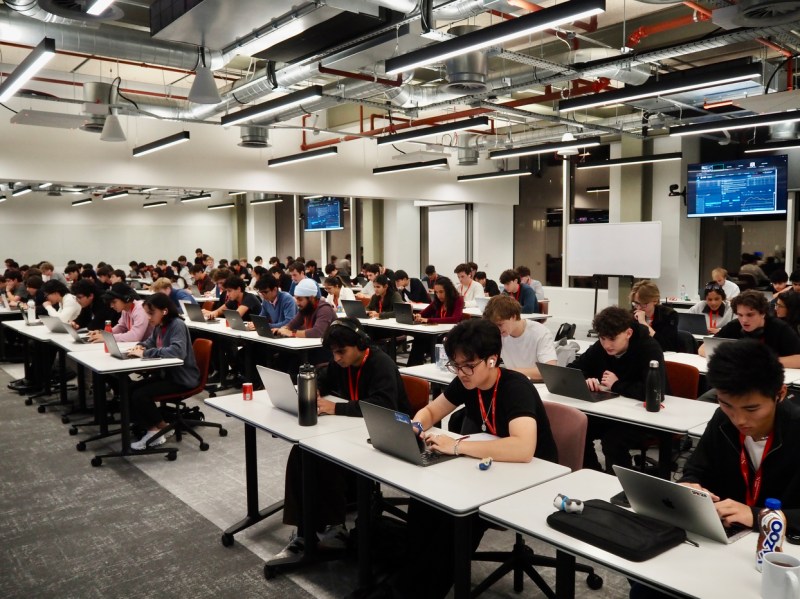
Fast-forward to 2026 and the society boasts more than 750 members across Northeastern’s global campus network. The group has hosted talks by finance and technology sector figures, put on simulations to give students a taste of what a job in the industry is like and run career advice workshops.
The student group has also helped one of its leaders land a job with a major investment bank.
Dara Hejazi, who was FinTech president until handing over the reins this month, credited the organization with bolstering not only the “confidence and courage” of his peers, but also his own.
“For me personally, my skills have changed and I think I’ve developed a lot in terms of speaking in front of people,” said the third-year economics student. “You become a bit more confident and you don’t hold back as much because you understand that, especially in this industry, you need to put your foot forward to ask questions and you need to learn every single day.”
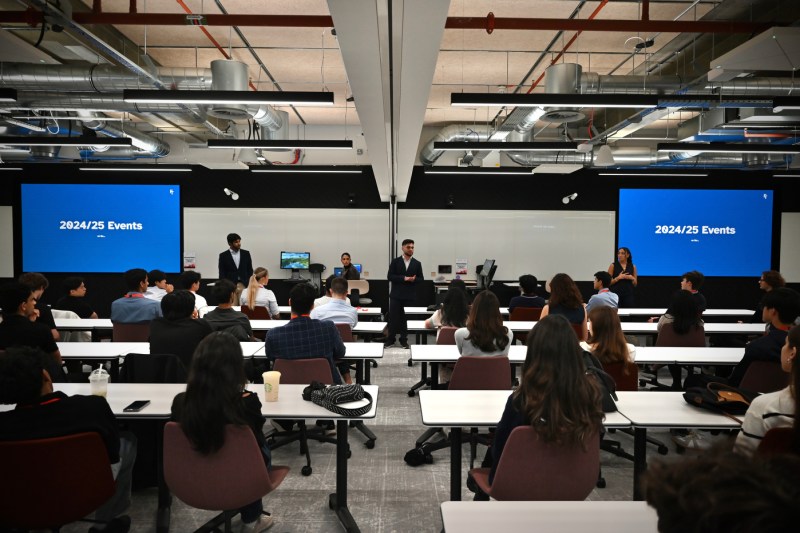
Hejazi undertook an internship with J.P. Morgan last summer and has since landed a permanent job after graduation with the U.S. investment bank’s asset and wealth management team based in Geneva. The 20-year-old from London said his experience on the executive committee of FinTech “really helped” to secure the position.
Mohammed Vahora, formerly senior vice president of the society, said playing a leadership role provided him with the soft skills he thinks will be vital to a future workplace that is likely to be upended by the adoption of artificial intelligence.
The 21-year-old, from Surrey, southeast England, referenced a quote from David Solomon, chief executive of investment bank Goldman Sachs, about the way AI will shake up the finance sector.
Solomon last year said that AI could complete “95%” of a registration prospectus for an initial public offering — when a private company first starts selling shares on a stock exchange — in only minutes, when it would have previously taken a six-person team two weeks to complete.
“The last 5% now matters because the rest is now a commodity,” said Solomon.
Vahora said the 5% that Solomon referenced was “where the real value lies.” He continued: “These soft skills — leadership, networking, having the ability to convince people — they really set you apart. I think that’s really what the FinTech Society has taught me.”
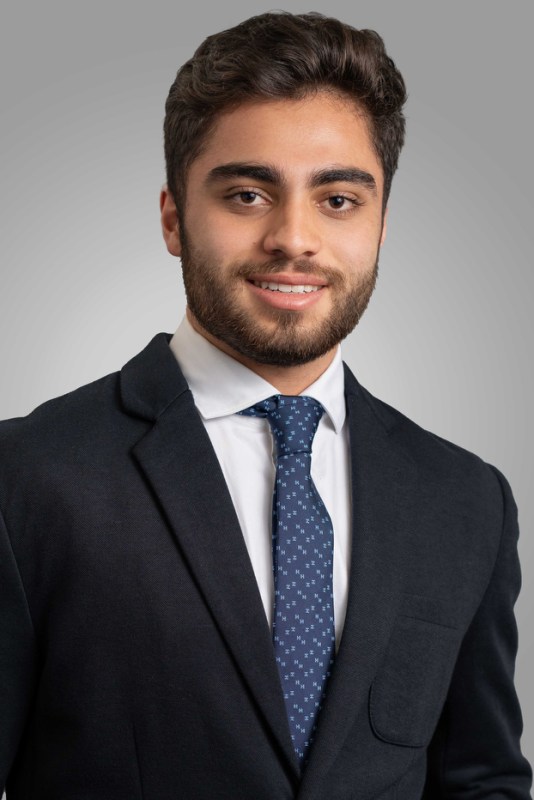


The third-year economics student has used his own network to entice speakers to the London campus, where around 300 of the FinTech Society’s members are based. It has attracted senior officials from household name finance and tech companies, including the Bank of England, Rothschild & Co. and Google, to provide insight into the industry to students, as well as create time afterward for networking with the experts.
The talks, resume workshops and industry simulators, including the society’s own Nexus Investment Fund, are designed to help students form a view on whether the world of fintech is for them, according to its leadership.
Editor’s Picks


At least 100 students flocked to take part in the most recent collaboration with AmplifyMe, a global provider of finance simulations. “You spend half of the time as an investment banker, half the time as an asset manager,” explained Hejazi. “You get practical, real-time experience of that high-stress environment.”
Rendon, 21, said the team has been told that the FinTech Society, which was set-up jointly by Hejazi and data science and economics student Arnav Mehta, has become a major draw for people applying to study at Northeastern. “We’ve had students who have said, ‘I’m coming for FinTech,” she said. “They see it as an opportunity career-wise.”
The third-year politics and international relations major said finance and technology was a “new world to me” but that she wanted to get involved in the society at its inception as she was curious to learn. Rendon, from Mexico, said she picked up so many practical skills, such as sharpening her math abilities, using Excel spreadsheets and learning the finance “lingo,” that at times it felt like she was taking an additional class.
But the “biggest outcome” was the interpersonal and leadership skills she developed as a result of being one of the main players in a student body that interacts with industries often considered to be male-dominated.
“No one necessarily teaches you how to be a leader and I think having these opportunities as a society, it was just amazing to do and to be in a position where I could share my ideas and what I thought it would be good to do,” she added.
Hejazi, Vahora and Rendon have now passed the baton to a new executive committee, with new president Elena Muri, a second-year business administration student, and her team leading the society for the rest of the academic year and into the next.
Having built it from the ground up, the society has left its mark on all three of them, whether it be a job to go to after university, a network to tap into after their finals or a newfound respect when they return home.
“I think for me, honestly, I’ve been taken more seriously because of it,” said Rendon. “It has opened doors to me in Mexico because I think people can see the hard work that went into it. Seeing a girl in the position of treasurer, it means people take you seriously as a result of that.”