Is the world better off in ‘Pluribus’? A supply chain expert says no
The apocalypse in Apple TV’s “Pluribus” comes with some benefits: The world’s supply chains are running more smoothly under an alien hive mind. But efficiency comes with a cost, a Northeastern supply chain expert said.
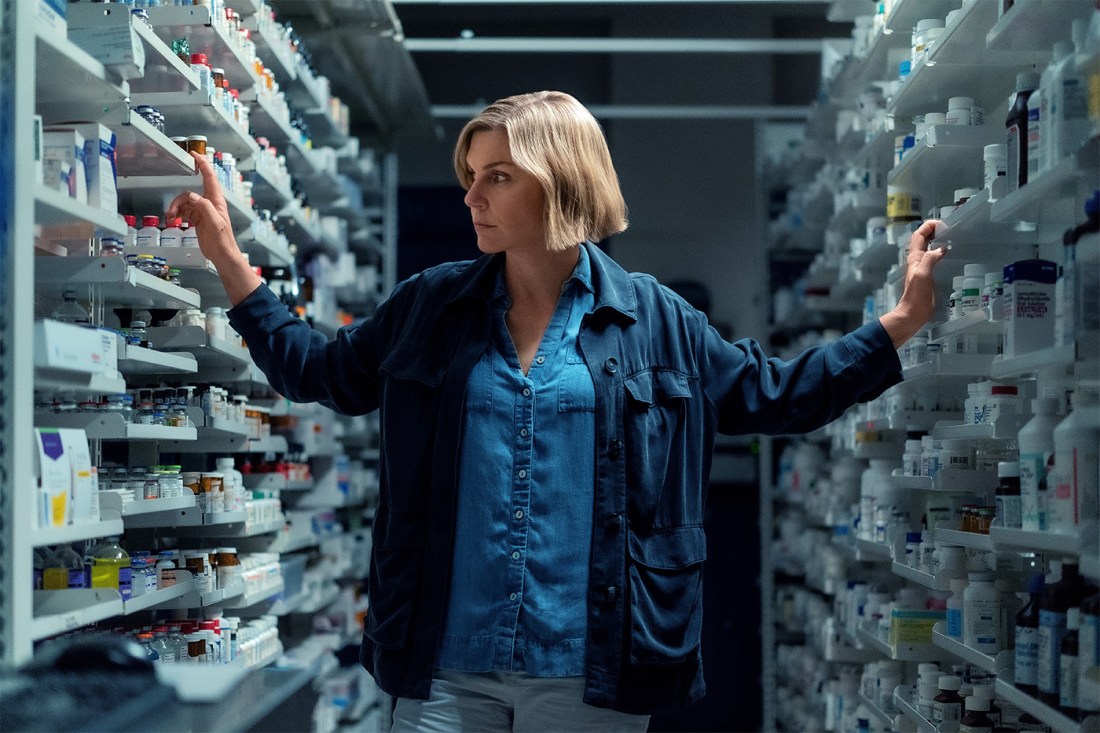

Spoiler alert: This story contains details about the first season of “Pluribus.”
What if the end of the world actually fixed the world’s problems?
In the world of “Pluribus,” Apple TV’s hit science fiction show from creator Vince Gilligan, almost all of humanity has become psychically glued together as a collective hive mind by an alien virus. They’ve lost their individuality, but they seem perfectly content. There’s no more war or crime. National borders and language differences have been erased.
Without all those human problems, the post-apocalyptic world in “Pluribus” runs more smoothly and efficiently than it did before. But that doesn’t mean it’s better, said Nada Sanders, a distinguished professor of supply chain and information management at Northeastern University.
Despite having “perfect information” and “perfect access to drones, trucks, rail,” in the long run, Sanders cautioned, a world run by a single, unified system like the one in “Pluribus” might actually be worse off.
“It’s a lesson for individuals, for companies, for everybody, in terms of what happens when all we focus on is pure efficiency at the extreme with all the information that we have,” Sanders said. “Ultimately, there’s nothing. It’s just stagnation.”
In supply chain management, there is a constant tug of war between standardizing operations so that people across the globe can reliably get what they need and customizing infrastructure so that systems can adapt to those same, ever-changing human needs.
In “Pluribus,” the hive mind has created a standardized system to the extreme. In a sense, it’s the ideal global supply chain.
Since every person in the hive mind is constantly psychically linked and shares every thought and feeling, it might not even be fair to call it a chain at all. With no individual links, it’s more like a single, unbroken wire.

Sanders freely admits real global supply chains are imperfect. They regularly face disruptions from international transportation infrastructure and geopolitical shifts. But the current system, as decentralized and faulty as it is, is also able to respond when things go wrong or even if there’s a specific need in a specific part of the world.
“[In ‘Pluribus’] we’ve become a perfect system but brittle in that it doesn’t allow for any customization and any one-offs,” Sanders said. “It has to be agile to perform in a lot of different ways.”
The 13 individuals who weren’t absorbed into the collective, including stubborn protagonist Carol Sturka (Rhea Seehorn), are a reminder of the humanity that’s necessary in the current system, Sanders explained. The hive mind, or the Others as Carol calls the hive mind, strives at every turn to make all 13 of them happy, even if it means lifting heaven and earth to do so.
Here, the show reveals “what it really takes to offer customization and individuality in the physical world,” Sanders said.
Editor’s Picks





At one point, Carol discovers the hive mind has moved all the food from her favorite grocery store to a central location to make food distribution easier. She demands they restock the grocery store just as it was. In response, the Others painstakingly move every product back to the store on trucks.
Since the hive mind has standardized everything to the extreme, it ends up using a lot of energy and infrastructure just to meet the needs and desires of one person.
Ironically, the hive mind exists among nearly every person on Earth, but in its unity, it has created a system that is entirely a single point of failure. More distressingly, it’s entirely unsustainable, Sanders said.
Deep into the first season, it’s revealed that the hive mind has an expiration date. It has a biological mandate that it cannot kill anything, plants, animals or otherwise. Even picking an apple from a tree is off limits, so it must rely on the planet’s existing food supply for sustenance.
That creates an inherent break in the supply chain: The hive mind predicts it will eventually run out of food in 10 years and face mass starvation. As efficient as it is, the hive mind is also a massive, unified system that is slowly but surely collapsing against its total inflexibility.
“It becomes brittle because after a while it’s going to create a stasis,” Sanders said.
To address this existential crisis, the hive mind calculates the exact amount of calories each body needs to sustain itself. Much to Carol’s horror, to meet those requirements, without killing anything, the hive mind turns to making human remains into protein shakes called HDP, human-derived protein.
If each person in the U.S. were restricted to the minimum amount of calories required per day –– 1,967 in the U.S., according to the United Nations’ Food and Agriculture Organization –– then the country would need 7.2 billion calories in its food supply to sustain for 10 years. However, with the hive mind’s inability to harvest freshly grown produce or kill animals for food, that food supply is severely restricted.
For a few years, the Others can continue creating HDP using the remains of the more than 800 million people who died during the Joining and the nearly 150,000 people who die globally every day due to natural causes, according to the World Health Organization. But the supply chain math still doesn’t add up, according to Sanders.
“It’s a sci-fi show; it’s an extreme,” Sanders said. “But I think what this extreme looks like is ultimate stagnation because if they’re all part of the hive, it’s just sameness. The only thing that they can do, this alien, is to go conquer other worlds and other worlds. But as a species, as a collective, there’s no growth.”


