European Physical Society honors professor’s groundbreaking contributions to the physics of complex networks.
Northeastern professor Alessandro Vespignani earns the European Physical Society’s top award for helping to lay the foundation for physics models of contagion.

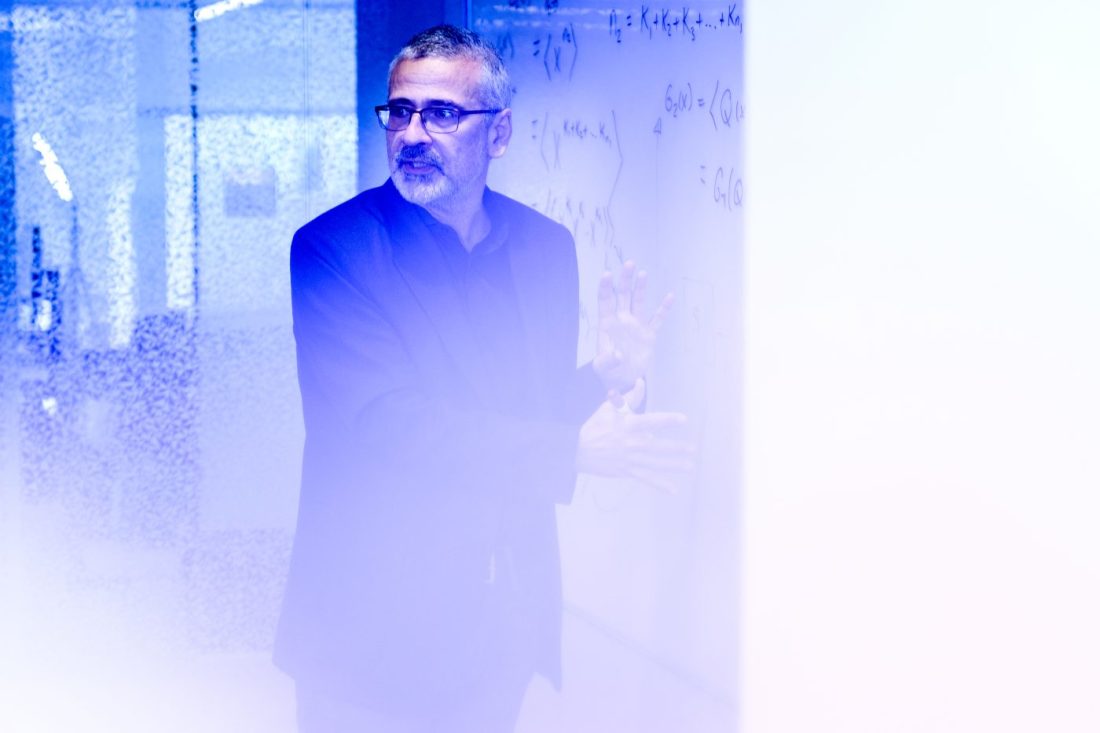
Years of research by Alessandro Vespignani, director of Northeastern University’s Network Science Institute, helped lay the foundation for physics-based models of the spread of infectious diseases, including COVID-19 and Ebola.
Now, the European Physical Society (EPS) has recognized Vespignani’s groundbreaking contributions to the field of statistical physics of complex networks with the Statistical and Nonlinear Physics Division (SNPD) award.
The society said Vespignani, who is also the Sternberg Family Distinguished University Professor at Northeastern University, earned the distinction for “unveiling the universal principles governing epidemic spreading and information diffusion.”
The award is one of the latest honors to be bestowed upon Vespignani, whom the Italian government knighted with the Order of the Star of Italy for his response to the COVID-19 pandemic and other contributions.
The SNPD award “is a really big honor and really recognizes the enormous contributions (Vespignani’s) made as a scientist,” said Samuel Scarpino, a fellow network scientist at Northeastern who directs AI and life sciences at the Institute for Experiential AI.
Vespignani said the award “was really a surprise” and acknowledges his work developing theoretical and foundational tools to describe contagion processes.
In applying physics models for the spread of disease, scientists have long envisioned humans playing the role of atoms and communities the role of molecules, he said.
But it wasn’t until recent years that scientists had mega data from cellphones and digital technologies “to make the final connection to practical problems,” Vespignani said.
“My last 20 years have been applying those ideas into the public health arena by really working on predictive analytics for infectious disease control,” he said.
Editor’s Picks





Since 2024, Vespignani has been leading EPISTORM, a CDC Center for Forecasting and Outbreak Analytics (CFA) funded initiative focused on improving early detection and preparedness for infectious disease outbreaks in the United States, including the flu.
Vespignani said he’s especially excited about this award since the other recipient, Thomas Witten of the University of Chicago, was an early inspiration in his career.
“I basically did my Ph.D. dissertation on some of his early work. It is a bit of a full circle and a big emotion to see I’m being awarded with one of the people that I consider a master of the field,” Vespignani said.
Vespignani and colleagues at the innovation center are continuing to work on setting up a pandemic early warning and forecasting system by integrating new data such as wastewater sampling at airport sentinel sites and developing new algorithms and modeling tools.
“We are trying to expand the sentinel network” and also make sure it catches diseases emerging from low and middle-income countries, he said.
EPISTORM also has collected and published data about the contact pattern of individuals in the post-pandemic U.S., breaking down statistics by income level, race, ethnicity and sex, Vespignani said.
Contacts are the “wiring” that turns infections into outbreaks — and that wiring did not snap back to pre-covid times when the emergency ended, Vespignani said.
“Post-pandemic, work, school, travel, and social mixing have all rebalanced in uneven ways, and if we keep using old contact assumptions we will misread transmission risk and mis-time preparedness,” he said.
Vespignani said the awards ceremony will be held in Europe this summer at an exact date and location still to be determined.
Scarpino said that during Vespignani’s long career, “He’s made some really fundamental contributions to our understanding of models of complex systems.”


