Could an autistic Barbie help children better understand the diagnosis?
The latest Barbie from toy giant Mattel comes with accessories that an autistic person might use to communicate or help them to avoid sensory overload.
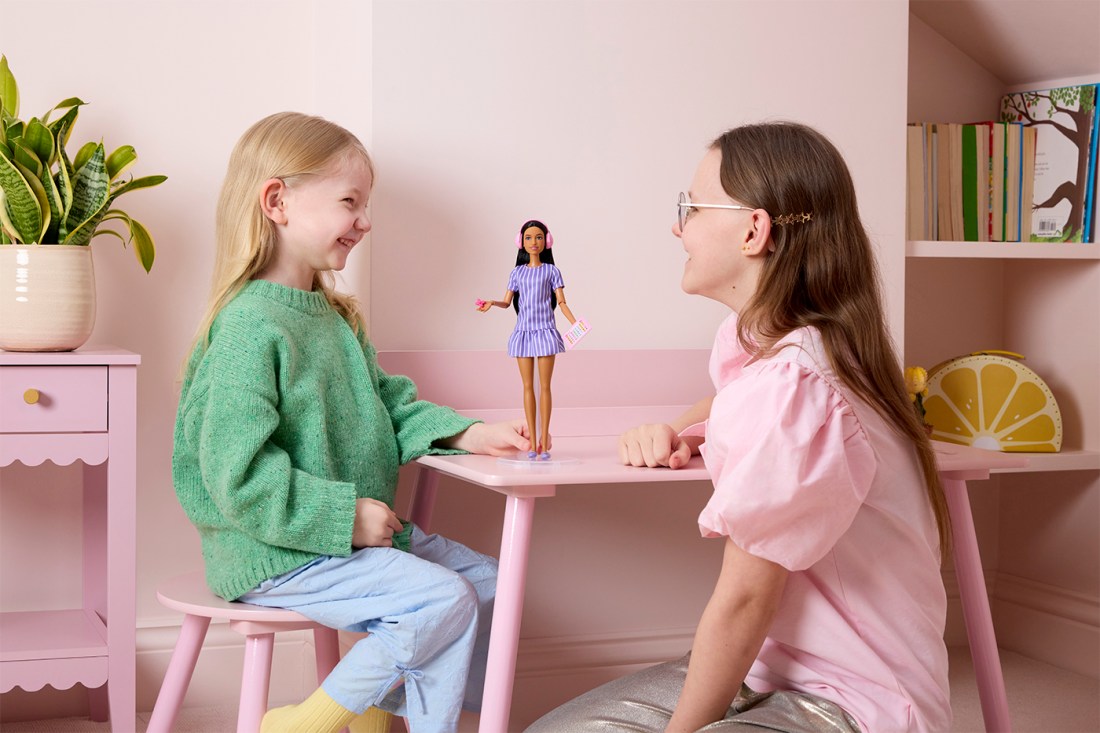

LONDON — Barbie has been a doctor, an astronaut and an all-round style icon since first going on sale almost 70 years ago. And now autistic Barbie has joined the lineup.
American toy company Mattel has announced a new doll that displays traits witnessed in some people diagnosed with autism.
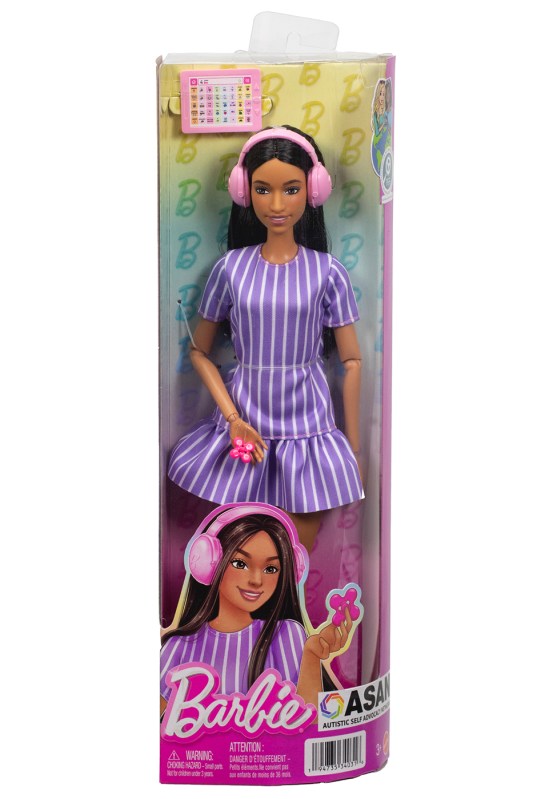
Autistic Barbie’s eye gaze is diverted to reflect how some with autism prefer to avoid direct eye contact and she wears noise-cancelling headphones to reduce sensory overload. Her purple pinstripe dress is also designed to be loose-fitting, said Mattel, to provide less fabric-to-skin contact.
The introduction of an autistic Barbie to the doll’s range, which was first released in 1959, has the possibility of helping children to better understand the diagnosis, said Maeve Donnelly, an associate clinical professor in applied psychology at Northeastern University.
“The more examples we can have of individuals with autism and what autism might look like are so valuable,” she said.

Donnelly, who previously worked in a school for children with autism before entering academia, said children “learn through play” and that interacting with the accessories that autistic Barbie comes with could assist them in understanding how best to engage with autistic people.
Mattel’s latest creation comes with a computer tablet that has Augmentative and Alternative Communication on its screen. A wide-variety of AAC is used by many with autism to aid communication. The new Barbie also has a finger-clip fidget spinner to offer a sensory outlet that “can help reduce stress and improve focus,” Mattel said.
“Children can play with them and they can learn what they’re like,” continued Donnelly. “And I think that the more they have those experiences, it primes them for those interactions with their autistic peers in their school environment, at the playground, etc — I think it’s really important.”
The new release has been largely welcomed by non-government organizations working to improve the lives of those living with autism.
Peter Watt, managing director of national programs at the U.K.’s National Autistic Society, said the agency was “pleased” that Mattel had “involved the autistic community in the development of this doll.” Mattel developed the Barbie in partnership with the Autistic Self Advocacy Network, a nonprofit disability rights group in the U.S.
In a statement to Northeastern Global News, Watt said: “It is positive to see authentic autistic representation on TV and films, the arts and in play, as better public understanding of autism across society could transform hundreds of thousands of autistic people’s lives.”
Donnelly said it would be important for children to be taught that autistic Barbie, while containing a number of different traits that someone with autism might display, was “just one representation of what autism might look like.”
The National Autistic Society explained that autism can come in many different forms. Some people with the diagnosis can find socializing confusing or tiring. Other traits include becoming overwhelmed in loud or busy places. Those with the neurodivergence may have intense interests, prefer order and routine and use repeated movements or actions to calm themselves or express happiness.
Courtney Hagen-Ford, an assistant professor of marketing at Northeastern in London, said autistic Barbie was likely to both raise awareness of autism and challenge stereotypes.
“Autism is incredibly under-diagnosed in women, so having a female representation of autism is quite something,” she said. “Hopefully, this is already changing some of the stereotypes — it is not just a boy who likes trains.”
Editor’s Picks




Worldwide, around one in 100 people are thought to have autism. In the U.S., about one in 31 children age 8 has been identified with autism spectrum disorder, according to figures published by the Centers for Disease Control and Prevention. The government body said the diagnosis is three times more common among boys than among girls
Both Hagen-Ford and Donnelly argued that the ability to mix and match Barbie accessories should help children understand that autism is not a barrier to professional and personal success.
“Barbie accessories have always been removable and the whole point of her was to dress her up,” continued Hagen-Ford, a self-confessed Barbie fan who recalls having four or five Barbie dolls when growing up.
“So yes, your Barbie with the autism accessories, she could go hiking, she could be an astronaut, she could be president.”
The “Barbie” movie, starring Margot Robbie and Ryan Gosling, was a huge blockbuster in summer 2023. Hagen-Ford said the film stressed the diversity of the doll’s range, a push that Mattel had started more than a decade before the Greta Gerwig-directed feature-length reached cinemas.
Mattel brought out the “Fashionista” line of Barbies in 2009 with the intention of having the doll reflect the diversity of the population, producing different body types, skin tones and disabilities. The Fashionista line has included a blind Barbie, a Down Syndrome Barbie, a wheelchair Barbie and a Type 1 diabetes Barbie.
While there may well be “a bit of PR” about this latest doll, having an autistic Barbie is right on brand for Mattel, argues Hagen-Ford.
“It is a bit of PR but, ultimately, they wouldn’t do this if there was not some benefit for themselves. … Mattel seeks to make a profit, as any major American corporation would,” she said.
“But this doll sits within the Fashionista line, which has a huge range of sizes, body types, hair types and different physical markers of diversity. To me, I would say it has got complete fit with who the brand is.”