How Iran cut the internet at the flip of a switch
As Iran’s internet blackout continues, experts explain how the government has the power to shut down the internet countrywide.
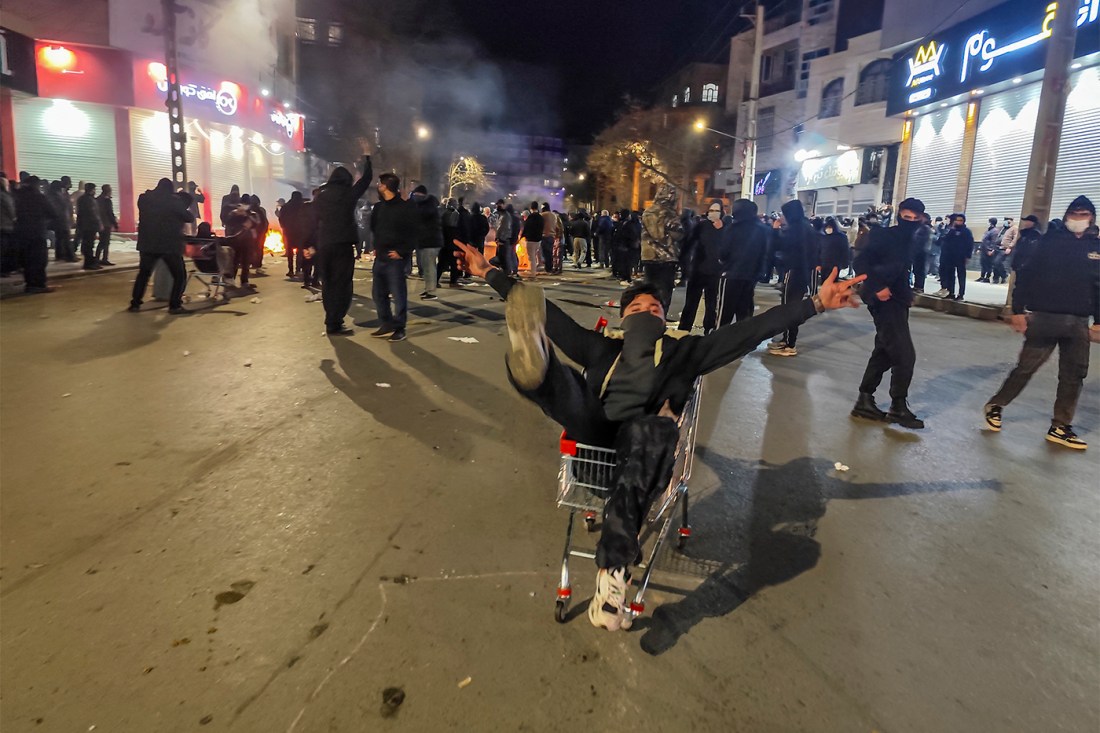

Iran’s nationwide internet shutdown has surpassed its 130th hour as tensions in the Middle Eastern country continue to escalate.
Iranian officials imposed the near blackout of the global information superhighway on Jan. 8 in an attempt to suppress anti-government protestors, according to international watchdog groups that have been monitoring recent events in Iran.
Since the protests started late December, at least 2,586 protestors have been killed according to the nonprofit advocacy group Human Rights Activists in Iran.
Reporting from other media outlets, including CBS News puts the number of dead potentially closer to 12,000 to 20,000.
While the country has eased some restrictions, allowing people to make international calls via cellphone, most internet restrictions remain in place.
Northeastern Global News spoke with David Choffnes, executive director of Northeastern University’s Cybersecurity and Privacy Institute, and Josep Jornet, associate director of Northeastern’s Institute for The Wireless Internet of Things, to better understand internet shutdowns.

What does it mean to shut down the internet?
“It literally means restricting access to the internet, either to only some users, to specific applications or to all uses and all applications,” said Jornet.
The easiest way to disrupt the internet’s routing mechanisms is to block people’s IP addresses — their unique network addresses — from being visible to the rest of the world, he said.
Northeastern Global News, in your inbox.
Sign up for NGN’s daily newsletter for news, discovery and analysis from around the world.

“Effectively, the devices are still turned on, but they are cut off from the global conversation because no one can ‘find’ them,” he said.
Choffnes added that during internet shutdowns you can often still connect your device to your home router or a cellular tower, but your service provider simply won’t send your data to the internet.
“It’s as if they just cut the cables that make internet communication work,” he said.

Why do some governments resort to this tactic?
Governments often limit or cut internet access to restrict the flow of information and “quell dissent”, according to the World Economic Forum.
They are effective in preventing “people to gather and coordinate” to plan large-scale activities, said Jornet.
“Also, to keep the outside world from knowing what’s happening,” he said.
In a Jan. 12 statement, the international rights advocacy organization Human Rights Watch said that the ongoing internet shutdown in Iran had “severely hampered efforts to corroborate unlawful killings and other violations.” It noted that the group was “documenting emerging evidence of killings, including verifying video footage from morgues and hospitals, as well as witness accounts.”
Do governments have a killswitch they can flip to cut internet access?
Some do, yes.
Much of Iran’s telecommunications infrastructure, for example, is controlled or owned by the state, making it easy for Iranian authorities to shut down service at a moment’s notice, the experts explained.
Iranian officials have spent years developing this centralized system known as the National Information Network, said Jornet. All data coming in and out of the country must pass through the state-controlled Telecommunications Infrastructure Company, giving the state full access to the information flowing through its networks, he said.
“Think of it like a house with only one main water valve,” said Jornet. “Even if there are many faucets inside (different Internet Service Providers like Irancell or Mobile Communications of Iran), the government holds the main valve and can shut off the flow to the outside world instantly.”
As demonstrated with the latest blackout, this type of control allows the government to essentially block any internet service they see fit, while allowing others, Choffnes explained.
“That’s probably why we’ve seen the vast majority, but not all, of the IP addresses have been made unreachable on the internet by the telecoms that control them,” Choffnes said.
China and Russia are a few other countries that have similarly structured their networks to exert greater control over people’s internet access, Choffnes said.
“These are often referred to as splinter nets,” said Choffnes. “The idea of the internet was that it was meant to provide global connectivity with no impediments, but instead we are seeing countries, usually authoritarian ones, creating their own internet within their own country and tightly controlling how they interact with the rest of the world.”
Why is it such a big deal to shut it down?
The world runs on the internet, and even short and relatively small-scale disruptions can have horrible consequences, Choffnes explained.
He pointed to the Amazon Web Services’ outage last fall as an example, which causes connectivity issues with everything from Reddit and Snapchat to Delta and Zoom.
“Many of the services we rely on for communication, commerce, and safety fell over,” he said. “Now imagine it’s all of those services we rely on. We’d be in pretty bad shape.”
How many internet shutdowns were there in 2025?
SinceJanuary of last year, there have been 97 intentional internet shutdowns by governments around the world, according to the Internet Society, a global nonprofit organization that tracks shutdowns. Since 2018, India has shut down the internet 423 times, the most of any other country, according to data compiled by the organization.
Can services like Starlink, the satellite internet provider, be used to circumvent internet blackouts?
Yes, and they are being used in Iran right now.
While Starlink devices are illegal in the country, recent estimates suggest that more than 50,000 Starlink receivers have been smuggled in and are in active use, according to Holistic Resilience, a U.S.-based nonprofit organization that provides support to Iranians to get access to the web.
A small group of people in the country have been using them to get online during the blackout, according to reports from The Guardian.
Starlink also began granting access to people in Iran to use its service for free.
Iranian officials are reportedly using jammers to try and cut access, but they don’t have as much control over them as their own telecommunications infrastructures, Choffnes said.
“They are jamming them because they don’t have centralized control,” said Choffnes. “They can’t tell Starlink to shut down. So in that case, they can only try and disrupt it.”
The government’s jamming technologies are not as sophisticated in preventing people from going online, Choffnes explained, as jammers need to be in proximity of their target for maximum potency.
However, “it is nonetheless inconvenient in the sense that it is strictly illegal to have a Starlink receiver,” added Choffnes. “You may be risking your life by using one of these receivers.”
Editor’s Picks





Is there an international body governing the Internet?
No, the internet has no centralized controlling body, Choffnes said.
The only international body involved is the Internet Corporation for Assigned Names and Numbers, which assigns IP addresses and domain names that are eventually given to companies and individuals, Choffnes said.
“Those bodies do not control how those addresses and names are connected to each other over the internet,” he said.
Are there no laws or standards that must be followed to operate on the internet?
We do have international standards prohibiting these forms of censorship, but individual countries don’t have to follow them. They have their own laws, Choffnes said.
“The United Nations has declared that freedom of access to information is a basic human right. It’s in the similar spirit of our First Amendment in the U.S., but enforcing that across borders is essentially impossible,” he said. “All you can try and do is evade [censorship], and there’s a lot of research on evading censorship, but all that requires internet connectivity, and right now that’s not the situation in Iran.”


