As peace talks loom, status of Russian language emerges as a key battleground in the Ukraine war
Beneath the latest series of negotiations, another long-simmering front in the war has started to come to a head: the fight over language, culture and identity.
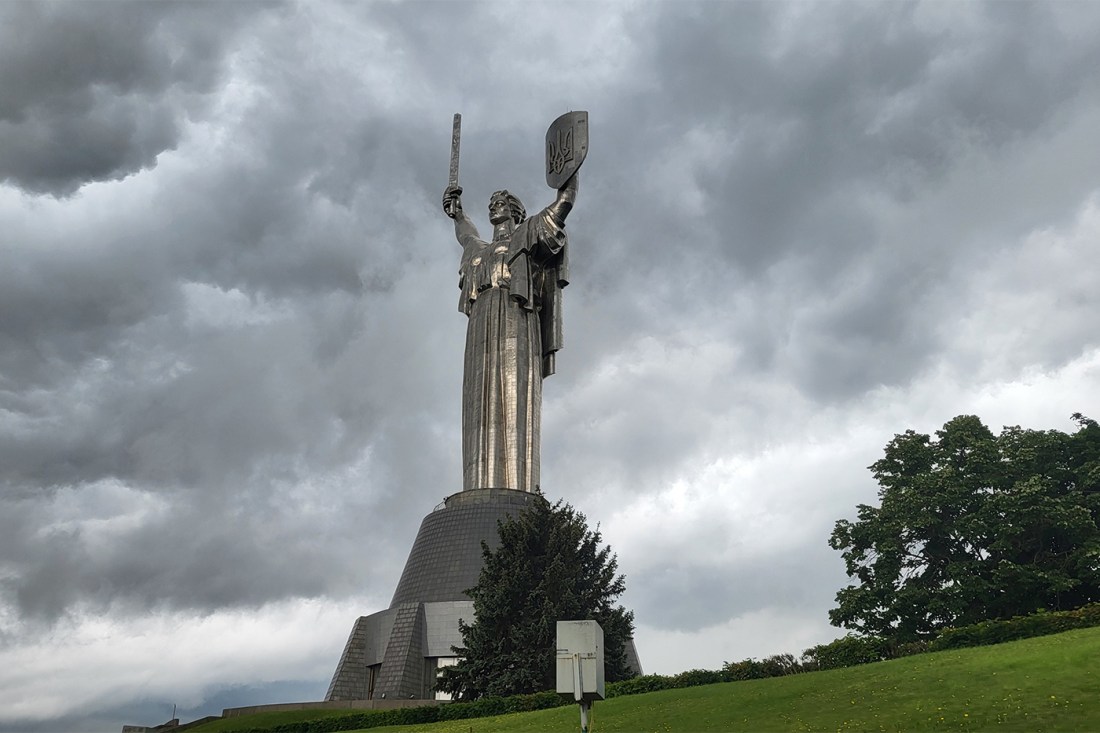

As Ukraine, Russia and the United States edge fitfully toward a U.S.-led peace proposal to end the war, much of the public discussion has focused on the contested Donbas region, the question of security guarantees and the shape of any settlement acceptable to Moscow.
But beneath the latest series of negotiations, another long-simmering front in the war has started to come to a head: namely, the fight over language, culture and identity.
On Dec. 3, for example, Kyiv moved to strip Russian of its status under Europe’s Charter for Regional or Minority Languages. And in the Russian-occupied territories in the Donbas, authorities have nixed Ukrainian language instruction and textbooks in schools, replacing them with Russian curricula and materials.
For the Kremlin, preserving the Russian language is linked to what Russia believes it needs for its own security — chiefly, Ukraine as a buffer region between itself and Europe more broadly, said Peter Fraunholtz, assistant teaching professor in history and international affairs at Northeastern University.
“The language component is about preserving Russian influence — certainly in the east, but ideally throughout the region,” Fraunholtz said. “It may seem innocuous, but it’s a powerful symbol for Moscow.”
Russian President Vladimir Putin considers the Russian language a principal element of Russian identity and has weaponized it as a way to try to secure control over Ukraine. One of his justifications for invading his smaller neighbor was to protect Russian-speakers from what he described as discrimination and persecution.
Fraunholtz said Russian anxieties about the Russian language now manifest can be traced back to EU efforts in the 2000s, such as the Eastern Partnership initiative, to engage former Soviet republics, which encouraged them to incrementally transition toward economic and regulatory practices more aligned with EU trade. From Moscow’s perspective, this signaled a broader civilizational shift that undermined Russia’s cultural influence in the region, he said.
“Language has long been a form of soft power for Russia, Fraunholtz said. “During the Cold War, the Soviets tried to teach Russian everywhere as a way of creating ties and spreading influence.”
The thinking was that if people learned Russian, they could study in Moscow, which further “cemented Soviet influence and its sense of superiority,” he added.
As developments on the frontline and diplomatic maneuvering dominate the headlines, the struggle over Russian language rights has become a potent ideological battleground, and experts say Moscow’s insistence on protecting “ethnic Russians” and preserving Russian culture in the Donbas and beyond has contributed to the ideological tug of war.
Julie Garey, a Northeastern associate teaching professor of political science who studies Russia’s relationship with the West, said Putin and the architects of the 2022 invasion have been consistent in their framing: that the operation was not simply about invading Ukraine, but about “defending ethnic Russians and defending Russian culture, language and history in Crimea” against what they described as Western threats to that identity.
“On one hand, there is something sincere in saying they want to preserve a particular history, culture, religion — even language,” she said. “There’s something to be said for wanting to protect people’s ability to identify with those things as a larger heritage.”
But, she said, that rationale is overshadowed by a far uglier reality: a war that has killed upwards of hundreds of thousands of people — one aimed at restoring Russia as a state, with real sway in the global order.
Editor’s Picks





A key demand for the Kremlin in negotiations to end the war has continued to be protection for Russian speakers in Ukraine.
Putin told English-language India Today TV earlier this month that Russia was determined to protect its interests in Ukraine, including its people, traditional values and religion that he said “has been cultivated on these lands for centuries.”
Indeed, Fraunholtz said he sees other forces behind this push to preserve the Russian language, including the Russian Orthodox Church, which considers both language and the status of Kyiv as central to its history.
“Putin isn’t inventing this rationale on his own; there are constituencies that support or originated these ideas,” Fraunholtz said.
In November, Putin signed the State National Policy Strategy of the Russian Federation until 2036, a strategic policy document that decried the “erosion of traditional Russian spiritual-moral and cultural-historical values” and what the Kremlin deems to be “growing Russophobia” abroad. The document also notes that Russia’s occupation of Ukrainian land has “created conditions for restoring the unity of the historical territories of the Russian state.”
Fraunholtz noted that the Kremlin’s urgency may stem in part from demographic pressures at home. He said the Russian Federation has around 100 languages, and birth rates are higher among non-Russian populations.
“So the issue may be less about people rejecting Russian and more about a shrinking ethnic Russian population,” Fraunholtz said.
The Russian language has actually rebounded in places like the former Soviet republics of Armenia and Georgia because of the recent exodus of Russians avoiding conscription, Fraunholtz said. It remains widely used in Central Asia, also former Soviet territory, though less so in the Baltic states.
Ekaterina Burvikova, a Russian language scholar and lecturer at Northeastern, said the war has transformed the Russian language from a “tool for everyday and professional communication” into a charged instrument of power and identity. As more Russian-speaking Ukrainians completely abandon the language, it remains a vital tool connecting generations — and one that can help shed light on the various “cultures, histories and social issues” within the broader Russian Federation, Burvikova said.
“The Russian language has also become a victim of the war,” she said.
The decision by the Ukrainian Parliament to strip the Russian language of protections, though denounced by Moscow, was celebrated by many across Ukraine.
“Today we have finally restored historical justice and turned the page on years of distortions that were used for political pressure and to legitimize Russification,” Olena Ivanovska, Ukraine’s language ombudsman, said in a Dec. 3 statement.


