Northeastern earns 2026 Carnegie classification for community engagement
Northeastern University has received the 2026 Carnegie Community Engagement Classification, recognizing its long-standing partnerships and local impact.


Northeastern University has received the 2026 Carnegie Community Engagement Classification, a designation that recognizes the quality and scale of the university’s community partnerships.
The Carnegie Classification for Community Engagement is an elective designation awarded by the American Council on Education and the Carnegie Foundation for the Advancement of Teaching. A total of 277 institutions currently hold the designation, representing fewer than 10% of eligible U.S. colleges and universities.
“We celebrate each of these institutions, particularly their dedication to partnering with their neighbors — fostering civic engagement, building usable knowledge and catalyzing real world learning experiences for students,” said Timothy F.C. Knowles, president of the Carnegie Foundation.
Chelsea Lauder, Northeastern’s director of outreach and programming in the office of city and community engagement, said “this classification is a testament to the investment that the university has put into being a good neighbor and caring about the impact that we have in the world.”
Northeastern first received the designation in 2015 and reapplied last year to maintain the classification.
“It amplifies and recognizes something that we already know — Northeastern has a deep impact on the communities that we reside in,” said John Tobin, the vice president of city and community engagement. “This is really a shared award. It simply would not be possible without the partnership of a multitude of organizations and the individuals that make up those organizations out in our neighborhoods.”
Northeastern partners with nonprofits, K–12 schools, city agencies and local businesses. In Boston, Northeastern prioritizes long-term partnerships with communities in Fenway, Roxbury, Mission Hill and the South End neighborhoods.
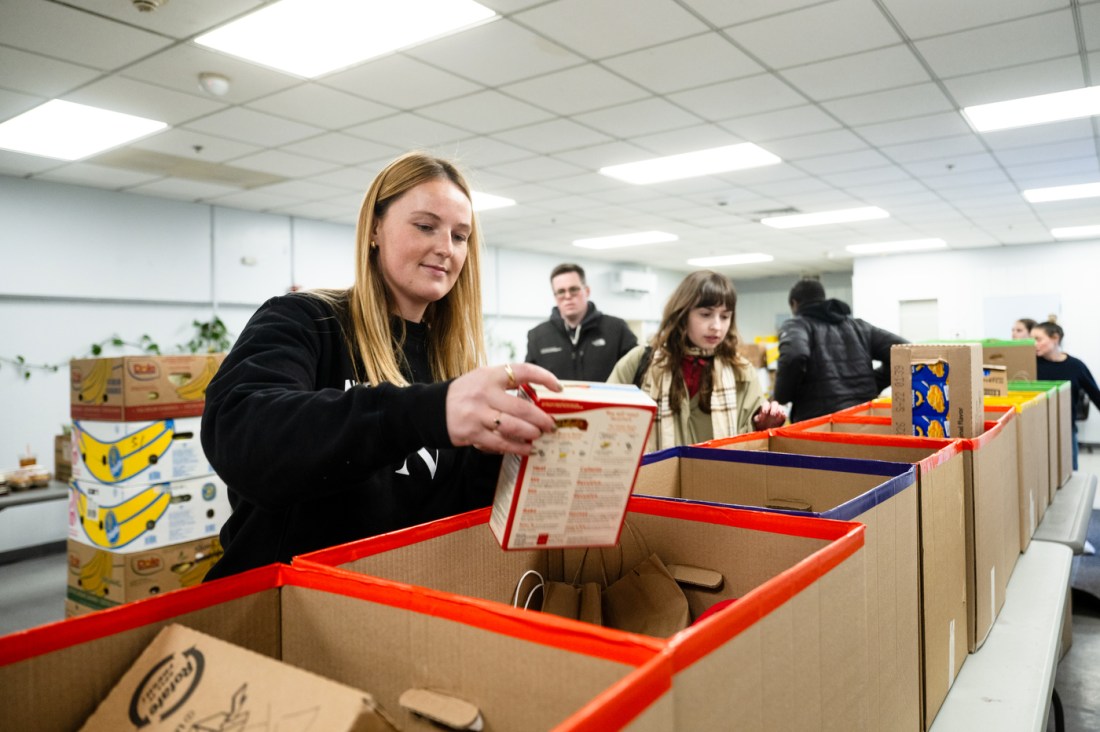
Student-run organizations such as Peace Through Play, which engages Boston youth through educational games, crafts and other learning mediums, directly affect Northeastern’s neighbors, Tobin said. Faculty-run initiatives help small businesses “get on their feet” by supporting back-of-the-house operations. Northeastern staff volunteers in the neighborhoods, participates in blood drives and delivers food to individuals in need in the Fenway area every week.
Mallory Rohrig, executive director of the Fenway Community Center, which addresses the diverse needs of the Fenway neighborhood with a broad range of programs and resources, said Northeastern has demonstrated a strong commitment to the Fenway community through meaningful partnerships, including event sponsorship, support of the center’s food pantry and placement of a co-op student.
“Northeastern’s approach reflects a deep respect for community-based organizations, responding to identified needs and empowering local partners to effectively serve their neighbors,” Rohrig said.
In fiscal year 2023, Northeastern invested $40.7 million in community initiatives, including scholarships for Boston-based youth, AmeriCorps programs and cash payments in lieu of taxes to the city of Boston. In fiscal year 2024, the university spent $335.5 million on procurement from small and local businesses, including women- and minority-owned businesses.
Recent initiatives include the creation of a $1 million housing stabilization fund, construction of a pedestrian footbridge connecting Fenway to Roxbury, and the establishment of a polling location at Northeastern Crossing, a dedicated community space that connects Northeastern University with its Boston neighbors.The university also established and supports programs such as Foundation Year, an alternative first-year program for low-income Boston-based students; Bridge to Calculus, an intensive six-week summer program for high school students; and the NU Summer STEM Program for middle school students.
During the 2021–2022 academic year, 69 faculty members taught community-engaged courses, reaching about 30% of the university’s students. Approximately 3,600 participants from more than 160 community groups use space at Northeastern Crossing every year.
Marianna Golyak, a Northeastern graduate and chief development officer at Beat the Odds, an organization dedicated to serving under-resourced youth in Boston’s low-income communities, said she was proud to be connected to a university that consistently shows up for its surrounding communities.
“Northeastern’s approach is grounded in trust, mutual learning and a deep commitment to creating meaningful impact,” she said.
Over the past decade, Northeastern has expanded into a global campus network with 13 campuses across the U.S., the U.K. and Canada. New campuses have been recognizing partners in their local communities, Tobin said. For example, Northeastern Oakland introduced a scholarship program for the youth living near the campus.
“Students, faculty and staff at other campuses outside of Boston, just like Boston, don’t want to just go to work and go home afterwards. They want to be part of the civic fabric of whichever city they reside in,” Tobin said. “It’s part of our DNA.”
The application process for the classification was extensive, Lauder said. The 91-page submission required months of campuswide collaboration to document how community engagement has expanded across teaching, research and service since Northeastern’s initial classification.
“No one person could fill out this application and write it,” Lauder said.
A core team of five led the effort, working with nearly 50 people across the university through a series of interdisciplinary working groups.