The cadre of marshals wants YOU
Northeastern’s cadre of marshals — the face of the university’s faculty at commencement ceremonies — is seeking new volunteer members.


When Ana Otero joined Northeastern University four years ago as an associate teaching professor of biology, she wanted to connect with colleagues outside her department.
To do that, she joined the cadre of marshals, a group of volunteer faculty members from across the university who represent the faculty in an organizational role during major events, helping to ensure that large, complex ceremonies run safely and smoothly.
Although she was a little stressed in the beginning — “because you know that everyone is looking at you,” she said — the experience soon became deeply rewarding. Through the cadre, Otero said she made friends in different colleges and disciplines, got to know the deans of colleges and staff members, and gained a better understanding of the university’s structure.
“I now look forward to the commencement and participating in ceremonies,” she said. “I sign up for as many as I can, and I enjoy chatting with everyone and being part of it.”
The cadre represents academic importance and decorum at events such as the President’s Convocation, commencement and college graduation ceremonies, said Chelsea Kryspin, associate director of Academic Ceremonies.
“They’re so extremely important to the entire ceremony, and we couldn’t do it without them,” Kryspin said.
The cadre is currently looking to recruit four to five new members.
What the cadre does
Christopher Bosso, professor of public policy and political science and a former chief marshal for three years, has been part of the group for 25 years. He began volunteering at Northeastern commencements in the 1980s.
“Being essentially a first-generation college kid myself back in the day when that was more typical and understanding how important it was to get your college degree, I thought it was really important for faculty to attend commencement if they could, and to be a witness to the joy,” he said.
When the first formal cadre was created in 2002, Bosso was invited to join.
“I primarily joined it because I enjoyed working at the commencement,” he said. “But being part of the cadre meant that I get to meet people from other parts of the university and be part of an important day in students’ lives.”
The group usually consists of about 20 volunteer faculty members who work closely with the Academic Ceremonies office.
Early each year, members submit their availability for the commencement and college graduation ceremonies. The chief marshal determines staffing needs for each event and assigns roles.
Typical assignments during the annual commencement in Fenway Park include escorting the presidential party to the stage, ensuring safety on the stage stairs, leading the procession of college flags or guiding lines of graduates from the staging area to their seats. Marshals provide advice on how to wear the regalia properly or resolve last-minute emergencies such as a missing tassel.
The cadre also helps maintain the pacing and order of the ceremony and is prepared to step in during unexpected situations, including evacuations or rerouting processions.
While everyone is rather happy and enthusiastic on commencement day, said Stefano Basagni, professor of electrical and computer engineering and associate dean of the global engineering campus, marshals feel the pressure of making sure the ceremony goes seamlessly.
“You are focused on organizing the students so that they don’t realize that they are being organized because it’s their day and they should just have a good time,” he said.
Basagni began volunteering at commencements after joining Northeastern in 2002 and became part of the cadre in 2008 after receiving tenure.
“What really makes us happy when we see each other and we serve in the ceremony, is that we are all enthusiastic about supporting our students,” he said.
In addition to the cadre, more than 200 faculty and staff volunteers help greet, direct, line up and seat 4,000-5,000 graduates at Fenway Park every year.
Camaraderie and cadre medals
Members of the cadre stay connected between ceremonies and gather each fall for an annual dinner.
“There’s a lot of collegiality and camaraderie,” said Mary Jo Ondrechen, professor of chemistry and chemical biology and the first female chief marshal, elected in 2024.
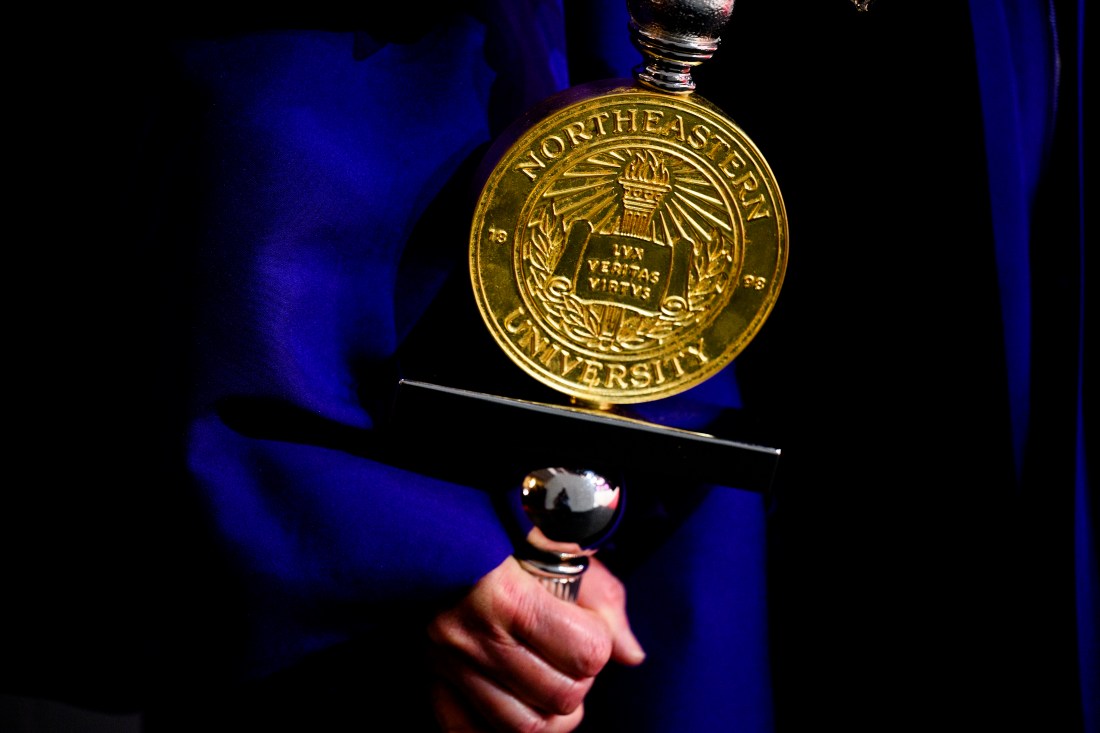
The Academic Ceremonies office also recognizes marshals with a special faculty cadre medal pinned to their regalia. Every five years, members receive a tag that attaches to the medal and indicates years of service.
“It’s just kind of sweet,” said Otero, who is looking forward to getting her five-year tag.
Who the cadre is looking for
The cadre values diversity across disciplines, ages and genders, said Lauren Kazi, an assistant director of Academic Ceremonies. Most successful cadre members are detail-oriented, can understand complex directions and pivot in unexpected situations, Kryspin said.
For Ondrechen, who will be reviewing applications, the most important factor is whether candidates recognize and value the importance of the commencement ceremony.
“The students who are graduating have worked very hard for those degrees, and it’s our duty to recognize them and honor them as best we can when they graduate,” she said.
Successful commencement, she said, also encourages students to become loyal and active members of the alumni community. The Academic Ceremonies office provides a lot of training resources, from detailed documentation for different roles and emergency preparedness guides to recordings of past ceremonies.
“We usually have new members shadowing another cadre member,” Kazi said.
In the beginning, she was given small tasks, Otero said, but she learned quickly.
“Everyone is very friendly and is willing to teach you and explain things to you. Even if you do something wrong, nobody gets upset,” she said.
Members typically wear regalia of their alma mater, but the university provides new members with Northeastern regalia if needed.
“It’s a wonderful experience and I encourage anyone who is thinking about being part of a larger role at the university, but also being able to connect with people outside their units to join the cadre,” Otero said.
If you are a full-time Northeastern faculty member and are interested in joining as a member of the cadre of marshals, please, email commencement@northeastern.edu for more information.