Want to get better at using AI? Try empathy
Working effectively with AI involves a special set of skills, but new research highlights an underrated one: empathy. A Northeastern researcher found that social skills are more valuable than you might think.
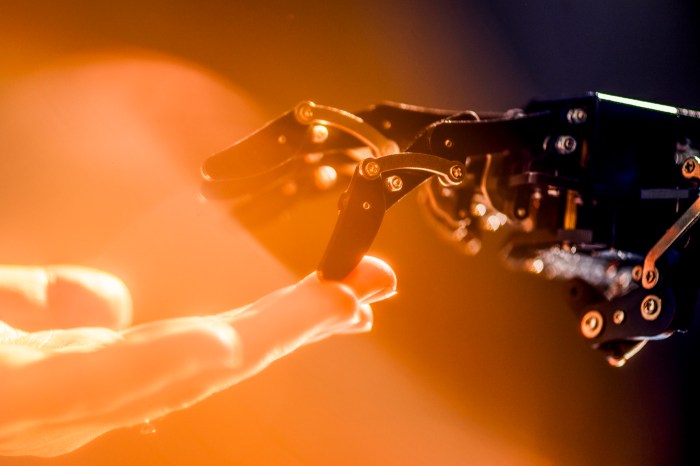

For an increasing number of Americans, a new kind of co-worker is making their work easier.
One in five Americans is now using artificial intelligence in at least part of their work, according to the Pew Research Center. But what does it mean, and what does it take, to collaborate well with AI? Until recently, the answer to that question has been technical literacy skills like prompt engineering, knowing how to get the best response from an AI chatbot like ChatGPT.
However, researchers found a different skill might make a bigger difference: empathy.
In trying to quantify human-AI synergy, Christoph Riedl, a professor of supply chain and information management at Northeastern University, discovered that the same skills that benefit human teams — empathy and perspective taking — help humans and AI agents.
“There’s no special AI skill,” Riedl said. “It’s just good old-fashioned soft skills.”
Riedl, who specializes in the study of team synergy and collective intelligence, and his collaborators teased apart how effective human and AI synergy is in different situations.
They developed a method for calculating human and AI collaboration, measuring a statistical prediction of how well someone should do on a task with how well they actually do on that task with or without the help of AI. Then, they tested that method on people with a range of different skill levels and two AI chatbots: the “state of the art” ChatGPT-4 and the “reasonably dumb” Meta Llama 3, Riedl said.

Participants faced a set of questions that researchers often use as an AI benchmark, which includes math, physics and moral reasoning questions. They would answer a few questions on their own and then answer questions with access to either ChatGPT or Llama.
Working on their own, humans got about 56% of the answers right, while ChatGPT and Llama got 71% and 39% right on their own, respectively. However, once humans and AI started working together, the results were immediately noticeable.
“That’s really interesting because alone the Llama model seems to be so dumb it can’t really answer these questions, but combined with human intelligence and … through their combined collaboration they create synergy,” Riedl said.
One of the most pressing questions around AI and its impact on labor is whether the technology will close the gap among workers of different skill levels, Riedl explained.
Riedl found that human-AI collaboration definitely benefits lower-skilled people. They have more room to grow, so their performance can increase much more with help from AI. However, while the chatbots in this study also helped higher-skilled people to a much lesser degree, even a smaller boost in performance kept them ahead of the pack.
“High-skilled people remain high-skilled with AI,” Riedl said. “It helps close the skill gap a little bit, but because it still doesn’t close it entirely, it, in a way, amplifies it because the best-skilled people are still the best-skilled people. If your goal is to solve the hardest problems, even the best people will benefit from AI.”
Companies like IBM have already acknowledged a significant AI skill gap among workers, with some of the inequity being traced to a gap in access to AI training. In research done by multinational recruiter Randstad, around 75% of companies have started adopting AI, but only 35% of employees have actually been trained in how to use the technology. Those gaps are particularly significant between men and women and baby boomers and Gen Z.
Editor’s Picks



However, much of the conversation around “AI skilling” has focused on technical skills, whether it’s programming or prompt engineering. Riedl’s research reveals that something called theory of mind, or social perceptiveness skills like empathy, can be just as important.
Some participants in the study would simply start a conversation with their chatbot by writing, “Help me answer this question,” without providing the question. These people hadn’t taken the time to understand what the chatbot did or didn’t know.
Others were more understanding. They would even write things like, “I’m not good at math. Help me understand this like I’m 12 years old,” to help the chatbot understand more about them. Already a great predictor of human synergy, this kind of perspective-taking had a concrete impact on the quality of AI responses.
“Because the AI spits out a better answer, you can then collaborate better and come up with a better answer for the question,” Riedl said. “The key driver is that my theory of mind ability is somehow reflected in how I prompt it, and that makes the AI write a better answer.”
As more and more people interact with AI on a daily basis, Riedl hopes the soft skills don’t get lost in the conversation around what it means to collaborate with these technological agents. They might be even more important than ever, he said.
“There’s just a general thing that makes people collaborate well with others, and it doesn’t really matter whether this other is another human or another AI agent,” Riedl said. “Soft skills make humans better at working with humans, they make humans better at working with AI, and it turns out it even makes AI better at working with AI.”


