After capture of Nicolás Maduro, is the U.S. now at war with Venezuela — and was the move legal?
The United States military, under the veil of darkness, carried out “a large-scale strike” in Caracas, Venezuela and captured the country’s president and his wife, according to President Donald Trump.
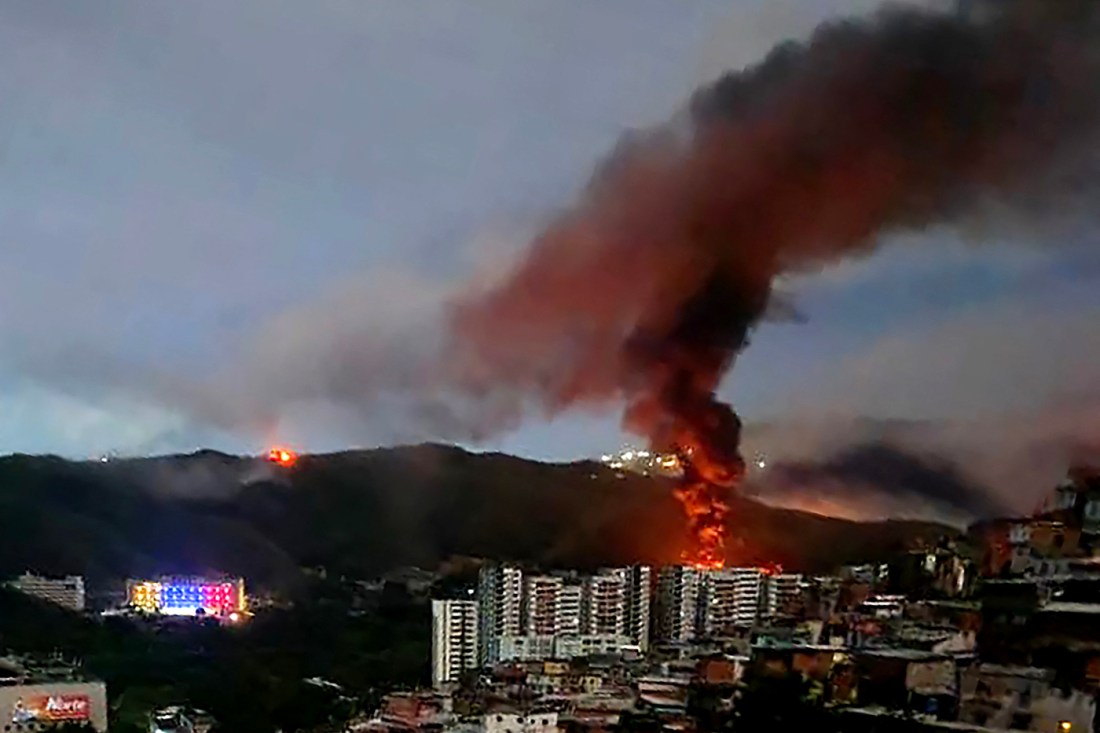

The United States military, under the veil of darkness, carried out “a large-scale strike” in Caracas, Venezuela and captured the country’s president and his wife, according to President Donald Trump.
“The United States of America has successfully carried out a large scale strike against Venezuela and its leader, President Nicolas Maduro, who has been, along with his wife, captured and flown out of the Country,” Trump said on Truth Social. “This operation was done in conjunction with U.S. Law Enforcement. Details to follow. There will be a News Conference today at 11 A.M., at Mar-a-Lago. Thank you for your attention to this matter!”
The dramatic capture of Nicolás Maduro and his wife, Cilia Flores, marks a sharp escalation after months of rising tensions that included increased sanctions enforcement, boat strikes in the Caribbean against alleged drug smugglers, and increasingly confrontational rhetoric from the administration toward the Maduro government, which it sees as illegitimate and promoting transnational crime.
It comes amid mounting speculation about potential U.S. action following reports that the Central Intelligence Agency had conducted a drone strike on a port facility in Venezuela in December, with officials also seizing an oil tanker in Venezuelan waters around the same time.
Jeremy R. Paul, a professor of law and former dean of the Northeastern University School of Law, said that if Maduro was on U.S. soil, seizing him in this manner might be consistent with law. But capturing the foreign leader in his home country raises questions about the reach of U.S. criminal jurisdiction — and whether such an act would violate international law.
“Allowing the seizure of a foreign leader in his own country to execute a warrant basically means that we are granting U.S. grand jurors, along with prosecutors, the power to declare war,” Paul said.
Article I, Section 8 of the U.S. Constitution gives Congress the express power to declare war.
The Department of State and the Department of Justice had previously issued a $50 million bounty on Maduro’s head for information leading to his capture and arrest. In a tersely worded press release, officials in August cast doubt on the legitimacy of the Maduro regime after Venezuelan authorities declared Maduro the winner of the 2024 election, earning about 51% of the vote.
Editor’s Picks




“Maduro claimed to have won Venezuela’s July 28, 2024, presidential election but failed to present any evidence that he had prevailed,” U.S. officials wrote. “The United States has refused to recognize Maduro as the winner of the 2024 election and does not recognize him as the President of Venezuela.”
Paul noted that there is precedent in U.S. law that even if Maduro’s abduction was unlawful, U.S. courts may try him here in the U.S. The precedent, known as the “Ker–Frisbie” doctrine, is controversial, he said, but has been in place for a long time.
Under the rule, a person can face trial in a U.S. courtroom regardless of how they arrived there. That means even if a foreign leader were forcibly taken in violation of international law, U.S. courts could still legally prosecute them once they are on U.S. soil.
“The Trump Administration will likely also assert the seizure was legal as part of the U.S. right to self-defense based on Venezuela’s contribution to drugs entering the U.S.,” Paul said. “How serious such an emergency is depends upon facts on the ground. But consider how many countries are sources of unlawful drugs and whether such a rationale can be reasonably confined to Venezuela.”
U.S. Attorney General Pam Bondi said in a social media post on Saturday that Maduro and his wife have been indicted in the Southern District of New York and will “soon face the full wrath of American justice on American soil in American courts.”
Maduro has been charged with “narco-terrorism conspiracy, cocaine importation conspiracy, possession of machineguns and destructive devices, and conspiracy to possess machineguns and destructive devices against the United States.”
The U.S. has carried out such missions — sometimes referred to as “capture or kill” missions — in the past, particularly during counterterrorism campaigns after the Sept. 11 attacks. Those missions, typically conducted by U.S. special operations forces or intelligence agencies, have been justified by U.S. officials as necessary for national security but have often drawn legal and diplomatic criticism.
Zinaida Miller, Northeastern professor of law and international affairs, said the actions of the administration of deposing and abducting the Venezuelan president “are a blatant violation of Article 2(4) of the UN Charter, which prohibits the use of force without Security Council authorization.”
“There is no defense: there was neither a prior attack nor threat of one by Venezuela that could even arguably make this act lawful self-defense. This is clearly an unlawful act of aggression,” Miller said. “International law is quite clear that one country cannot lawfully overthrow the leader of another, nor can it try them in its domestic courts.”
The Saturday morning strikes represent the most direct U.S. action against Venezuela’s leadership in decades — a dramatic departure from previous efforts, dating back to the Obama administration, to isolate Caracas through diplomatic and economic pressure.
For Venezuela-born Vanessa Salas Fuentes, news of Maduro’s arrest brought feelings of elation at the prospect that Venezuelans could wrest control back from a government that forced millions into exile, ruled through repression and engineered electoral outcomes.
“As a Venezuelan immigrant in the U.S., there is generally a misunderstanding about why we [Venezuelans] are happy” about Maduro’s removal from power, Fuentes, a Northeastern alum, said. “The price that we’ve been paying for the last 26 years is a lot higher than what is at the table now.”
However, Fuentes added that “there is no question this could backfire.” She said she believed that not only was Maduro “never” going to concede his grip on power, but that the country had become a failed state — a view shared by many experts.
Meanwhile, pro-Maduro demonstrators took to the streets in the Venezuelan capital of Caracas to express support for their head of state, calling for his release, according to images shared on social media and in international news reports.
Pablo Calderon-Martinez, associate professor in politics and international relations at Northeastern University in London, said the U.S. capture of Maduro is an “extremely concerning development” and unlikely to guarantee regime change in the South American country, an outcome Trump has openly discussed.
“We have seen how this movie ends,” Calderon-Martinez said, adding that the Maduro regime is “sufficiently institutionalized, in my opinion, to survive a leadership change.”
World leaders reacted to the news Saturday morning.
Russia was quick to condemn the U.S. seizure of Maduro and his wife, calling the pretexts cited to justify the actions “unfounded,” according to a statement from the Russian Foreign Ministry.
“Ideologized hostility has prevailed over reasonable pragmatism and over a willingness to build relations based on trust and predictability,” the statement said, adding that Moscow confirmed its solidarity with the Venezuelan people.
Kaja Kallas, the European Union’s foreign policy chief and vice president of the European Commission, said that the “EU has repeatedly stated that Mr. Maduro lacks legitimacy and has defended a peaceful transition.”
“Under all circumstances, the principles of international law and the UN Charter must be respected. We call for restraint,” Kallas said in a social media post.
The Chinese Foreign Ministry issued a statement, stating that China “firmly opposes such hegemonic behavior by the U.S.,” and that it “calls on the U.S. to abide by international law and the purposes and principles of the UN Charter, and stop violating other countries’ sovereignty and security.”
The strikes and capture “seriously violate international law and Venezuela’s sovereignty, and threaten peace and security in Latin America and the Caribbean region,” Chinese officials said. “China firmly opposes it.”
In a press conference on Saturday, Trump said the United States “will run the country” of Venezuela “until such time that we can do a safe, proper and judicious transition.” He also noted the military was prepared to conduct “a second wave of strikes” if necessary.
Maduro and Flores were arraigned on Monday in a federal courtroom in Lower Manhattan. The pair pleaded not guilty.


