This mental health care startup launched from a chance encounter
Navimental helps parents navigate mental health challenges in the health care system.

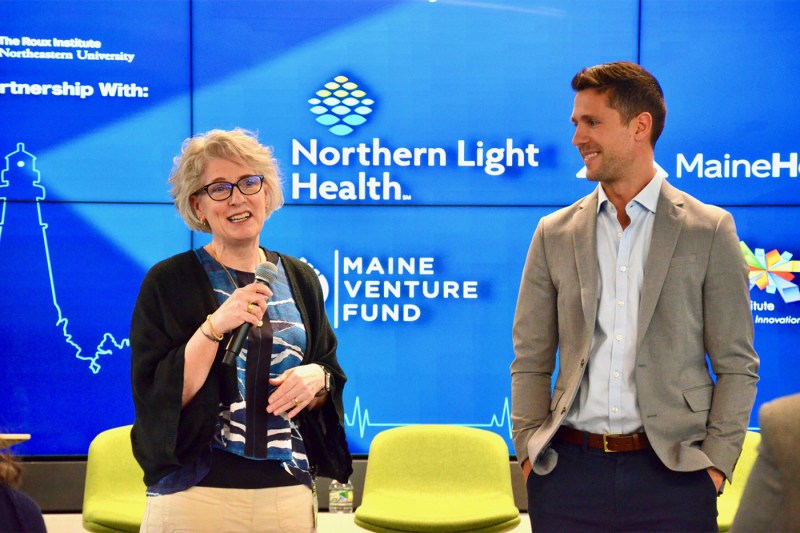
Michelle Fong and Mike Warren’s startup, Navimental, was born through a chance encounter.
The two met through a Start Summit done in partnership with Roux Institute on Northeastern University’s Portland campus and MaineHealth Pen Bay Medical Center, held in Camden, Maine in April 2024. The theme was leveraging technology to improve youth mental health, and Fong was hoping to connect with someone who could make her dream possible.
Fong wanted to create a platform to help parents whose children are dealing with mental health crises. What she found from her experience as a parent in this position was that there was little help for her to navigate this corner of the health care system.
“I’d had this idea kicking around in my brain for probably over a year, but with no real computer skills to implement it,” Fong said.
The Roux’s focus on seeding health care innovation around Maine caught her attention and she became involved in hopes of finding someone who could help bring this idea to life.
At this event, she met Mike Warren, a master’s degree student in computer science at the Roux with a background in business and technology. The two bonded over having similar experiences.
“My family growing up was impacted by mental health, and having that experience got me interested in going to this event and seeing how others in the community were thinking about mental health and what could make positive change in Maine,” Warren said. “Michelle and I connected and we really fell in love with this idea.”
From there, the two formed Navimental, a platform that allows families to connect with peer navigators, parents who offer advice on how to navigate different components of a child’s mental health treatment. Support from the Roux Institute allowed the two to take Navimental to the next level.
“One of the biggest problems for parents on that journey is isolation,” Fong said. “Navimental offers the peer experience to give you a trusted co-journeyer and somebody who can help you with your isolation and organize your thoughts into logical next steps so that you can move forward and have hope again for you and your child.”
The pair officially launched Navimental in August. They’re now focusing on how to make the endeavor financially sustainable, and they’re doing this with the help of mentors from the Roux’s Future of Healthcare Founder Residency, where they started in April.
The Roux’ Future of Healthcare Founder Residency brings 10 companies together for a year where they workshop ideas and work with mentors and an entrepreneur-in-residence to help guide their business. Participants also get a $50,000 business investment, access to the Roux facilities and in-house services from the institute.
The residency was launched three years ago in partnership with Maine Health, Northern Light Health, Maine Venture Fund and Maine Technology Institute to bring health care innovations to Maine, which has one of the oldest and most rural populations in the country, presenting unique challenges when it comes to workforce and health care. It has helped 29 ventures in Maine since its launch.
Through the residency, Warren and Fong consulted with experts in the insurance industry on selling Navimental to health care businesses and employers. The pair is trying to pitch the product to other businesses as well as individual consumers.
“It’s been critical to pointing Navimental in the right direction as a business,” Warren said. “We’ve always heard this is a need, but how are we going to make money and grow this into a sustainable business? That’s helped us answer the most critical question of turning something we know can make a difference into something sustainable and growing.”
Editor’s Picks





Much of the inspiration for Navimental comes from Fong’s experience with her daughter’s mental health and neurodevelopmental challenges. Fong left her career in biotech and pharma as navigating her daughter’s care became overwhelming. She later received her master’s degree in public health, studying policy to see if she could find a way to change the system.
“Parents have an experience through all of this,” she said. “If I’m a parent who needs to go and get therapy because I’m stressed managing a child with complex health needs, insurance will cover that. But what they traditionally haven’t covered is talking with another parent who’s experienced in this journey and trained to talk to me about navigating the care continuum. That’s what we’re trying to bring to parents who traditionally haven’t had access to that support.”
Deb Mills-Scofield, a Maine business owner and mentor-in-residence for the Healthcare Founders residency, said she was drawn to mentoring Fong and Warren because she personally has seen the need for Navimental from her own parenting experience.
While Mills-Scofield said she learned to navigate the health care system with the help of professionals, many families need help figuring out who to call when their child needs help.
“I knew immediately I wanted to work with them because it’s a need that’s not filled anywhere,” she said. “There’s nowhere to find that in a cohesive manner and it’s always on your mind. Just having someone to help you weed through all the aspects would have been invaluable.”
Navimental fills a health care gap not just in Maine, but across the nation, said Elena Brondolo, director of the Future of Healthcare Founder Residency.
“Across the country, we’re seeing huge delays in behavioral health care access,” Brondolo said. “Part of that is people having difficulty understanding how to navigate the different resources that are available to them and especially in rural populations where you might not have that immediate community connection to understand what services are available.”