Was the death of Shakespeare’s son Hamnet inspiration for one of his greatest works?
Shakespeare expert Daniel Swift looks at the historical accuracy of ‘Hamnet,’ while scriptwriter Rory Gleeson examines how to turn a popular novel into a film.

LONDON — William Shakespeare wrote: “If this were played upon a stage now, I could condemn it as improbable.”
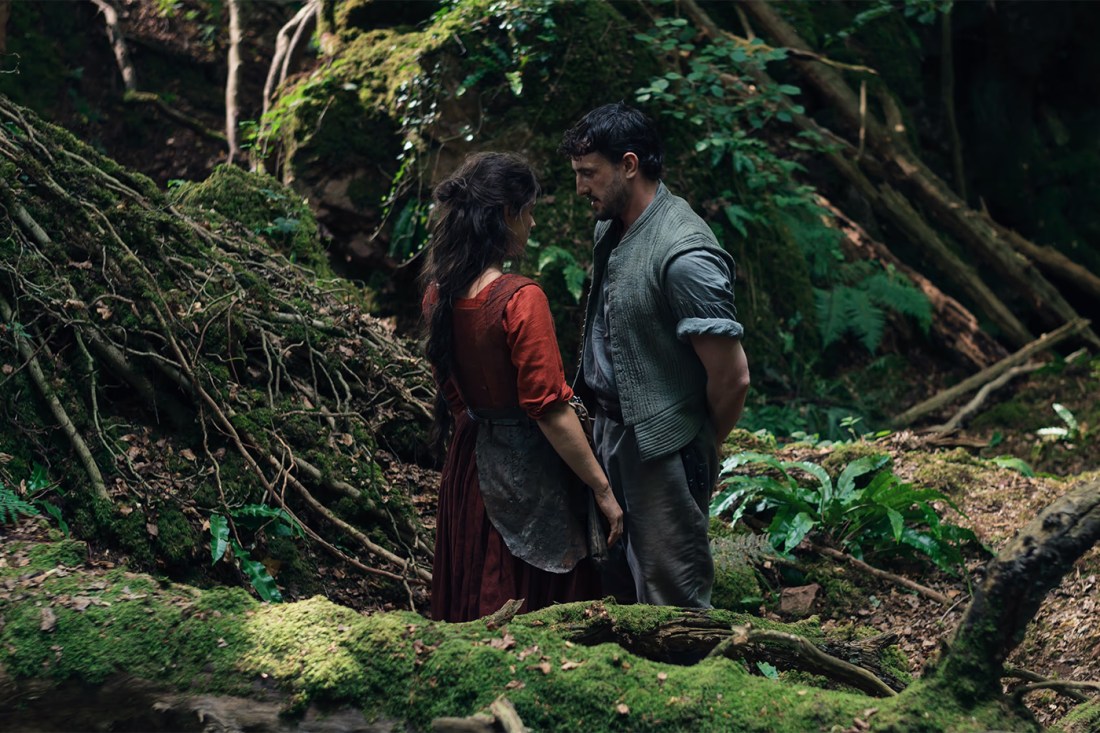
Only the playwright would be able to decide whether the same is true for “Hamnet,” the Oscar-tipped film recently released starring Paul Mescal and Jessie Buckley that offers a fictionalized account of a dark period in his life.
“Hamnet,” based on Maggie O’Farrell’s best-selling novel of the same name, is an exploration of the theory that one of The Bard’s most revered plays, “Hamlet,” was inspired by the tragedy of losing his 11-year-old son.
Daniel Swift, associate professor in English at Northeastern University in London, said there are “pretty reasonable” arguments to support that theory.
First, there is the timing. Hamnet — born in 1585, along with his twin sister Judith, to Shakespeare and his wife Anne Hathaway (the couple also had an older daughter, Susanna) — died in 1596, potentially of plague, which had regular outbreaks in Britain at the time. “Hamlet” was thought to have been written in about 1600 — only four years after Hamnet’s death.
Then there is the subject matter of the play. “If we look at ‘Hamlet,’ it’s very much a play about grief and memory and is focused on fathers and sons,” said Swift, who recently published “The Dream Factory,” a book about Shakespeare’s early career.
The names “Hamnet” and “Hamlet” were also “interchangeable with one another” in Elizabethan England, added Swift. Readers of Shakespeare, including O’Farrell, have seized on that to claim a direct correlation between Shakespeare’s personal tragedy and his stage tragedy.

But Swift said there are “problems” with what he calls a “simple” way of looking at the origins of “Hamlet.”
The first is contextual. There had been a popular play in London in the early 1580s called “Hamlet” that experts believe formed the basis of Shakespeare’s version. “What Shakespeare loved to do was take an old play and rewrite it,” Swift remarked, with Shakespeare doing something similar with “King Lear,” “Henry V” and other of his stage plays.
The life of a Scandinavian prince that contained similarities to the storyline of “Hamlet” also featured in the type of chronicles Shakespeare often used for inspiration when writing, said Swift.


Then there is the matter of Shakespeare potentially naming the main character after his son. “That’s not true either,” said Swift. “Almost always in Shakespeare’s time, people named their children after godparents — that’s where you got the children’s names from. And guess what? Hamnet, Shakespeare’s son, was named after his godfather.”
That is not to definitively say there was no link at all between the death of Shakespeare’s only son and one of his greatest works, Swift was keen to add. What “Hamnet,” both the novel and the film, positions is that Shakespeare potentially flipped the story of his own grief around — a father grieving his son — to act as inspiration for the tale that revolves around a son’s mourning for his father.
“You can see a way in which there’s a beautiful transformation,” said Swift. “He’s transforming those feelings of grief, and that’s certainly very possible.”
It is not only Shakespeare’s plays that have helped Hollywood to cash in — stories based on his life, no matter how far removed from reality, have gone down well with cinema-goers. According to the online movie database IMDB, the 1999 blockbuster “Shakespeare In Love,” starring Joseph Fiennes and Gwyneth Paltrow, raked in nearly $300 million at the box office.
Other films, such as “All Is True,” featuring Kenneth Branagh and Judi Dench, and “Anonymous,” have also looked at the different stages and controversies in the author’s life.
The push to explore the reasons why Shakespeare produced what he did is as much a ”projection from our modern age” as it is about uncovering history, Swift argued.
“We really want Shakespeare to be someone who is recognizable, human and writing about feelings and suffering in his life, and then giving beautiful words to that suffering,” he continued.
“And that might or might not be true of Shakespeare himself. The truth is that I don’t think that people in Shakespeare’s time quite thought about literature in that way. They didn’t really think about art as something that was very personal to themselves.”
O’Farrell’s “Hamnet” sold 2 million copies in the U.S. and U.K. and has been translated into 40 languages. Its adaptation for the big screen, with its story about Shakespeare’s split life between his family in Stratford-upon-Avon and his theater work in London, was a collaborative effort between the Northern Irish novelist and Oscar-winning director Chloe Zhao.
Rory Gleeson, an author and scriptwriter, said adapting a popular novel like “Hamnet” will have forced the pair to work in tighter parameters compared with working on a less well-known work for the screen.
The assistant professor in English at Northeastern said: “With a really popular and critically and commercially well-received novel like Hamnet, you’re a little bit more constrained because a lot of your audience will be those who love the novel, and they will be expecting a certain fidelity to it.”
He said the novel’s success was down to it being “deeply affecting” and it had already proved that it could connect with a large audience “in a very special way.”
“Naturally, you don’t want to try and go too far away from that,” he added. “You really want to take the really moving parts of it and try to transfer that to the screen as well as you can.”
That does not mean such films are necessarily wedded to the books they are based on, as book-loving audiences can well attest to. Gleeson said a certain amount of creative license will likely be taken so that the screenwriter or director can “put their own mark” on the work.
“Adapting can be really exciting and very fun to work on but it is also this tricky little dance because you don’t want to go too far away from the original but you also have to have your own distinctive voice in there,” he said.
“For anyone who’s loved a novel, it is very unlikely they’re going to love the film in the same way because it just hits differently. You see a novel in your head, whereas a film is there for you to see, so it’s never going to fully match up.”