Design your own experiments in Northeastern’s Wet Lab Makerspace
Independent research shines at Northeastern’s Wet Lab Makerspace, where you can take seminars on microbial art, basic lab skills and even design your own experiments.

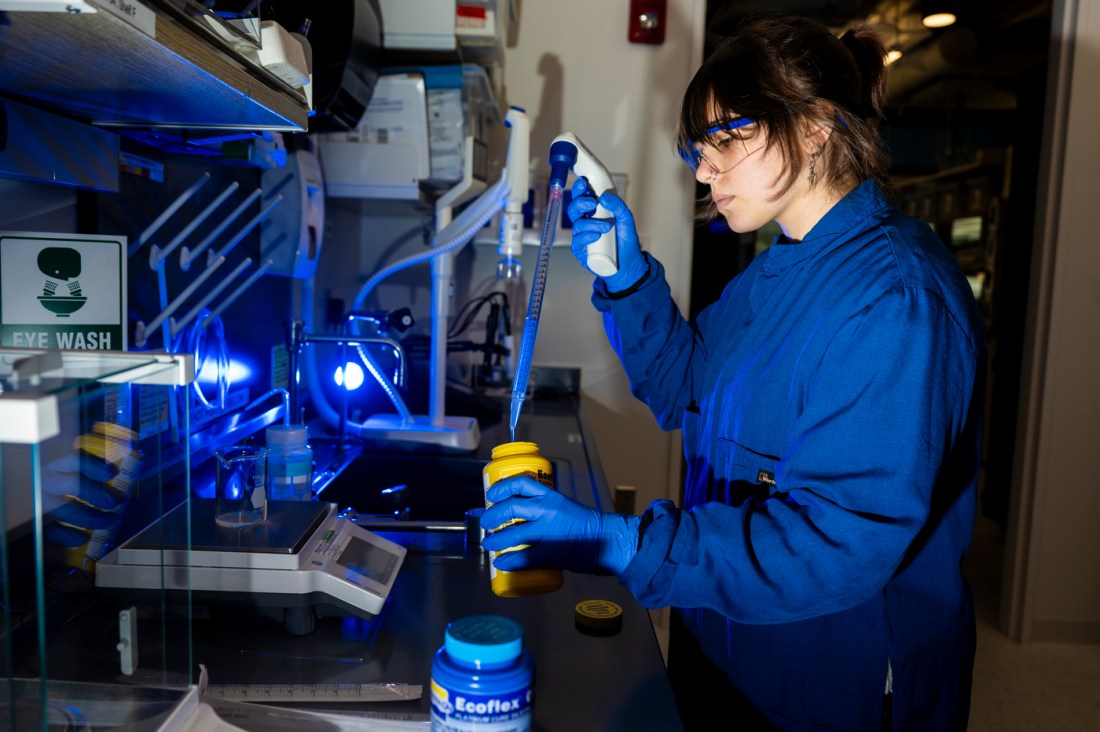
Stepping inside Northeastern University’s Wet Lab Makerspace, you’re greeted by the hum of machines and light glinting off workbenches and science equipment.
Equipment like Bunsen burners and petri dishes may look familiar, while the specialized gear of cryo-freezers and flow cytometers may not. Yet no matter your familiarity with chemistry or biology equipment, if you’re a member of the Northeastern community, it’s there for you to explore.
Located in Northeastern’s EXP research complex, the Wet Lab Makerspace provides students, faculty and staff with the skills they need to conduct their own experiments, from gene sequencing to making microbial art. Feel uncomfortable taking on your own experiment? The lab also provides regular seminars to get you up to speed on safety, tools and experimental approaches.
How to get started
Helen Kurkjian is the senior makerspace manager for the Wet Lab. The best way to get started with the space, she says, is to take an orientation, offered daily, and then to sign up for a seminar. The seminars require no prior training, except for the orientation.
The seminars vary in length, but each consists of a single session where you can explore microbiology, basic lab skills or microbial art. For microbial art, participants use dishes filled with an agar medium to grow microbes into interesting and colorful patterns. Kurkjian sees this as a way to appeal to people who might find biology unapproachable.
Blending art with science helps draw those people in, she says. When participants learn how to cultivate microbes to make art, those skills are broadly transferable into experimental contexts, Kurkjian notes.
Kurkjian says that, as far as she’s aware, the wet lab’s approach to community participation does not exist on other academic campuses.
Whether you’ve taken a wet lab seminar or not, Kurkjian says that Northeastern community members are always welcome to propose their own experimental project, for which the makerspace can provide the tools and materials.
Just like in the “dry” EXP Makerspace, which offers NU community members everything from sewing machines to 3D printers, wet lab users cover the cost of more exotic ingredients, while the wet lab itself provides common materials and all the supplies used in seminars.
Talking tomato plants
Ian Lebovitz is in his last semester at Northeastern, majoring in ecology and evolutionary biology. Before moving on to the job or graduate school markets, he wanted to conduct independent research to show off his chops and interests. “I’ve been trying to make my own experience,” he says.
Working with his thesis adviser, Lebovitz proposed an experiment investigating how plants “communicate” through mycorrhizae, the fungal networks that link root systems. For instance, when an insect feeds on a plant, that plant can release protective chemicals that travel through the fungal network and cause adjacent plants to release the same chemical preemptively.
What isn’t yet well understood is whether plants will respond similarly to non-biological threats. To study this, Lebovitz will spray one plant with a saltwater solution to see if a neighboring plant, connected through the fungal network, registers a similar chemical response.
This is “an emerging part of botany as a field,” Lebovitz says of his research area. He was decisive about the wet lab’s impact on the study: “I wouldn’t be able to do it without the makerspace.”
Art, design and science
Editor’s Picks




Katia Zolotovsky, an assistant professor of art and design with a joint appointment in chemistry and chemical biology, sees the wet lab as “an essential resource” for her interdisciplinary students, giving them “a safe, well-supported environment to prototype bold ideas and understand biotech through creative practice,” she says.
Using the wet lab, Zolotovsky has seen students sequence the Charles River’s urban microbiome to publicize pollution, develop algae and local waste-based clothing and even a toy, called SquidKid, that hosts bioluminescent microorganisms, she says.
Kurkjian has seen undergraduate students gain real-world skills that translate into better employment opportunities through this kind of project-based learning.
“One of the things that co-op employers really look for is hard evidence” of students’ skillsets, she says, and she hopes to implement a certification system in the coming months.
Kurkjian says that the space has been running at full force for a little over a year, but she has big plans for where it can go. For one, she has “a huge spreadsheet of workshops” she’d like to develop. One in particular involves mammalian cell cultivation, a more advanced seminar for both safety and skill reasons, she says, but “students really want to have hands-on bench practice.”
While Kurkjian says that most of those who come to the lab are undergraduate students unaffiliated with another laboratory on campus, the Wet Lab Makerspace is a place for all Northeastern students, faculty and staff to explore their own curiosity.