Playing pollution detective off Nahant Beach, a search for clues leads to a stunning bacterial count
A Northeastern University graduate student tested beaches near the Nahant campus to find local sources of pollution.

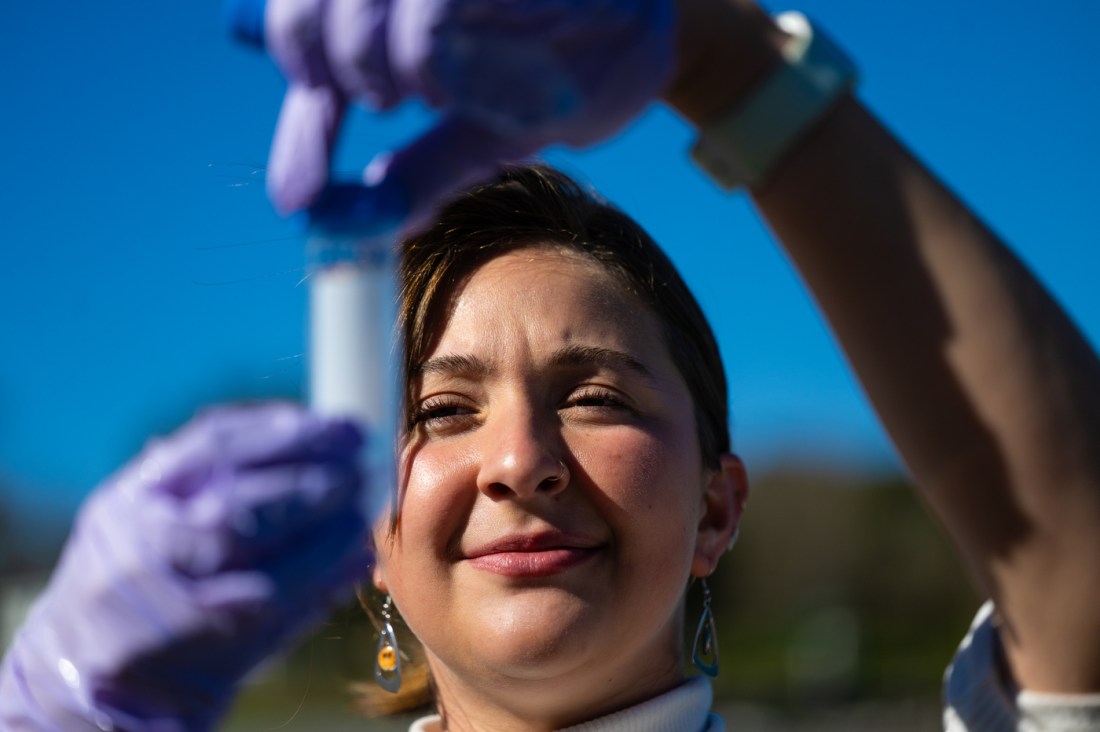
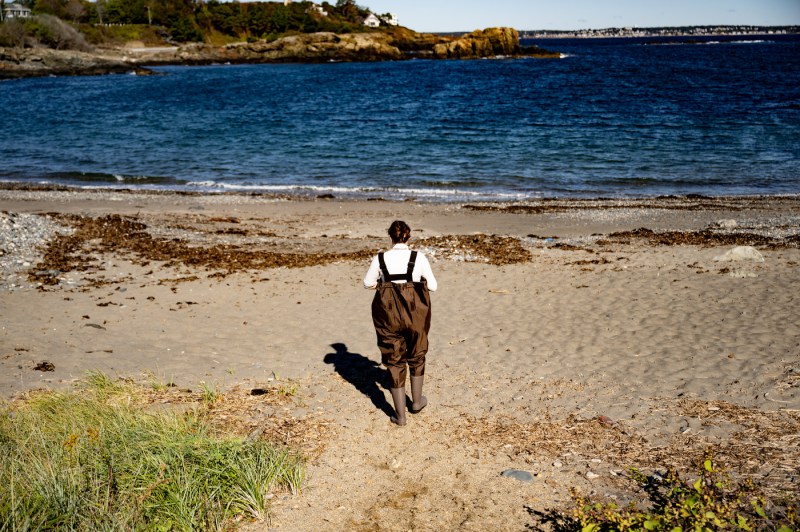
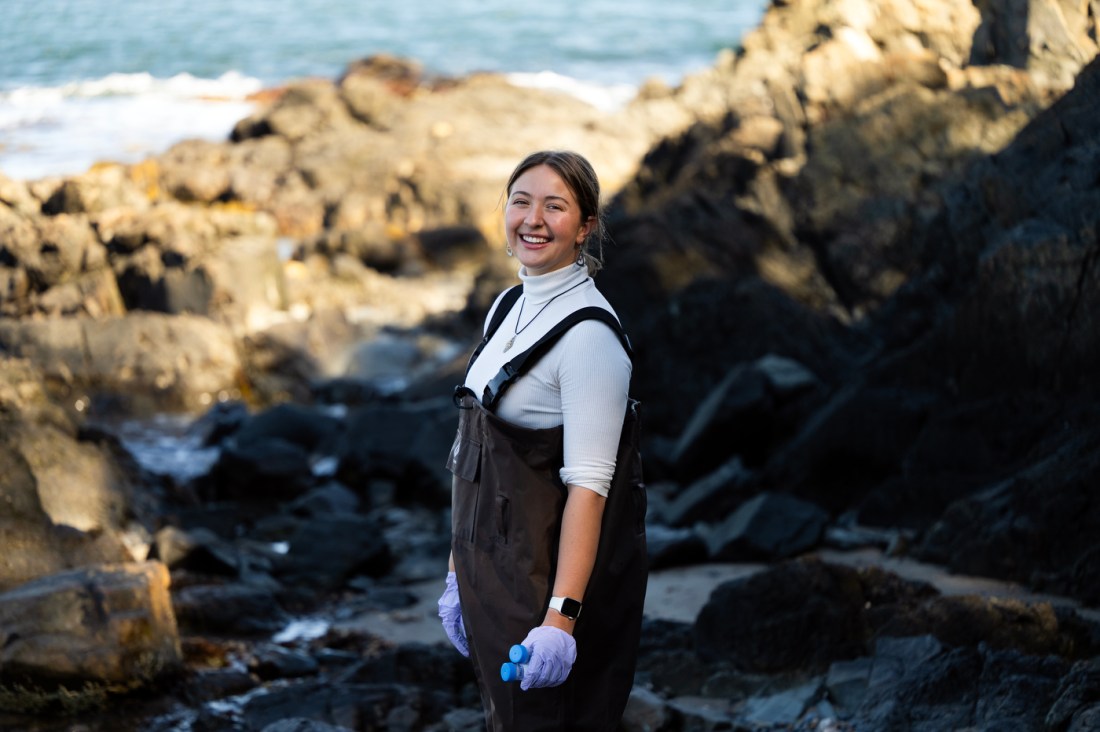
Wearing waders into waist-deep water off Nahant Beach on the coast of Massachusetts five days a week, Northeastern University graduate student Hannah Bray played pollution detective, searching for sources of contamination that at times reached astronomic levels.
What she found, said local environmentalists, could lead to important policy changes and cleaner swimming water for residents and visitors.
“We’ve been watching Nahant’s water quality go down and down for the last five years,” said Andrea Amour of Save Kings Beach, which funded Bray’s research.
“We were trying to find out where the pollution is coming from,” she said.
With state-required testing taking place only once a week, on Tuesdays, Save Kings Beach hired Bray, a master’s degree student in Northeastern’s Nahant-based Three Seas program, to fill in the gaps.
Bray collected water for analysis from Thursdays through Mondays during the summer swimming season at five points along Nahant Beach, including one in the adjoining town of Lynn. Volunteers from Save Kings Beach took over testing on Wednesdays.
“They wanted to see if daily testing would shine a light on different trends. I’m trying to see if there are any standout patterns,” Bray said. Her research, which she presented Dec. 12, included a process of elimination, since outfall pipes, the usual suspects, didn’t seem to be playing a role.
Outfall pipes are large culverts that empty into the ocean, carrying everything from storm water to dog waste to sewage from improperly installed systems.
Such a pipe has been associated with high pollution levels down coast at Kings Beach in Lynn and Swampscott, Amour said. But there is no outfall pipe at Nahant Beach, creating a mystery as to the source of the pollution.
“We were perplexed,” Amour said.
Among the 200-plus water samples collected by Bray this summer were some clues — filthy clues.
A beach hut converted to a laboratory
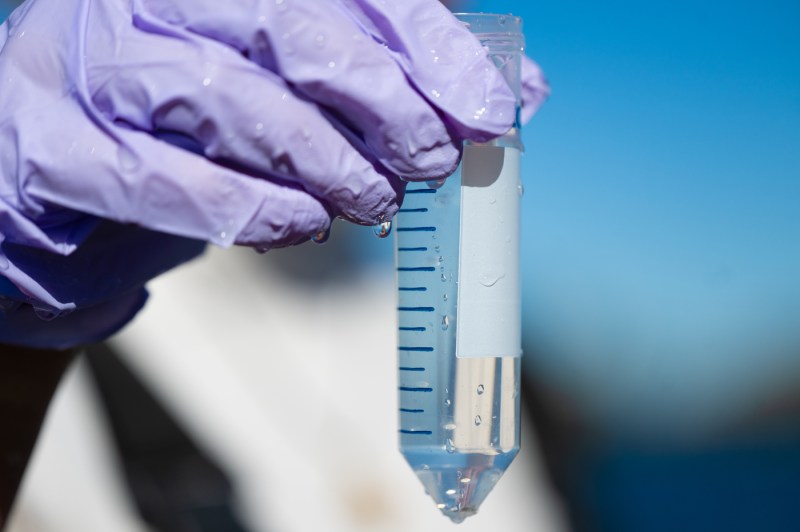
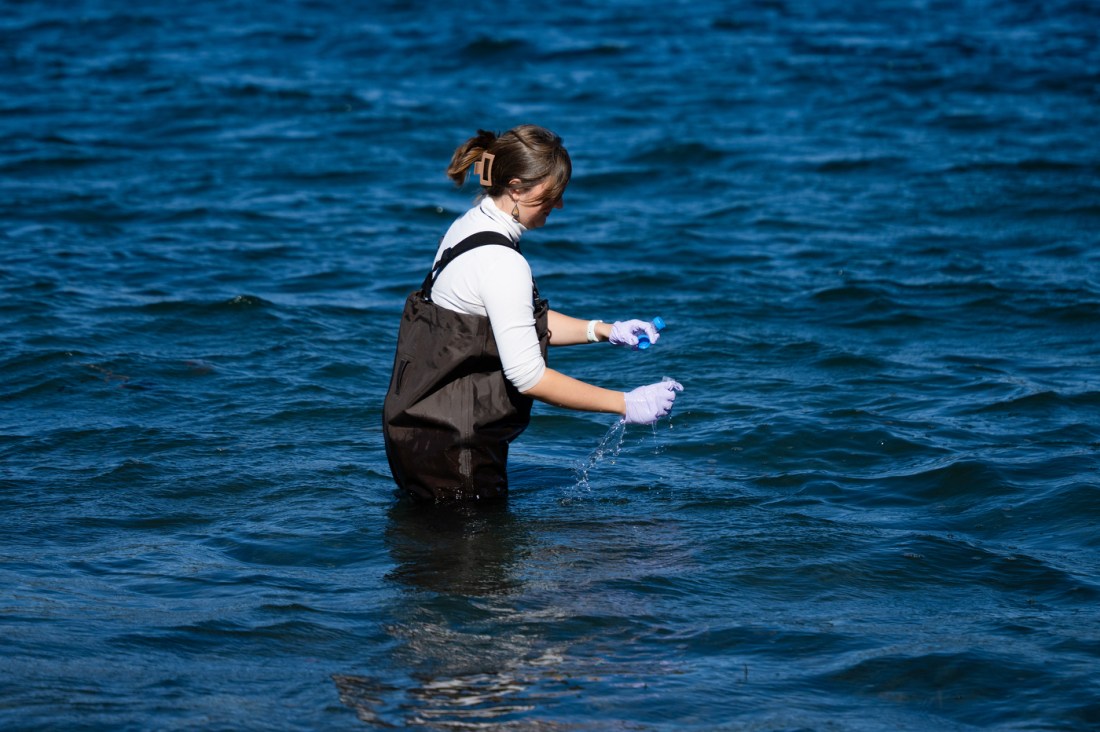
To obtain water for testing, Bray waded about 3 feet into the coastal Atlantic waters and let the ocean pour into a 100-milliliter bottle she held about 12 inches below the surface.
The state Department of Conservation and Recreation allowed Northeastern professor Aron Stubbins to convert a nearby beach hut into a laboratory. Bray diluted the seawater in the hut and mixed it with an agent that reacts to the presence of Enterococcus bacteria, an indicator of fecal bacteria.
“If you find that bacteria, there’s a good chance there’s other sewage-related organisms around,” Stubbins said.
Next, Bray incubated the samples in something called an IDEXX Quanti-Tray containing rows of tiny wells, examining them under a UV light that glows in the presence of bacteria.
For most of the summer, bacterial counts off Nahant flew in the face of recent annual trends by remaining fairly low, which Amour said may be attributed to a lack of rainfall washing pollutants into the seawater collected by Bray and others.
‘Everything changed’
“Everything changed in mid-August,” Amour said. On a few days when other members of the team were covering for Bray, “the entire Quanti-Tray lit up.”
That meant the bacteria had reached at least 24,196 colony-forming units, the maximum capable of being held by the tray.
For comparison purposes, consider that Nahant typically tests between 10 and 100 cfu’s, with the state closing beaches to swimming at 104 cfu’s, Amour said.
The bacterial counts in these samples were literally off the charts, she said. “We thought something must be going on here.”
After volunteers noticed a water main cleaning truck parked by the Nahant rotary, they spoke with company representatives and learned that the firm had been contracted to clear out a drain 39 feet long and 4 feet wide, Amour said.
Editor’s Picks




“It had been completely compacted with junk. It was compacted so heavily, they had to take a firehouse” to loosen up the material in order to vacuum it up, she said.
While there is no way to prove some of the sludge from the drain got into the water, the fact that the water’s bacterial count spiked at points during that period suggests a correlation, Amour said.
As a result, Save Kings Beach plans to request that nearby municipalities and the state conduct drain cleanings near the ocean in April, when the water is not open for swimming.
Then, “if there does happen to be any accidental jettisoning of junk, that will happen in a non-swimming time,” Amour said, pointing out that bacteria fester in backed-up pipes.
“These drainings should not take place in the peak of summer,” she said, adding that “the project as a whole would have likely not happened at all without Hannah.”
Bray said she sees the daily testing project as a catalyst for conversations about maintaining the health of the coast.
“When I would go out in my waders, people would stop me and ask what I was doing,” she said. “Then they’d bring up their two cents about what was happening with the beach closures. At the community level, it’s been a really good thing to see the public be a little more aware of what’s going on.”