What can babies teach us about brain development?
New technology allowed Northeastern researchers to get a glimpse of how this organ develops.
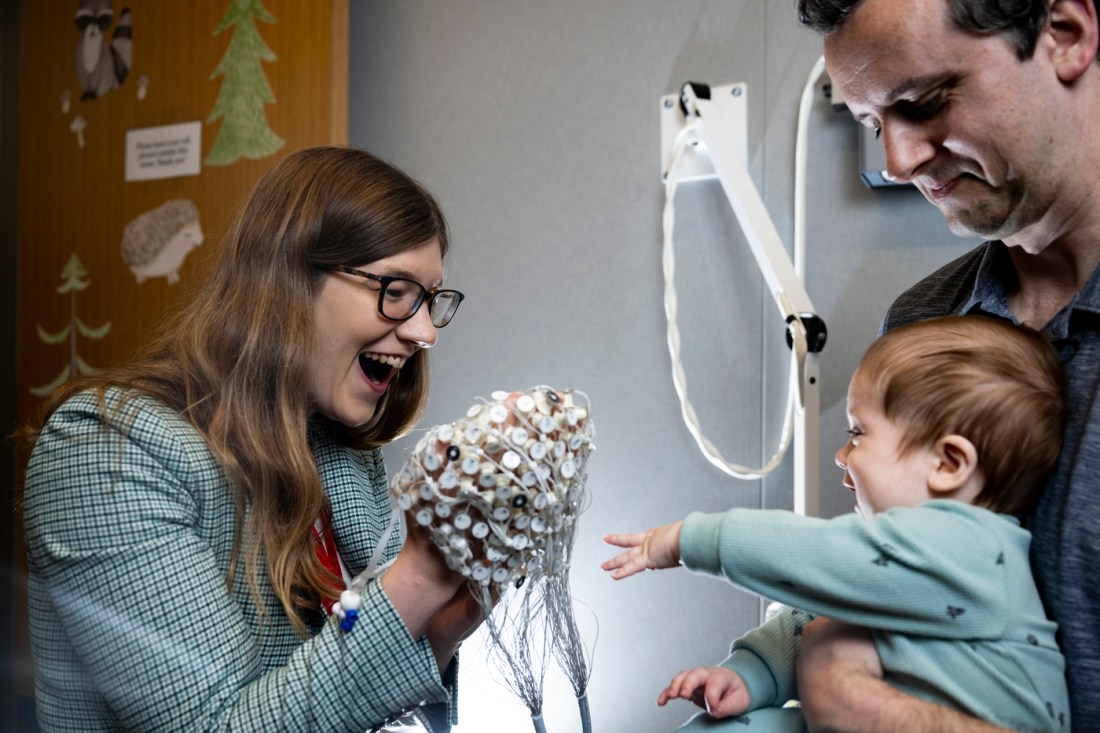

A lot of brain development happens early in life, but researchers don’t have a strong understanding of how a baby’s brain develops while they’re awake.
New research from Northeastern University sheds light on how babies develop brain network patterns during their first two years of life as they are exposed to new stimuli for the first time using an electroencephalogram, or EEG, which is a test that records the brain’s electrical activity.
“It’s such a rapid window of change for the brain to come out into the world,” said Laurel Gabard-Durnam, an assistant psychology professor and director of the Plasticity in Neurodevelopment (PINE) Lab at Northeastern University. “It’s a really exciting window to understand how these things first form and start to work together to coordinate behavior.”
These patterns, called functional networks, are a set of regions across the brain that are coordinated in their activity in order to achieve some sort of function, said Gabard-Durnam, also a member of Northeastern’s Institute for Cognitive and Brain Health.
“That’s the best reflection of how the brain does what it does to allow us to behave, move and think,” she added. “It requires multiple coordinated regions working in sync to get that level of precision and incredible cognitive things done.”

Researchers have used MRIs on sleeping infants to understand how brain networks are first constructed, but limitations with technology confined how much they were able to understand how brain networks were first constructed or used while infants were awake. But through the use of electroencephalography and other computational tools, scientists found a novel approach to studying the redevelopment of these networks while infants are awake.
“The temporal resolution from fMRIs is so slow that they cannot effectively capture the moment-to-moment changes in neural activity,” said Priyanka Ghosh, a postdoctoral research fellow at the PINE Lab who worked on the study. “With longitudinal EEG, we saw that through infancy, as the baby grows, the network transitions get rapid with age. EEG gives us this flexibility to capture these fast-evolving networks while the baby is awake, which is amazing.”
Using EEG, researchers were able to see how these babies’ brains organize and develop themselves through “microstates,” which is a snapshot of large-scale brain activity.
Editor’s Picks





The research was the result of what Gabard-Durnam described as “a truly unique international collaboration” through a grant mechanism called Welcome Leap, which allowed researchers to study different cohorts of children around the world to find differences and similarities in their brain development. They collaborated with researchers in Cape Town, South Africa, and Sao Paulo to study babies from those regions over their first two years of life.
The testing involved showing the subjects, ranging in age from 3 months to 2 years old, baby-friendly images, movies or playing sounds meant to grab their attention. The baby’s brain activity would then show up on a recording machine where scientists, and the parents, could see the brain in action.
Ghosh said each microstate corresponds to different resting-state functional network, with one being more energetically dominant in any given moment.
“It’s like switching a TV,” she said. “The network configurations mostly switch between the auditory, visual, salience, dorsal attention and default mode network (DMN). Each network represents a kind of function. The auditory network corresponds to sensory processing when there is an auditory stimulus. And then there is a very famous DMN that is the most dominant network in resting state.”
Despite only lasting milliseconds, these microstates correspond closely with large-scale fMRI networks in adults and the topographical patterns they create repeat over time.
“You could think of each one of these as sort of a fingerprint,” Gabard-Durnam said. “It’s easy to tell when the brain is in this fingerprint state in terms of the activity that’s going on. But which one is energetically dominant in any given moment will change.”
She added that “the configuration in that moment is the driving configuration for the brain and then it may switch back. It’s important for understanding what information you’re actually going to take in.”
Ghosh said studying babies from two different areas of the world allowed the researchers to also look into how cultural differences might impact development.
This understanding of early brain development can help with future childhood interventions.
“There are a number of very sensitive windows for brain growth, for brain function, for intervention,” Gabard-Durnam said. “We know that intervention is most helpful and supports are most helpful if we can get to kids early. So there are a lot of reasons for trying to figure out what key brain dynamics are happening in those first one thousand days of life.”